

|
|
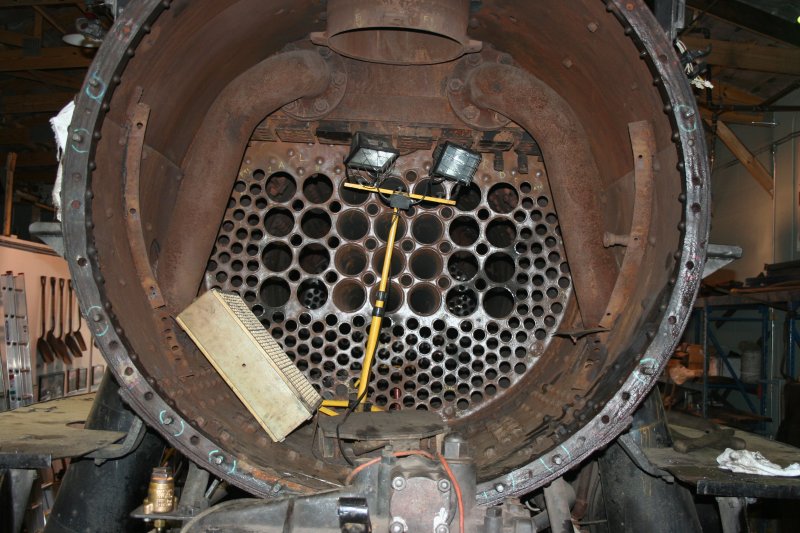
Sunday, August 19. 2012Steam Department Update 08-18-2012The number of volunteers at the Steam shop was lower this weekend as it usually is during Thomas weekends. However some key tasks were completed. On 1630: · The last of the troublesome smoke box bolts was removed. With the bolts out, I was able to clean up all the holes and test fit new "T" bolts into all of them bar one. The new bolts are now being ordered for 10 of the 11 holes. The 11th requires more work. The smoke box has clearly been reinforced since this one was fitted so a rivet is now positioned that prevents setting the bolt into the ring from the rear. Tom will need to make a special stud that we can fit from the front and secure by welding a nut on the back. However, this repair is now largely complete and ready for when we refit the smoke box front sheet.
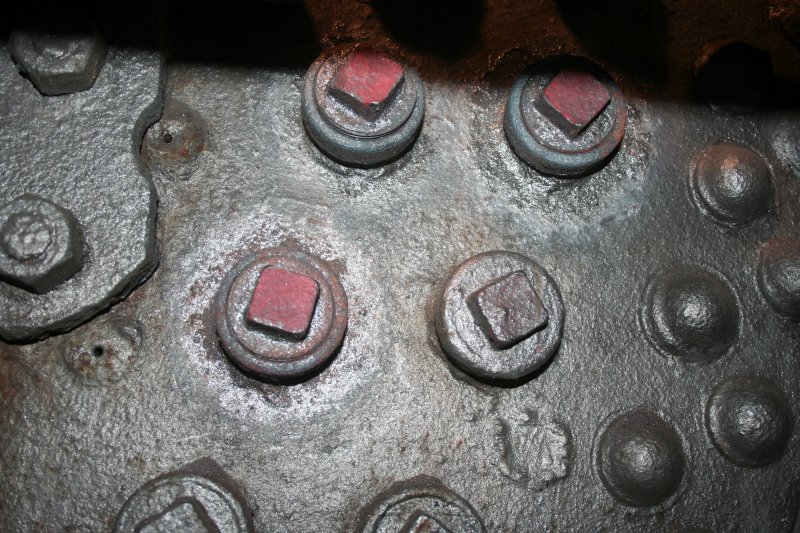
· All the flexible stay caps, that were marked as requiring removal, were successfully freed. This requires heating the socket of the stay with a torch before unscrewing the cap. Applying brute force to the socket wrench without using heat to loosen the thread is absolutely not recommended!. Cracking or otherwise damaging the socket would mean that the whole stay must be removed by drilling it out of the inner firebox then rethreading and fitting a complete new stay - several days of work - so it is a big relief that all are now off with no damaged sockets. One damaged cap was successfully removed and will be replaced with our last spare cap. A few more will be ordered to ensure that we have some spares in hand. The caps must be removed and the stays hammer tested where the stay does not have a full length tell tale hole.
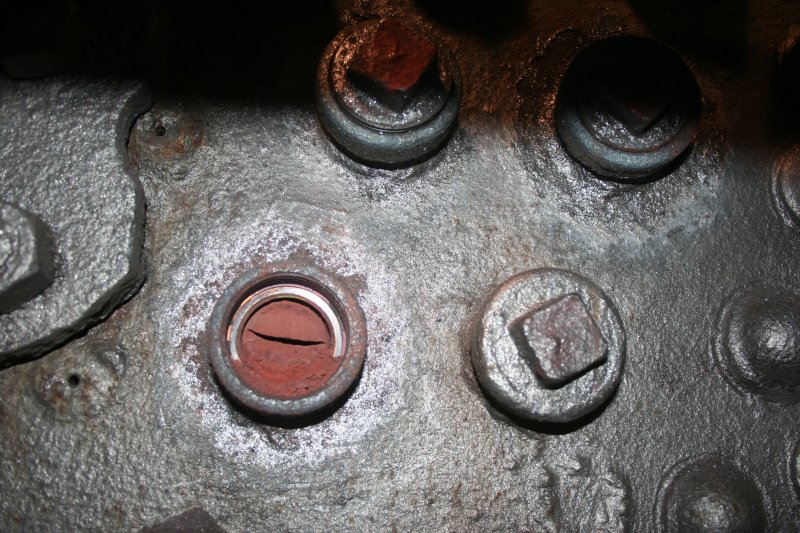
Once the cap is removed you normally find rust, scale and debris that must be cleaned out to allow later hammer testing.
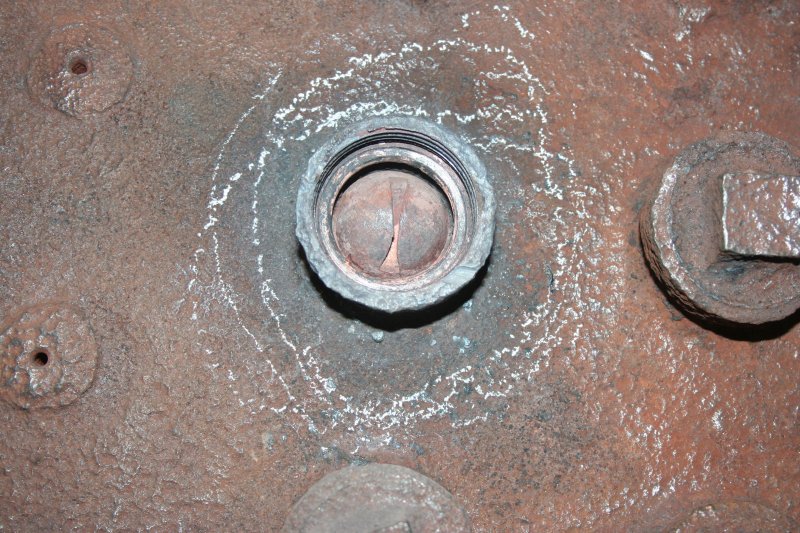
Once clean you can get a good idea of how the stay operates. In the center is the ball head of the stay, a long steel rod the other end of which is threaded into the inner firebox sheet The slot in the ball would have been used when the stay was installed to turn the rod and so screw it into the inner firebox sheet. The ball sits in the socket, which is welded to the outer firebox sheet. Screwing the rod into the inner sheet tightens the balled end of the rod against the socket. As with rigid stays, the objective of the flexible stays is to hold the inner and outer firebox sheets together against the full pressure of the water and steam that lies between the sheets when the boiler is in service. The difference is that flexis are used where it is calculated that there should be (marginal !) movement between the two plates as they expand This would strain and potentially crack a rigid rod. The movement of the ball in the socket allows this movement. Tightening the ball into the socket provides a significant, but not complete, seal against the boiler pressure so the cap provides the final seal. This is why there is likely to be some debris in the socket when you first remove the cap.
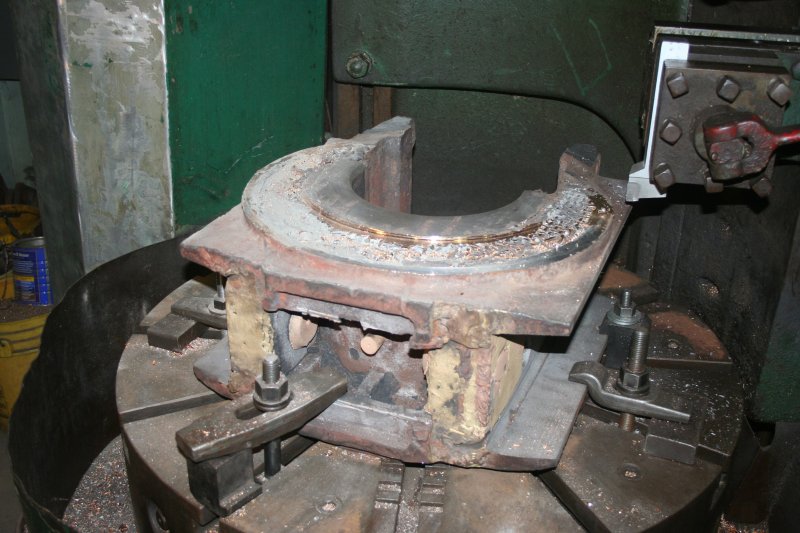
· Mike continued with test fitting of the patch. · We also started on the exercise of measuring the holes in the tube sheet and matching these to the ferrules that must be fitted before the tubes can be inserted. · Most importantly, it now looks as if we should have good news on the welding by next weekend. On 428: · Machining is now well under way on the thrust bearing surface of the first axle box.
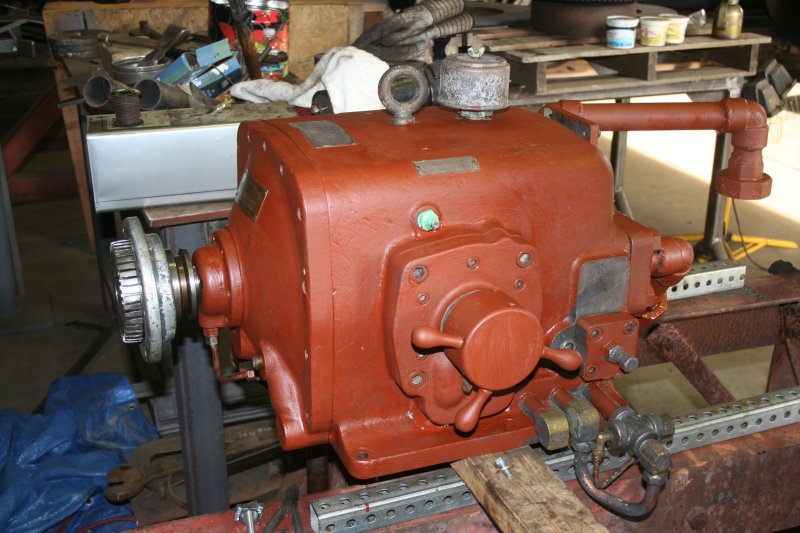
This clearly shows the remains of the old thrust bearing which consisted of mesh (actually old spark arrestor mesh from the smoke box was specified in the UP drawing), which was tack welded to the face of the casting and held in place the babbit which was poured into the recess, allowed to set and then machined smooth. · The overhaul of the pump mechanism for the planer was completed. The next step is to clean and test the hydraulic drive mechanism.
Nigel |
Blog AdministrationCalendar
QuicksearchArchivesSyndicate This Blog |
|||||||||||||||||||||||||||||||||||||||||||||||||


Comments
Fri, 03-29-2024 21:26
We're slackers and spend more time working on the equipment in the shop than keeping all you readers updated. We'll work on it, but I'm sure updates [...]
Thu, 03-14-2024 08:02
What happened to the Department Blog? It's been over 2 years and I still regularly check for updates, but nothing comes...
Mon, 12-27-2021 16:28
Happy New Year to all the Departments at the Illinois railway Museum! Thanks for all the good work you do in railroad preservation. Ted Miles, [...]
Wed, 10-13-2021 13:33
Was the CB&Q 1309 every transported to IRM?I’ve been reading old issues of Rail&Wire and the car was mentioned several times.
Mon, 06-07-2021 22:40
I was wondering if in the model layout display what scale would you guys be using and would you be displaying model train history as well? Just [...]
Wed, 06-02-2021 17:27
Nice to see 428's cab back on. Looking forward to when it is operable!
Tue, 06-01-2021 16:47
I hope the work will continue on the UP #428. Now that they are the museum's connection to the national railroad network; she would be very [...]
Sat, 04-17-2021 23:07
What is the status of 126, the Milwaukee Buffet car that is in S. Dakota? Any guess on when or if it will get to IRM?
Wed, 04-14-2021 21:09
Perhaps it is time to scrap the remains of the c, B & Q 7128 to make room for the Villa Real. Ted miles, IRM member
Wed, 04-14-2021 15:26
Hi IRM my name is Jason and I was wonder If you guys would be willing to save a CN Dash8-40cm they are currently being retired by CN and being [...]
Fri, 04-09-2021 19:56
Bear in mind that the Nebraska Zephyr is an articulated train set, so cars cannot be inserted at will. Although cars and/or a second engine could be [...]
Wed, 03-31-2021 11:37
I believe Silver Pony is currently on the back burner, and has been put into storage in one of the barns. The car needs a lot of work done to it's [...]