

|
|
Sunday, December 30. 2012Steam Department Update 12-29-2012It is a "second-hand" update this weekend, courtesy of Phil Cwikowski. I did not make it to Union this Saturday as we had family visiting. Unfortunately, absent anyone who had experience with the tube roller, we were not able to roll more tubes into 1630 but a good deal of other progress was made. On 1630: · measurements were taken to fit the ferrules for the super heater flues. It looks as if we have enough for the firebox but will need to find or make some more for the smokebox; · the flues are now alongside the locomotive ready for refitting when the fire tubes have been secured; · the scaffolding and spare tubes have now been cleared so that we have free access to the front of the locomotive again; · needle chipping of the cylinder covers was completed and primer was applied to protect the cleaned surfaces;
· the valve chambers were checked for sand blast material that could have been carried over from the boiler cleaning. The good news is that they appear clean and free of debris. In other areas: · Major progress was made on the wheel lathe. Air pressure was applied for the first time in decades to release the lock holding the back head. With this done, attempts were made to move the back bead on its slides ........... and it moved!!. This is critical as the back head weighs several thousand pounds and, were it jammed, it would require very heavy equipment to free it. After this the gear for turning the shaft of the back head was investigated and this was also turned. All of this checking is critical as these parts are normally moved under the power of substantial geared motors. Since it has not operated in many years it is critical to ensure that these huge parts are free to move before we apply power as major damage could occur if they are jammed when power is applied. The tricky part is judging the difference between jammed and normal resistance when it is normally moved by a large motor thru substantial gearing !!. · Stu and Bob returned to work on the planer and further progressed the cleaning and reassembly of this machine;
· We gathered the information to calculate the total weight of the new air compressor and motor assembly so that Rick can now identify the vibration isolators that we will need to mount it. So progress on a number of fronts. Hopefully next week we can continue with the tube rolling. Nigel Wednesday, December 26. 2012Steam Department Update 12-22-2012With Christmas close it was a small but active team at the steam shop this weekend. The next major milestone on 1630 was achieved as planned.
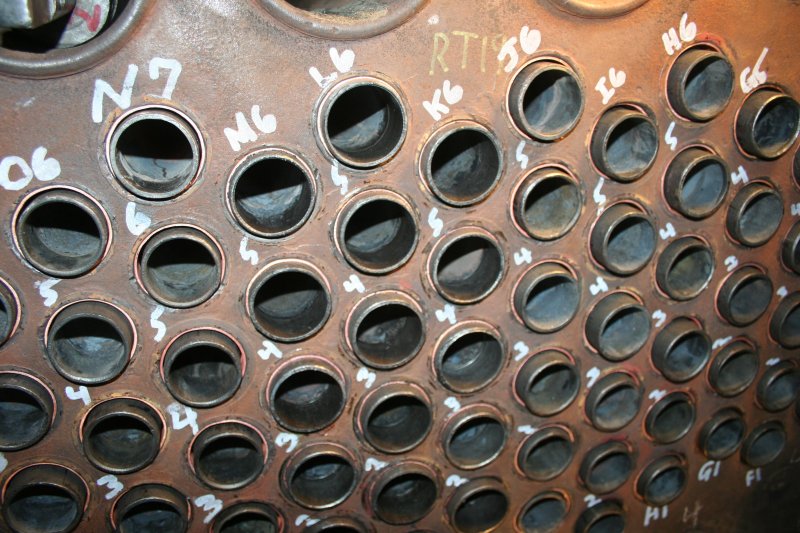
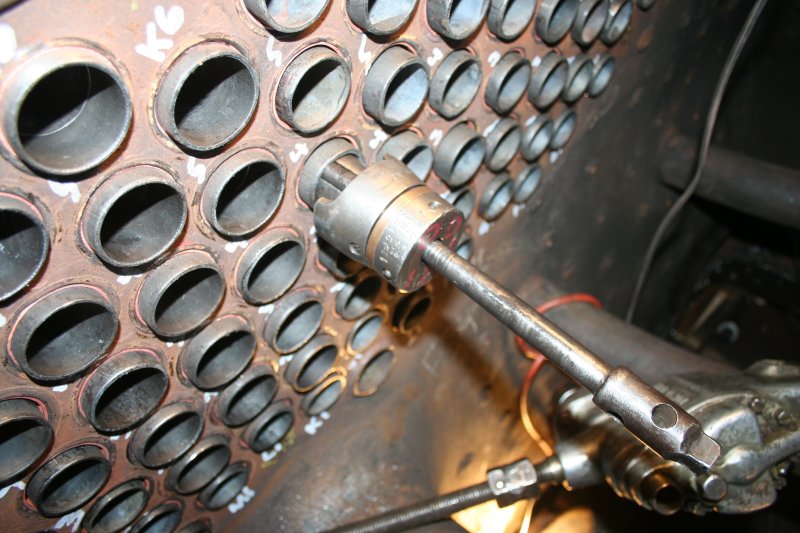
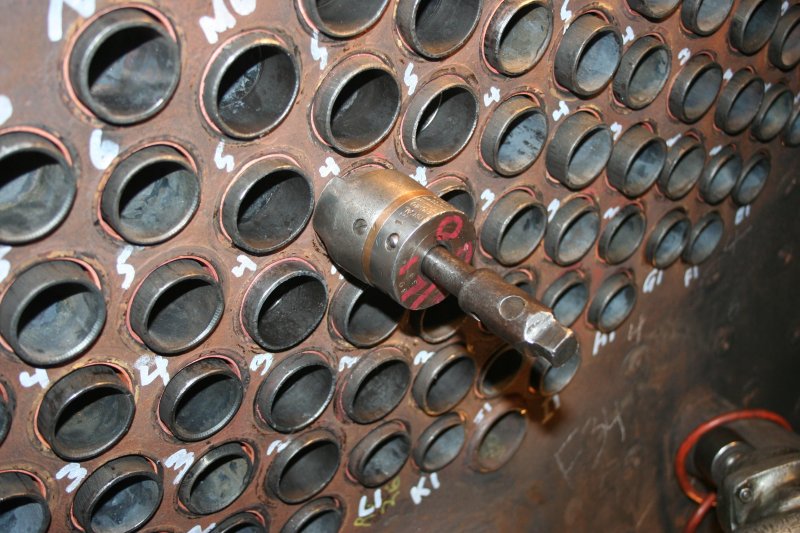
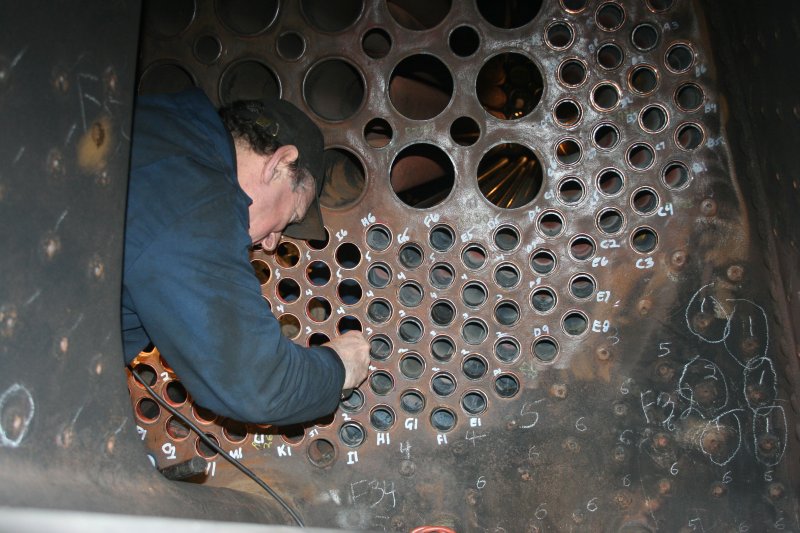
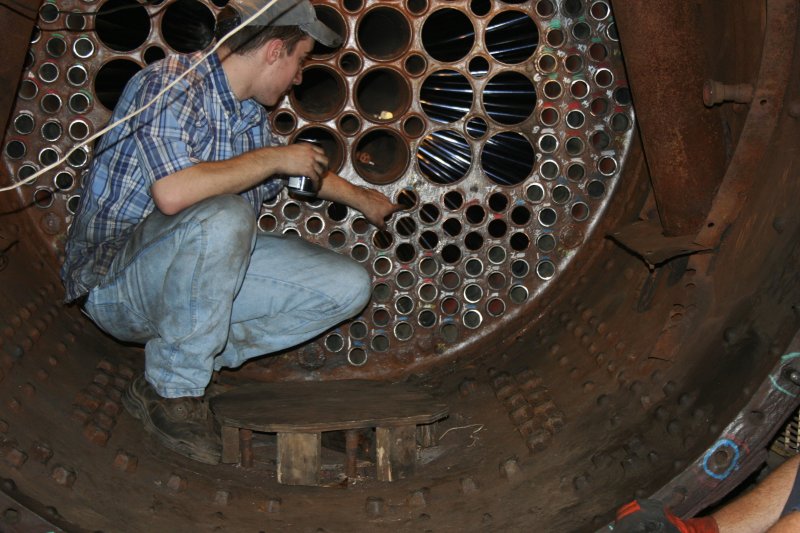
The last 17 fire tubes were loaded so all except for the 9 that will be installed along with the super heater flues are now in place. Then we moved on to rolling the fire box ends. As with each step, this was initially slow. It is critical that we fully understand the technique and can do it right each time before we start to do it on a large scale. However we made a good start, got more confident as the day progressed, and by end of day the first 15 were rolled. Looking closely at the view below you can see the effect. Comparing columns K, L and M to the adjacent columns, these are now tight in the tube sheet and set at a consistent 1/4 inch projection beyond the sheet.
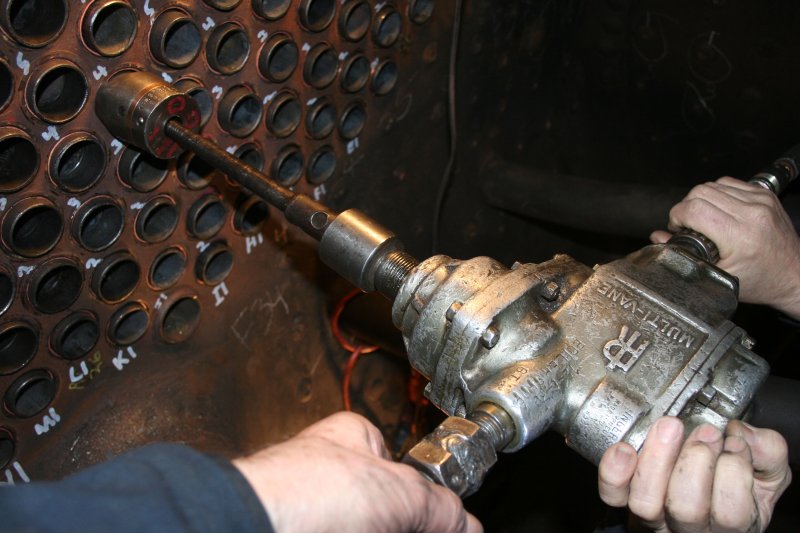
Once we have proved that everything is watertight the projection will be beaded over. All tube ends in the fire box are beaded to protect the joint from the direct effects of the fire. The rolling requires a team of three and is achieved by first setting the tube accurately with a 1/4 inch extension beyond the tube sheet. The team member in the smoke box then clamps that end of the tube to prevent movement. The roller is then inserted into the tube. Here you can see the construction of the roller. Three small hardened rollers are turned by the rotation of the tapered pin that is inserted thru the center.
The air motor is attached and rotates the central tapered pin.
The rotating pin is slowly drawn into the roller forcing the three hardened rollers out into the wall of the tube slowly increasing its diameter. When the tube is fully expanded against the ferrule and tube sheet the taper pin has been largely drawn into the roller.
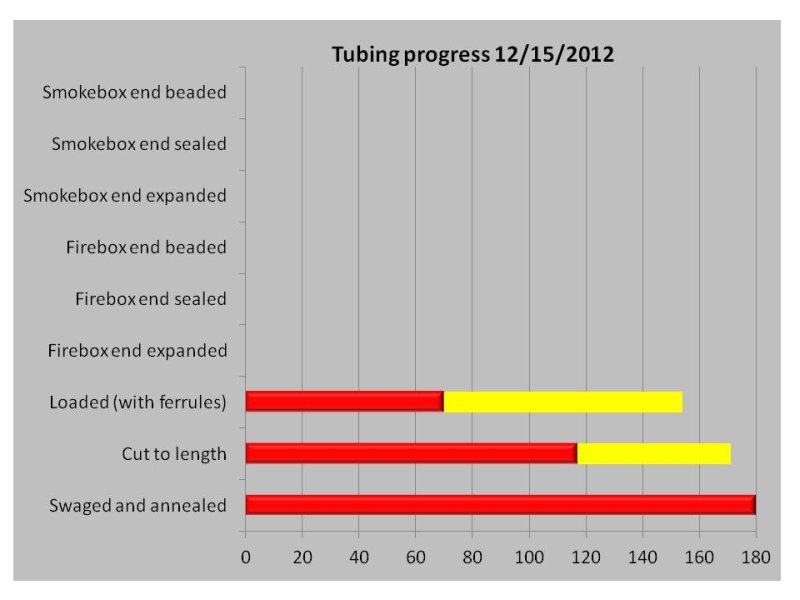
The motor is then reversed to free the pin and the process continues with the next tube. In addition to the work on the fire tubes: · annealing was completed on the 16 super heater flues, so these are now ready to load once the fire tubes are secured; · drilling continued on the fire box patch. The holes are now complete on the front face. Once holes are made in the side face it will be finally formed to the mud ring along its whole length. We also took advantage of reasonable, if cold, weather to jack the end of the KCS tender to remove the wood packing that was left between the rubbing plates when it was delivered. This should now be in a condition which will allow it to be shunted so that the box cars of parts can be relocated back by the road to allow access. Nigel Sunday, December 16. 2012Steam Department Update 12-15-2012I suspect that a number of steam shop volunteers are, like me, feeling rather stiff, aching and bruised this morning. However, that is an indication of a very productive day yesterday. On 1630 the re-tubing is almost at the next key milestone. All but 17 of the tubes below and around the super heater flues are now loaded into the boiler and, by end of day those 17 are all cut to length. So it should not take more than an hour to load these next week.
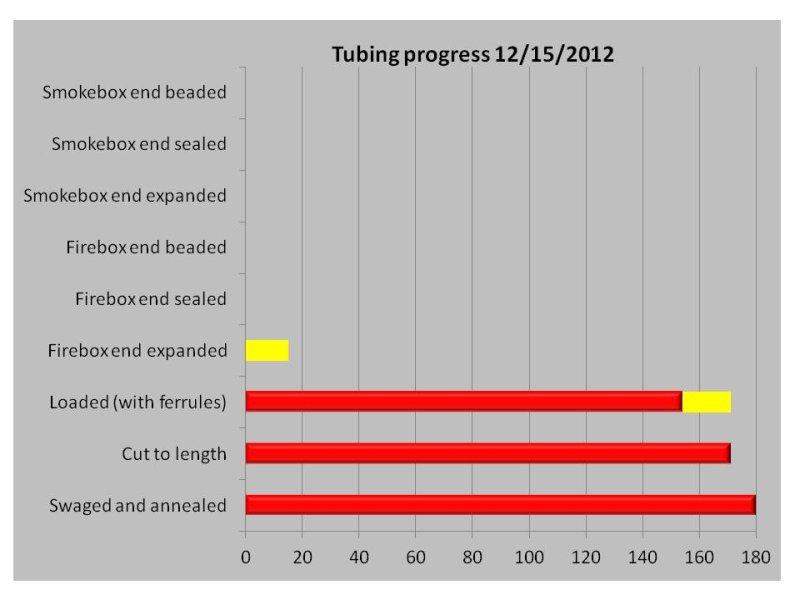
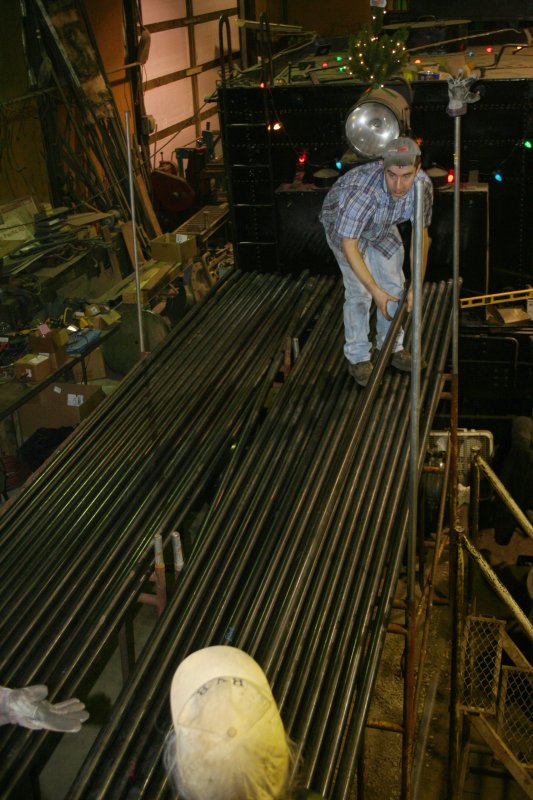
Those following the progress chart will notice a discrepancy between the full total of 180 and the target (171) that we are currently working toward. These are the 9 fire tubes that lie in between the super heater flues that have been removed. These will not be loaded at this time but slotted in as the super heater flues are fitted. This will not be done until the 171 are secured by expanding. After a couple of hours hammering ferrules into the remaining holes in both tube sheets, loading started in earnest. Here Phil stands on top of the large pile of tubes on the staging.
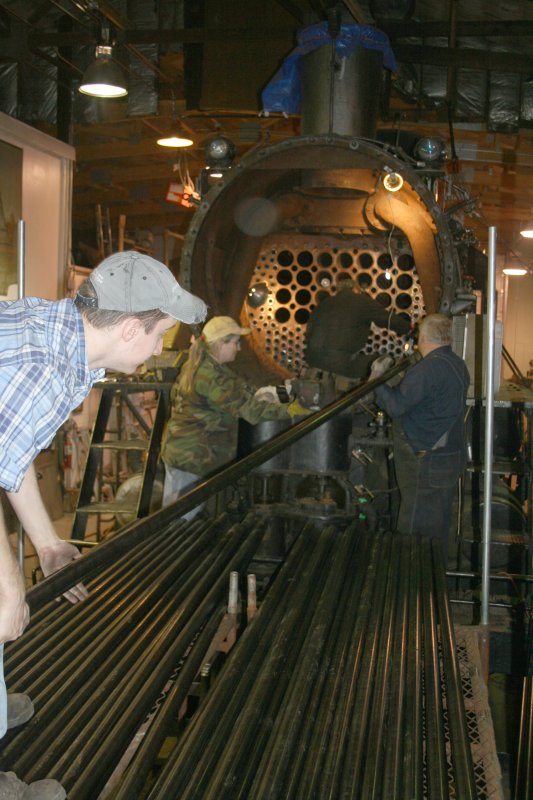
Phil selects a tube of the correct length and passes it to the team who feed it into the next hole in the front tube sheet.
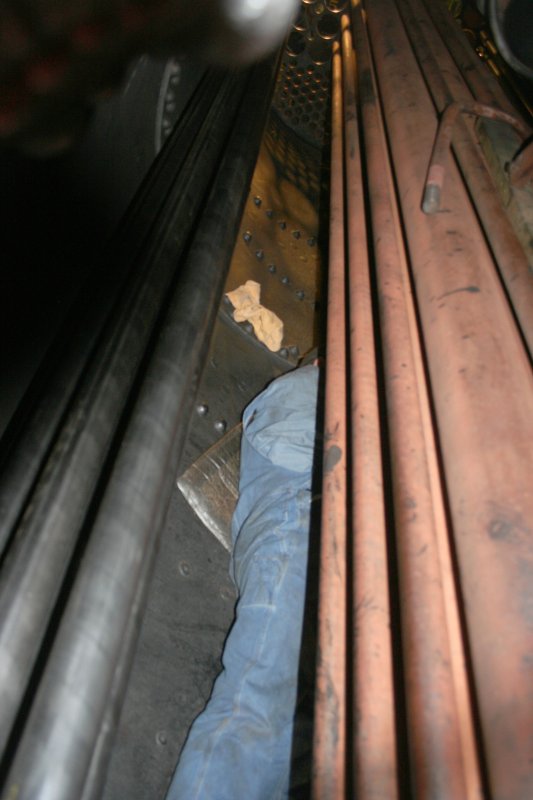
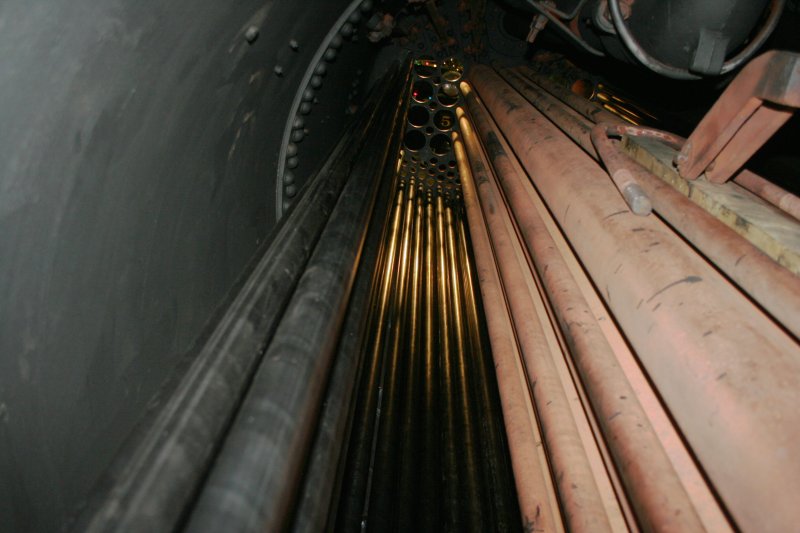
Slowly it gets more and more restricted in the barrel. Matt (believe me this is Matt !!)guided the tubes thru the barrel at the sides and here at the bottom under the super heater flues. By this stage he was looking rather uneasily at the space left for him to make his exit !.
Shortly after this, Matt squeezed his way out thru the remaining gap leading to the access hatch, having finally checked that no rogue objects remained in the boiler. Hopefully this is the last time that anyone will be able to get to the bottom of the barrel for the next 16 or so years !!. Squeezed in between the siphons in the firebox I was guiding the ends of the tubes into the rear tube sheet.
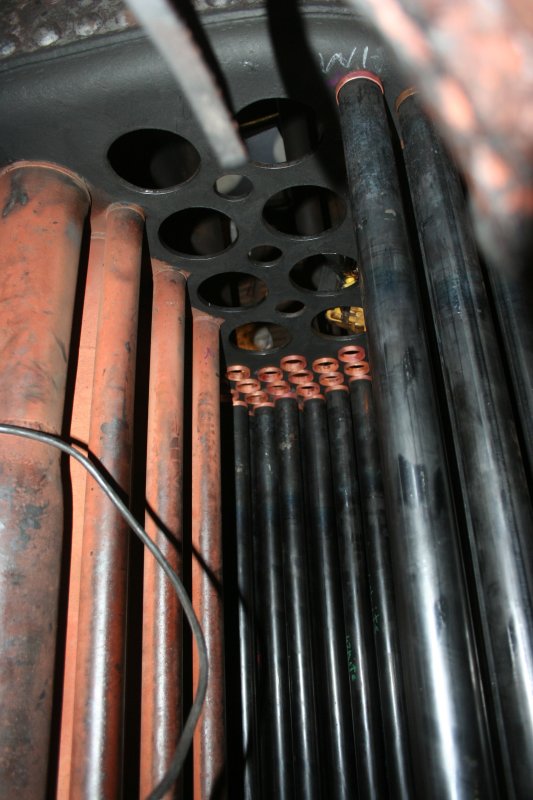
Once Matt was out, we continued loading tubes by sliding them in on top of the ones below. The trick to this is the guy in the firebox (normally me !) who has to catch the end of the tube with a hammer handle, lift and then guide the end into the rear tube sheet. By the end of day you can see the 17 remaining gaps in the front sheet and the large number of tubes now in place can be seen thru the super heater flue holes.
Inside the boiler is a very different picture when compared to where Matt was lying a few hours earlier
The rear tube sheet now is now largely full with the small area of projecting ferrules indicating where the remaining tubes will be fitted.
Comparing this to the shot at start of day shows just how many tubes have been moved into the boiler.
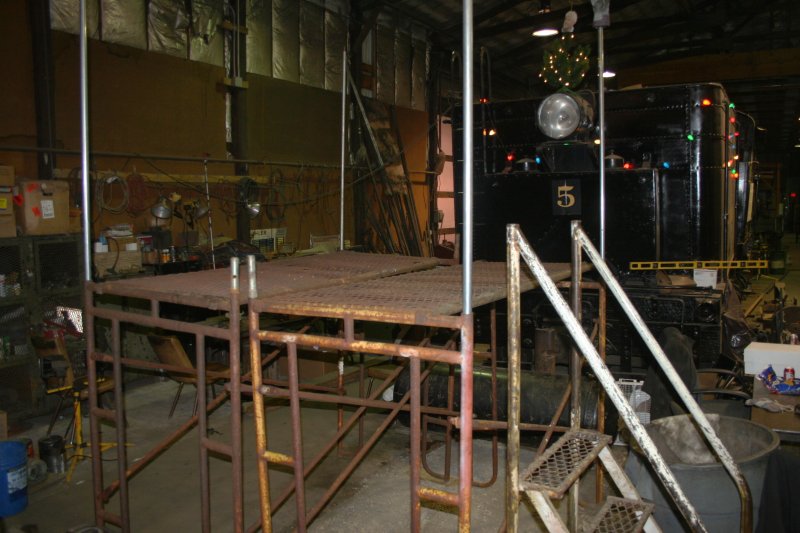
The staging area beside the locomotive is now empty. We are starting to get space back into the shop. It is amazing the sheer volume of tube that fits into the boiler.
The one thing that slowed us towards the end was that you can no longer keep a stock of cut tubes ready to load. With only a few to go, they have to be exactly the sizes required for the remaining holes. So we stopped loading in mid evening, having loaded all the precut tubes. We then cut the exact sizes needed for those 17 holes ready for next Saturday. Work also started on annealing the super heater flues ready for loading and expanding. This will be a different technique from the fire tubes as they are too large in diameter to fit the furnace and will need to be heated using the acetylene torches. The first of these was annealed yesterday (1 down 15 to go).
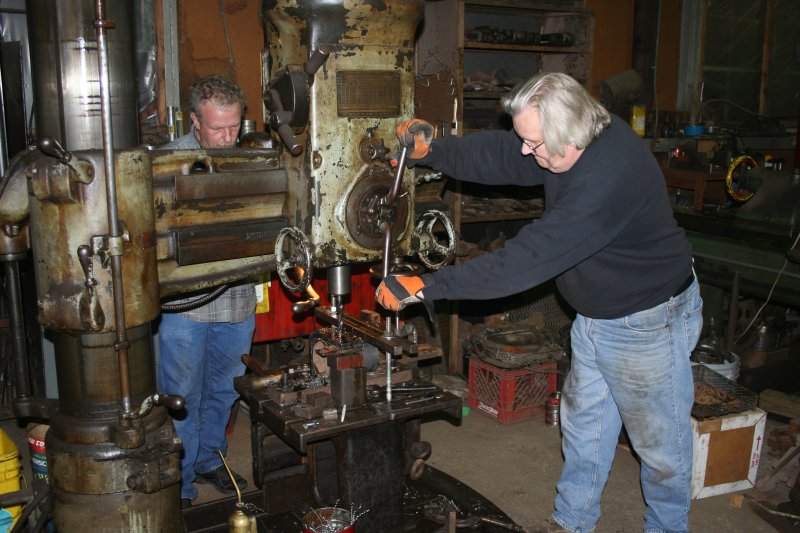
Meanwhile work continues on fitting the corner patch to the firebox. Here Mike and Jerry are drilling the patch using the pillar drill.
Much to our relief, Dennis our welding expert who has been away for a number of weeks, made it in yesterday. This was critical as the team fitting the patch need to work closely to his requirements in shaping and fitting the patch. Dennis was also able to start on welding the gear for the wheel lathe while Mark started work on freeing the back head on its slides so that it should move when the gear is attached. Overall a very successful day. Nigel |
Blog AdministrationCalendarQuicksearchArchivesSyndicate This Blog |


Comments
Fri, 03-29-2024 21:26
We're slackers and spend more time working on the equipment in the shop than keeping all you readers updated. We'll work on it, but I'm sure updates [...]
Thu, 03-14-2024 08:02
What happened to the Department Blog? It's been over 2 years and I still regularly check for updates, but nothing comes...
Mon, 12-27-2021 16:28
Happy New Year to all the Departments at the Illinois railway Museum! Thanks for all the good work you do in railroad preservation. Ted Miles, [...]
Wed, 10-13-2021 13:33
Was the CB&Q 1309 every transported to IRM?I’ve been reading old issues of Rail&Wire and the car was mentioned several times.
Mon, 06-07-2021 22:40
I was wondering if in the model layout display what scale would you guys be using and would you be displaying model train history as well? Just [...]
Wed, 06-02-2021 17:27
Nice to see 428's cab back on. Looking forward to when it is operable!
Tue, 06-01-2021 16:47
I hope the work will continue on the UP #428. Now that they are the museum's connection to the national railroad network; she would be very [...]
Sat, 04-17-2021 23:07
What is the status of 126, the Milwaukee Buffet car that is in S. Dakota? Any guess on when or if it will get to IRM?
Wed, 04-14-2021 21:09
Perhaps it is time to scrap the remains of the c, B & Q 7128 to make room for the Villa Real. Ted miles, IRM member
Wed, 04-14-2021 15:26
Hi IRM my name is Jason and I was wonder If you guys would be willing to save a CN Dash8-40cm they are currently being retired by CN and being [...]
Fri, 04-09-2021 19:56
Bear in mind that the Nebraska Zephyr is an articulated train set, so cars cannot be inserted at will. Although cars and/or a second engine could be [...]
Wed, 03-31-2021 11:37
I believe Silver Pony is currently on the back burner, and has been put into storage in one of the barns. The car needs a lot of work done to it's [...]