| BLOG | DIRECTIONS | SCHEDULE | STORE | |
Monday, December 17. 2012LINE DEPT. UPDATE 12-17-12Friday, I installed the connector to 84 track trolley frog and removed some old span wire in yard 8. A rainy Saturday: BOD meeting, Cleaned up my area in the B&G building. Sunday brought better weather. Two poles were pulled and one installed. One pole was removed on the North side of the connector track now that new spans were installed on the new pole and trolley wire transferred to them. At the Central Ave. crossing at yards 6,7,8, one old pole was pulled on the Northeast corner and a new 30 ft class 4 pole was set on the Southeast corner. The new pole is replacing an old rotten one and will help support the crossing. Max Tyms Sunday, December 16. 2012
Roof painting on the Big ... Posted by Roger Kramer
in Passenger Car Department at
13:49
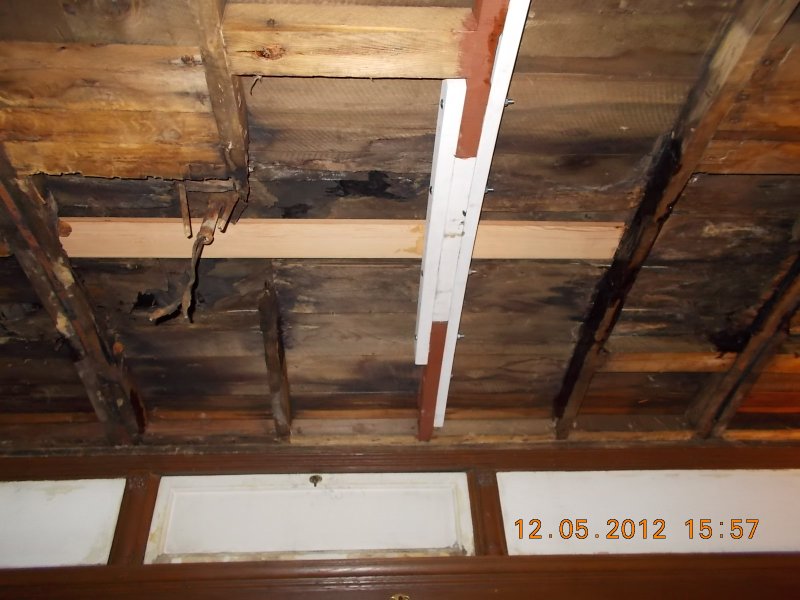
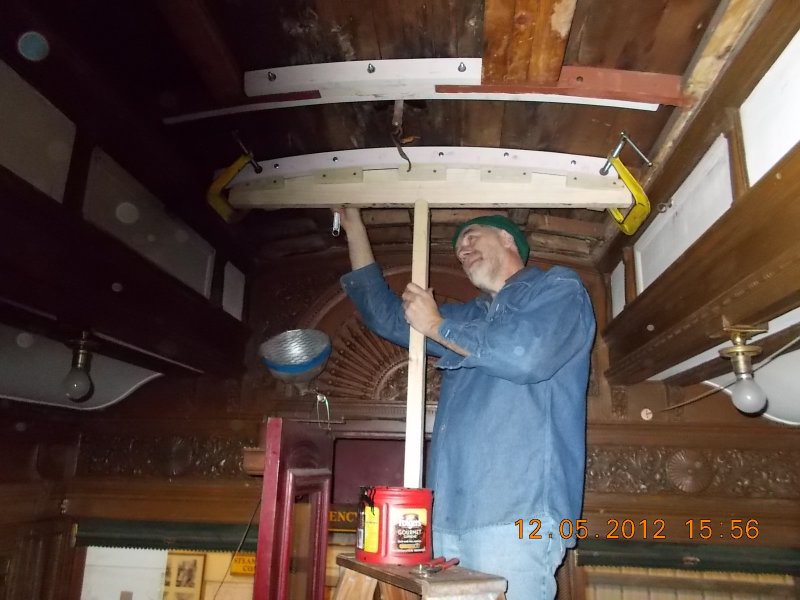
Comments (3) Roof painting on the Big "John."After working on reinstalling the vestibule parts I took a break in the fall of 2011. When the weather turned to the cold side I began working on the roof of the John Mcloughlin. Since the vestibule looked so nice the peeling, dusty silver gray roof certainly did not compliment the " new look" for display. Here then are some results of my efforts to improve the sleeper's appearance My attention will now be turning to the interior women's bathroom. My next blog will feature the before pictures of the bathroom and a sample of the finished product. When considering your next donation to IRM please include the Barn 14 Inside Storage Fund. You'll be glad you did!!! Roger Sunday, December 16. 2012
Steam Department Update 12-15-2012 Posted by Nigel Bennett
in Steam Department at
12:14
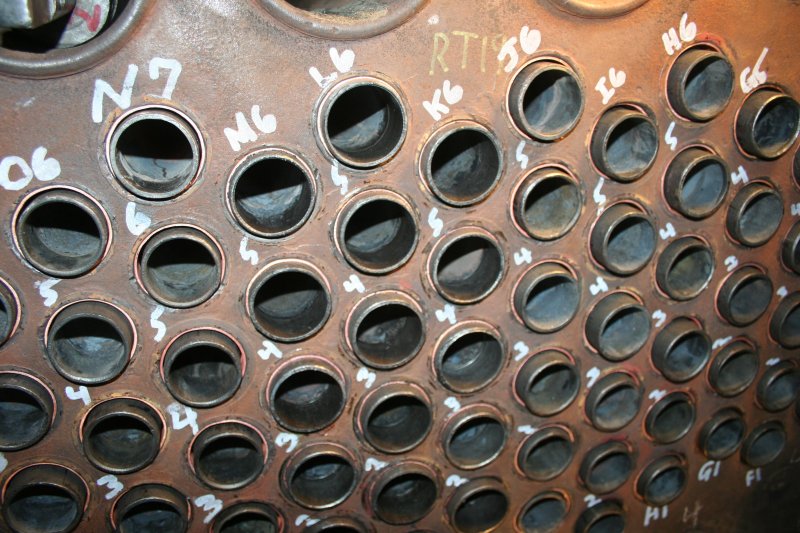
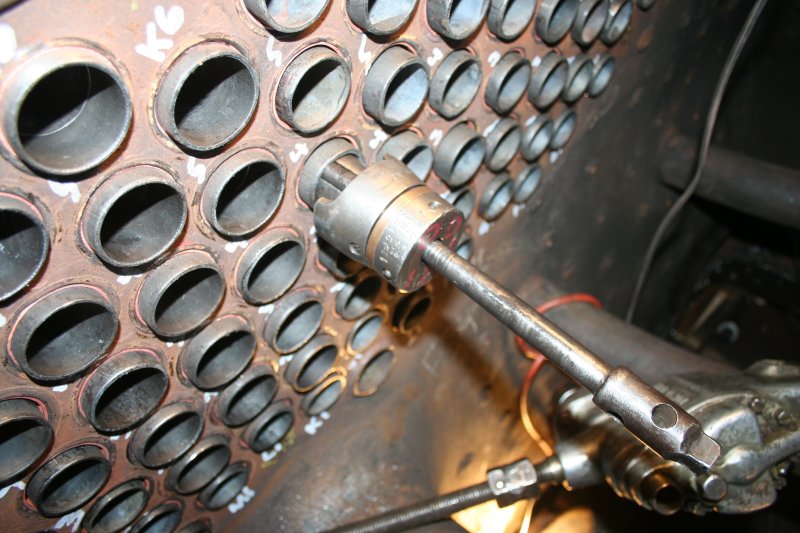
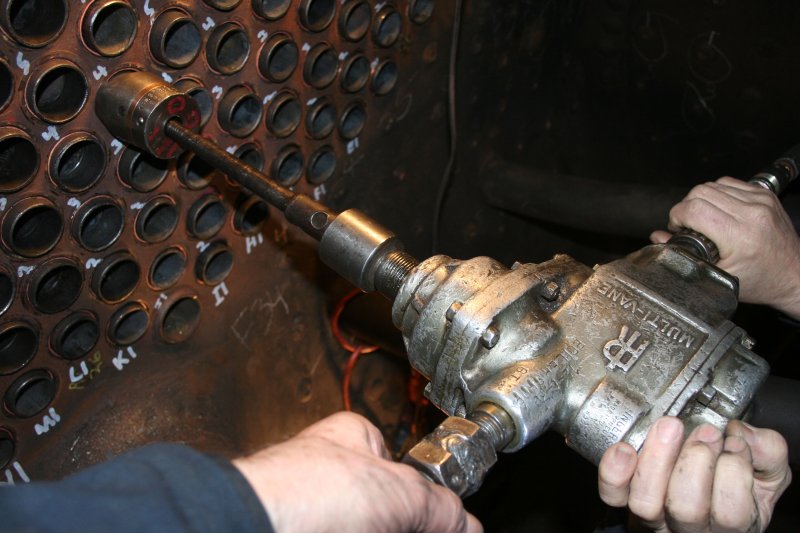
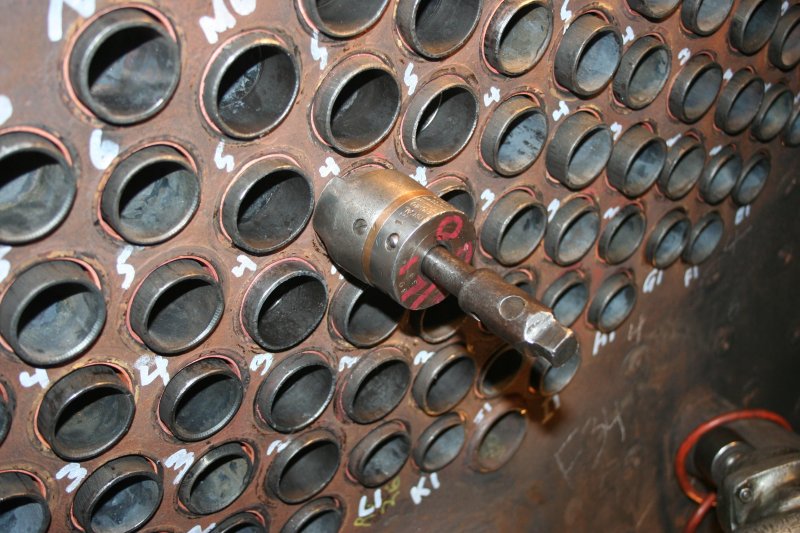
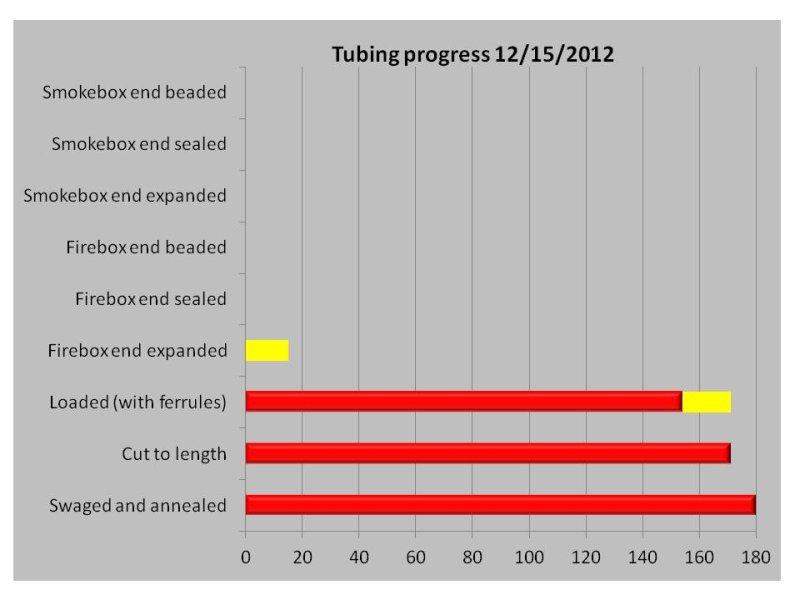
Comments (4) Steam Department Update 12-15-2012I suspect that a number of steam shop volunteers are, like me, feeling rather stiff, aching and bruised this morning. However, that is an indication of a very productive day yesterday. On 1630 the re-tubing is almost at the next key milestone. All but 17 of the tubes below and around the super heater flues are now loaded into the boiler and, by end of day those 17 are all cut to length. So it should not take more than an hour to load these next week. Those following the progress chart will notice a discrepancy between the full total of 180 and the target (171) that we are currently working toward. These are the 9 fire tubes that lie in between the super heater flues that have been removed. These will not be loaded at this time but slotted in as the super heater flues are fitted. This will not be done until the 171 are secured by expanding. After a couple of hours hammering ferrules into the remaining holes in both tube sheets, loading started in earnest. Here Phil stands on top of the large pile of tubes on the staging.
Phil selects a tube of the correct length and passes it to the team who feed it into the next hole in the front tube sheet. Slowly it gets more and more restricted in the barrel. Matt (believe me this is Matt !!)guided the tubes thru the barrel at the sides and here at the bottom under the super heater flues. By this stage he was looking rather uneasily at the space left for him to make his exit !.
Shortly after this, Matt squeezed his way out thru the remaining gap leading to the access hatch, having finally checked that no rogue objects remained in the boiler. Hopefully this is the last time that anyone will be able to get to the bottom of the barrel for the next 16 or so years !!. Squeezed in between the siphons in the firebox I was guiding the ends of the tubes into the rear tube sheet. Once Matt was out, we continued loading tubes by sliding them in on top of the ones below. The trick to this is the guy in the firebox (normally me !) who has to catch the end of the tube with a hammer handle, lift and then guide the end into the rear tube sheet. By the end of day you can see the 17 remaining gaps in the front sheet and the large number of tubes now in place can be seen thru the super heater flue holes.
Inside the boiler is a very different picture when compared to where Matt was lying a few hours earlier The rear tube sheet now is now largely full with the small area of projecting ferrules indicating where the remaining tubes will be fitted.
Comparing this to the shot at start of day shows just how many tubes have been moved into the boiler. The staging area beside the locomotive is now empty. We are starting to get space back into the shop. It is amazing the sheer volume of tube that fits into the boiler. The one thing that slowed us towards the end was that you can no longer keep a stock of cut tubes ready to load. With only a few to go, they have to be exactly the sizes required for the remaining holes. So we stopped loading in mid evening, having loaded all the precut tubes. We then cut the exact sizes needed for those 17 holes ready for next Saturday. Work also started on annealing the super heater flues ready for loading and expanding. This will be a different technique from the fire tubes as they are too large in diameter to fit the furnace and will need to be heated using the acetylene torches. The first of these was annealed yesterday (1 down 15 to go). Meanwhile work continues on fitting the corner patch to the firebox. Here Mike and Jerry are drilling the patch using the pillar drill. Much to our relief, Dennis our welding expert who has been away for a number of weeks, made it in yesterday. This was critical as the team fitting the patch need to work closely to his requirements in shaping and fitting the patch. Dennis was also able to start on welding the gear for the wheel lathe while Mark started work on freeing the back head on its slides so that it should move when the gear is attached. Overall a very successful day. Nigel Sunday, December 16. 2012Wood Shop Update - December 15, 2012I would like to introduce Mr. Paul Cronin. Paul grew up in Boston and did volunteer work for the Seashore Trolley Museum in Kennebunkport, Maine when he lived out east. Fast forward to today when Paul has relocated to our area in the Midwest. He is now becoming a regular volunteer in our shops on both Wednesdays and Saturdays, and we are happy to have his help. Paul started the day by applying primer to the new tack molding for Lake Shore Electric 810. With the tack molding finished, Paul moved on to add the first coat of deep rich maroon finish paint to three new windows for our Chicago Great Western X 38 snow plow. He seems willing to tackle almost any job, and is a careful and thorough worker. To end the day, Paul helped me a bit planing and sawing a new front panel for a wood toolbox. WELCOME ABOARD, Paul Speaking of windows, we got some more done, this time for two new front windows for the CGW X 38 plow, these to go in the elevated cupola cab. Some tricky fitting, depending on how lucky you are, and then gluing. Victor Humphreys has squared up the frames in the glue press and applies one last squeeze with the handwheel. Ray Pollice was on hand to do some more of what is becoming his specialty. He is removing layers of old paint down to bare shiny metal, and he really does a GOOD job. This piece is a handhole cover from the table saw that Henry Vincent has been working on. Ray also did three more items for the motor and drive set up on this saw. Thank you, Ray - stop by anytime! Tim Peters has moved on in full swing to his THIRD all wood elevated car, this time the Chicago Rapid Transit 1024. One of the next things to address are structural issues, and in particular the car needs its wood end beam replaced by a new one. First step, make a paper template showing size and shape, and the locations of multiple holes. Next he transfers that to a rigid piece of thin tempered masonite, as shown here. I expect it will not be too long before the sawdust will fly. That itself is not a trivial task as the first step is to move and setup the first cuts on a massive 12x12 timber salvaged last year from the demolition of a feed mill in nearby Huntley. Thursday, December 13. 2012Big John Update #3The last blog about the John McLoughlin was six months ago! The next couple of entries will show you the progress that has been accomplished on this sleeper. Previously, I have shown the results of 2 members efforts in needlechipping, sanding, and priming the myriad of small spaces and corners in the vestibule. Its more time consuming than just "chipping" away at a large surface. Not only do you have to remove the myriad of small parts but then one must separately clean and paint each one, then store them, and remember how and where they belong. After all the painting, now to the installation of the parts. Here then are a few pictures of those efforts. Please help in our efforts, donations are always needed. This restoration is being funded only through your donations to the John McLoughlin heavy weight 8-1-2- sleeper. For those who have not as yet considered a donation to the museum in 2012, please consider the INSIDE STORAGE FUND and make this your donation project of the year!!! Thanks as always Roger Thursday, December 13. 2012Wood Shop Update - December 12, 2012For several of the last few years, we have had a tradition of a pot luck volunteer Christmas Party. If has grown from a handful of folks to a larger and larger group every year, many departments attending, and sharing good cheer. I bet there were over 45 attending this year. So without further ado MERRY CHRISTMAS Just as the party grows larger, so does the work of setting up the wood shop, putting away the projects, and a substantial cleanup. A big thanks goes out to all the committee members and helpers, especially Pete Galayda (shown here) and his wife Jan. "Go to the dust collector and take a left." There were ample food dishes and deserts to sample and no one went hungry. It was set up buffet style and a long line quickly formed. But that does not mean no work was done. Before the serving started, Jim Leonard and Dave Rogan were prime painting the three new windows for our CGW X 38 snowplow. We finished the woodworking on them last week and they gathered little dust. After lunch, they were dry enough to flip over and the other side is also prime painted. The wood shop serves all and any department and all types of work. John Faulhaber is leading the way to make a lot of new material for the Lake Shore Electric 810 traction freight trailer. We selected and purchased the lumber a few weeks ago and here John is doing the layout work on a large plank, destined to become new tack molding. There is enough stock to also make almost 350 linear feet of specially profiled tongue and groove pieces for the roof. Dave Rogan and John Faulhaber start the process by creating a straight and true edge on each piece, running them through our jointer. Jeff Brady is in the background working on new sheet metal window post caps for Michigan Electric 28. After jointing and ripping several pieces, the crew here is doing the profile work for a drip lip. Jim Leonard, Dave Rogan, and john Faulhaber have set up the saw and are guiding the twelve foot long pieces through the process. That is longer stock than we usually process, but we want to minimize the number of joints on this stock when installed on the car. We made 96 feet of material, sanded it and Jim got primer on one side before leaving for the day. Not bad production for an afternoon when everyone had a full belly and wanted a siesta more than anything else! Henry Vincent is far enough along restoring separate parts for the new table saw, that he was able to apply some shop green finish paint. Jon Fenlaciki has been working to restore a window for Indiana Railroad 65. Now in the final stages of glazing, I am confident it will soon resume to its rightful place on the car. Tuesday, December 11. 2012Connector track electrifiedTrolley wire has been installed on the connector track. This allows electric operation from barns/yards 6, 7 and 8 directly to South Junction and the carline. The zig zag moves using the tail track and crossing the Carline at the diamond with the movement against normal traffic flow can all be avoided. I know it may appear that nothing is getting done in D/C line, that is because often the work being done is invisible to the visitor. Parts need to be reconditioned. Budgets are better than what they were 30 years ago but these projects are expensive. I am running out of some parts. Projects like this one take several budget-years to accumulate materials before anything tangeble can be seen. The volunteers are spread so thin now days that I am usually working alone. I hope this "bloging" will encourage some new volunteers to A/C-D/C line. I am proud of what I get done here. Come join me. You don't need an appointment... just show up. New anchors, down guys and frog pulloffs at Central Ave. This is the main anchorage for wire in yards 7,8 and connector track. I began work on this project over two years ago when poles were set and guy anchors installed. Completion of the connector track overhead directly effects improvements to the mess of loose overhead in yards 6,7 and 8. It's all a big spiderweb of span wire, most of it not properly served. The yards 6,7,8 project is another story. Those yards are already much improved by the replacement of rotten poles and installation of several new tight cross spans. Several of these cross spans support wire on the connector track and all three yards. New anchors, down guys and several frog pulloffs were installed North of Central Ave allowing the wire in all three yards and connector track to be pulled up tight. This also straightened the "groink" in the trolley bus line at the crossing. Good tight overhead wire starts with solid anchorage. That, has been a problem. In the early days of IRM we had to "make do" with whatever materials we could procure. This often meant not too rusty second hand parts, old but still sound poles and crossarms. Occasionally, our friends at the local electric utility would "lose hardware" in the field or "clean" the storeroom and we would get some good stuff. Often we had to make do with smaller or less hefty material than what was preferred Materials we couldn't get for free we had to buy with the little money we had. We bought cheaper materials, the smallest that would do the job. Combined that with a lack of experience and you get guy anchors creeping out of the ground over time, down guys getting loose, used poles rotting. Those practices in the past resulted in loose sagging overhead today. Fortunately, thanks to our visitors and supporters IRM has grown to the point where we can afford to buy the right materials and with our dedicated volunteer we can begin fixing the problem areas. The first part of the project involved providing a good anchorage. Over a couple of years new 30 and 35 foot class 4 wood poles were purchased and installed. Some were replacing rotted poles along the South side of yard 8. Wherever poles were replaced that required guying, new anchors and down guys were also installed. The typical guy installation consists of a 4" square curved washer, 3/4" machine bolt, a guy hook (hog ear) with lag, 5/16" EHS galvanized guy wire, 1 porcelain strain insulator(johnney ball), 5/8"x7' anchor rod with thimbleye nut and a single 8" anchor helix. Attachment to the anchor is made with 2 three bolt clamps( this allows future adjustment). Attachment to the hog ear and johnney ball are made with preformed deadends. Normally, guy and span wire attachments to insulators and hardware,here at IRM, are made by the serving method using softer Siemens Martin grade wire. This is in keeping with our desire to maintain a historical motife. Experience has shown that down guys here at IRM are subject to such abuse that the strength of EHS wire is necessary. EHS wire is too stiff to be served so, preformed deadends or guy clamps are used. A fullround steel guy guard is attached at the ground end to both protect the guy from damage and make the guy wire more visible to pedestrians. At the South end of the track was a slight curve. Span wire was installed between three poles on the outside of the curve this is the "backbone" for pulloffs which guide the trolley wire around the curve. Four bracket arms were installed on the new 35 foot poles. 4/0 grooved hard drawn copper trolley wire was pulled in and tied off. A new trolley frog and section insulator were cut in on the carline at the South end of the first "S" curve. The new trolley wire was deadended on the section insulator. Now the new trolley wire could be pulled up close to sag and tied off at the North end. Before the wire could be brought up to full tension, the pulloffs on the curve had to be installed and pulled up to near final position. Also, the track 83 trolley frog had to be removed so that a section of the track 84 wire could be unspliced and swung over to the connector track. Doing this would avoid having to make several splices. With the former track 84 wire over the connector track, the new wire could be sucked up to final sag and spliced together thus energizing the new wire. Next the pulloffs on the curve were adjusted to their final position and all spans were served up permanent. The last thing to do was clip the tangent poles allowing the track to be put into service.
|
Blog AdministrationFind us on FacebookCategory TreeCalendarQuicksearchArchivesSyndicate This Blog |
Powered by s9y.
Comments
Mon, 06-17-2013 09:50
Wish I could be there to help.
Fri, 06-14-2013 16:50
Matthew, Any special event is the decision of the museum Board. My personal opinion is that it is likely that there would be a special event to [...]
Thu, 06-13-2013 18:33
Hi, I have a question, if or when she is restored and back up and running this or next year. Will their be a special event set up for the return of [...]
Tue, 06-11-2013 22:36
The whistle 1630 wore for a while that you're thinking of was a Frisco 6 chime donated by a former member of the steam shop. It was on it a few times [...]
Tue, 06-11-2013 18:03
You are talking here about something well before my time !. I have not seen her with anything other than the whistle she now carries. If she [...]
Mon, 06-10-2013 16:17
i'm curious here. Will 1630 ever wear the ATSF 6 chime she had on for a while? Better defines her, I love the deep whistle she has now but the higher [...]
Sat, 06-08-2013 15:15
Many many many many many thanks for getting the Spaulding webcam working!!!!!
Fri, 06-07-2013 16:55
The donation was to the museum as a whole. How it is used and whether any comes to steam department projects will be the decision of the museum [...]
Fri, 06-07-2013 16:53
Basically the plan is "ONLY" reassembly. As far as we know she is is reasonable mechanical shape. The big mechanical problem that stopped her (slack [...]
Fri, 06-07-2013 16:28
Nigel I read you guys got a one million dollar check donation!!! Will this be used to finish 1630 ,428, 5 and get started on the others next in line?
Fri, 06-07-2013 16:16
So does 1630 basically only need reassembly? With the boiler in particular. Does her tender or running gear need any work before she's ready for the [...]
Fri, 06-07-2013 12:00
Hello.. The voltage we are using and presumed the RR also used is 120 vac. The system is a little unique because the lite bulbs are each 60 volts. [...]