| BLOG | DIRECTIONS | SCHEDULE | STORE | |
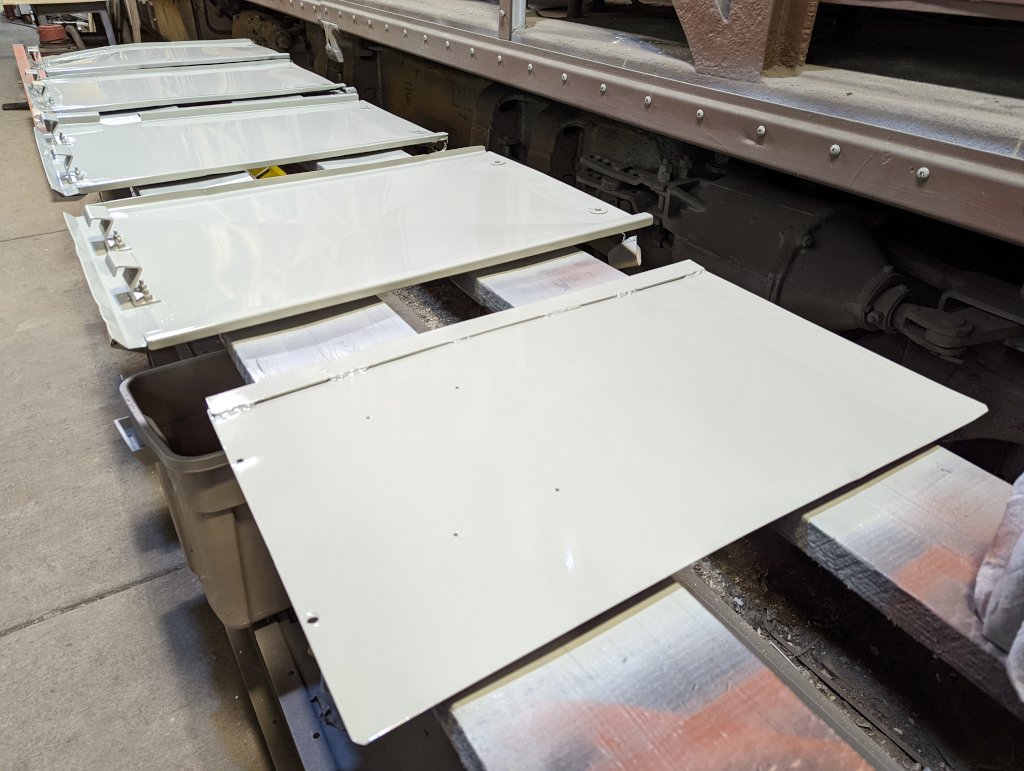
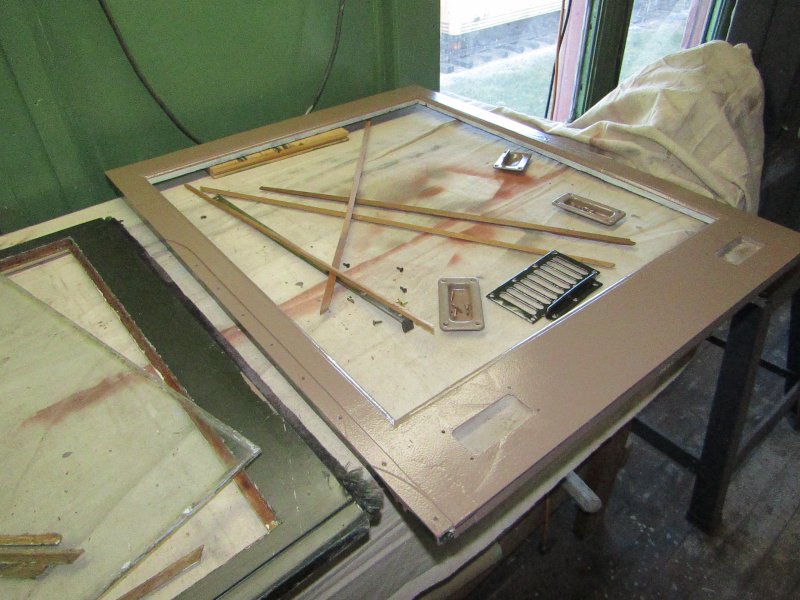
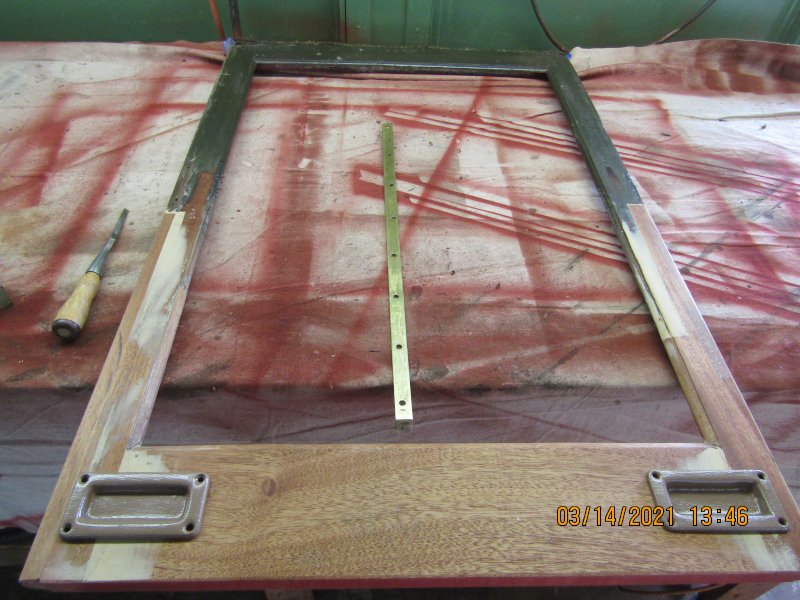
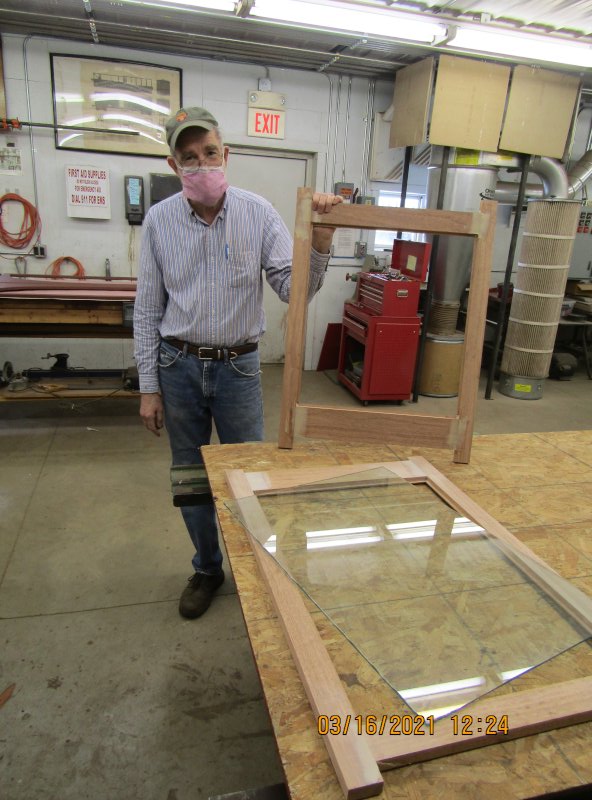
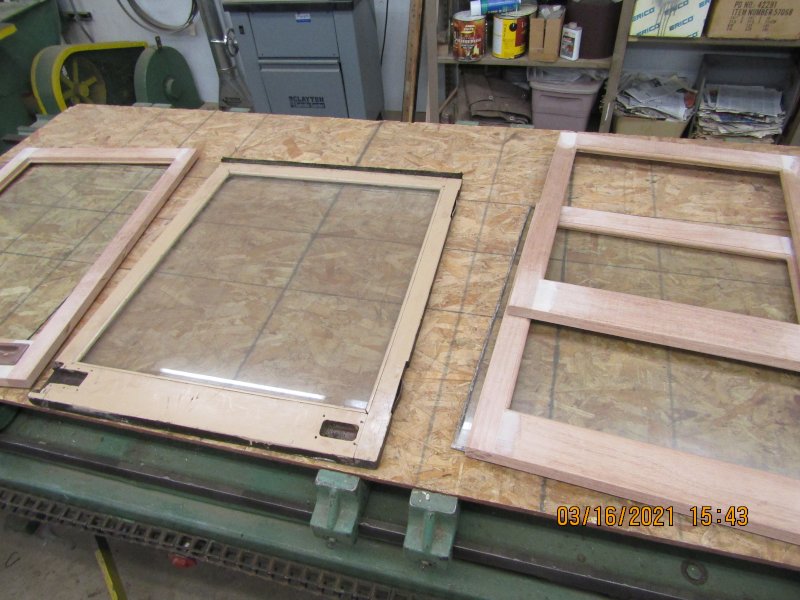
Monday, June 17. 2013Wood Shop Update - June 15, 2013The first order of business today is to extend a welcome to new volunteer Steve Muchow (on the right). Dave Diaz and Steve fabricated the last four new ceiling lighting panels for Cleveland Transit System 4223. Dave also applied the first coat of finish paint to eight previously fabricated and primed ceiling panels for the 4223. This is a BIG step forward and they look really good, and took up a lot of the space on the west end of the shop. The large center panels are behind Dave, several of the smaller lighting panels can be seen on the left. While the other fellows labored inside the shops (it rained heavily in the morning hours), Lorne Tweed and Ray Pollice are drilling many holes and installing the screws. With a lot of planning and prep work, well over 100 of the interior panels and trim pieces were aligned and fit into place, and are now being permanently fastened. Tim Peters is at the table saw and most of us watch his progress eagerly on the Chicago Rapid Transit 1024 project. What can he be making now, what is he thinking, does he have a plan? The answers to the above questions posed by all the inquiring minds are shown here. Above, Tim fabricated a new sub sill from some old growth nearly century old southern yellow pine. Here, you can see the deteriorated pieces removed and now the new timber framing being fitted. In recent weeks we have been following along the steps needed to repair the platform knees on the west end of the car. The final results are in. Both sides have new steel, new wood, and are ready for final touchup and painting. John McKelvey is at it again with a new lounge section armchair for the Passenger Car Department. You recently saw the stunning finished work on a similar chair, here is the starting point showing how poor the condition is, and the fact that nearly every facet of the piece will receive attention. Norm Krentel is fastening down one of the last roof board slats on the north side of the Michigan Electric 28. I would hazard a guess that over 90% of the roof now has the new surfaces installed. Not that any of that was simple but what is remaining is the very tricky bonnet and end roof at the front of the car. The Passenger Car Department has requested that we make several new windows for one of their cars. The sample is leaning against the drafting desk while Rich Witt makes the necessary measurements and transfers those to paper for a good working drawing. And of course there was lots of other wok happening in the shop and the barns. The CGW Russel Plow continued with Buzz Morisette working on the new windows and cab cupola repairs, Victor Humphreys adding more interior lining and trim pieces, and of course we always try to make up the next needed pieces for priming so the work can continue, whatever the weather gods bring us.
Sunday, June 16. 2013
Steam Department Update 06-15-2013 Posted by Nigel Bennett
in Steam Department at
11:18
Comments (0) Steam Department Update 06-15-2013We are moving away from the traditional pattern that my jottings on Sunday are a simple summary of what happened the previous day !. Increasingly work is taking place several days a week whenever people are available. Since last Saturday one or more people have been in the shop on several days. The focus is on 1630 and particularly on completing the riveting. Progress on the riveting has been steady. It may be slower than we might have hoped but it has to be correctly done and we are now well on our way to completion. · On Tuesday Dennis made good around the hole for the rivet that had to be removed after last Saturday. · On Wednesday a team including Tom, Mike, Phil, Rod and Jerry worked most of the day and set three more rivets including the first two countersunk rivets in the corner itself. · Yesterday Ralph took over from Rod in the critical role of forming the rivet head and three more rivets were placed. This took us into the worst area of all, the apex of the corner. These should be far the worst ones we have to place and they are now in and good. The reason that this area is nasty is not apparent from the outside. Externally the rivet heads appear well spaced (and actually have patch screws between them). However, the geometry of a tight bend means that, on the inner sheet, the rivet head are as close as they can be. So in some cases, once one rivet has been installed, it must be caulked and any excess material removed to ensure that the bucker can be placed to drive the adjacent rivet. According to Tom's reading of some railroad maintenance standards this is not a new problem. This suggests that, in later years, some (the Santa Fe was likely one) did not use rivets thru the apex of the bend but welded the corner to the mud ring. This would probably be logical when thinking of the forces involved. The strength of the sheet when bent into a tight radius curve will be such that there is probably little force on the rivets in the corner as the boiler is pressurized. However, this is academic in our case as welding the corner would require the mud ring to be solid in that area, not thru drilled for rivets as it is on 1630 ..... and we are surely not in the business of replacing a section of the mud ring which is in perfectly good condition !. · So, after these efforts we have 3 more rivets to fit. These are ones that require some additional forming of the holes for the countersink before they can be placed and this will hopefully continue during the coming week.
Around the critical riveting we continued to progress other jobs in preparation for the testing and reassembly that will kick off once the rivets and stays are in place. · Paul and Cameron continued the installation of wires to hold the insulation. The firebox is now well on its way to completion. Nigel spent quite a while wondering how on earth to wire the sides of the firebox where there is no apparent way to secure the wires to the firebox. After a bit of cussing about the lack of any photographs of the old wiring before we took it off .... Tom pointed out that there is no wiring because the insulation in this area is attached to the cladding sheets so that it can be easily removed to check the stays that are behind the cladding in this area. · With Vince's help I installed all the wash out plugs aside from the one in the immediate area of the riveting. This is a job that requires care. The plugs are brass and have a tapered thread to seal into the steel boiler sheets. They must be cleaned, lubricated with the graphite sealing compound and carefully run into the threads before being finally tightened with a wrench. While the final tightening requires significant torque, it is critical that the plug is smoothly in its thread before force is applied. The results of forcing a cross threaded brass plug is pretty devastating to the brass threads !. · Jeff is setting up to cut insulation blocks ready for installation. (If you visualize rectangular blocks of insulation that are to be fitted around the outside of the circular boiler barrel, we will need a whole lot of blocks with the long edges cut to a standard angle to fit closely with the adjacent blocks). Hopefully we will have these precut and ready for when we are able to fit them. · The smokebox front ring was retrieved from storage and set up on stands in front of the shop where it will be used to cut the pattern for the gasket that will be required to seal it to the front of the smokebox. Alex made good progress in wire brushing the surface ready to start work on the gasket.
So work continues steadily. Once the last three rivets are in place we will be close to the next big step of testing the tubes for leakage. Nigel Thursday, June 13. 2013
CGW X38 Update - June 12, 2013 Posted by Robert Kutella
in Chicago Great Western X 38 Russell Snow Plow at
14:57
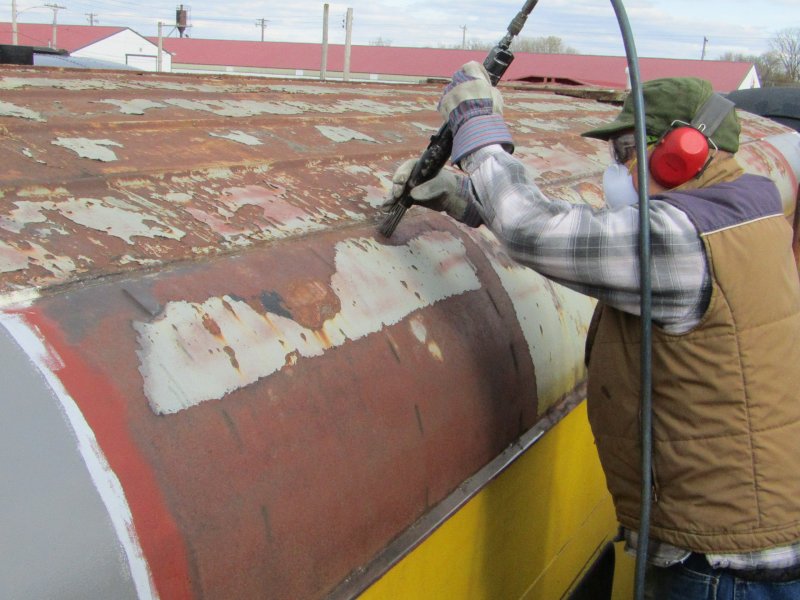
Comments (0) CGW X38 Update - June 12, 2013This was certainly an odd weather day. The forecasters were unified in the prediction it would rain all day, until mid afternoon when it it be REALLY BAD weather. Some volunteers may have been scared off and some events in Chicago were postponed. Two of the volunteers had concerned wives who called the shop to tell them to clear out before 2 PM to beat the predicted storms. We figured we could get an hour or two of work in on the plow, so began with that right away in the morning. And worked along for almost six hours without rain! We got a lot done. Shop work was the first task for Buzz Morisette as he worked to fabricate another new window sill for the cab cupola. This one is destined for the rear window area, if I am not mistaken. Why, it is Dave Rogan of course. Here he is leaning out the cupola window area, and wire brushing the metalwork. Earlier he and I had two needle chippers going at once scaling layers of old paint. You see what those areas look like to your right of Dave, in this picture. Then Dave was using a power wire wheel to clean down to bare metal, seen in the posts to your left left. And below the roof line a hint of the old yellow paint is visible. Always with an eye to the sky, Victor Humphreys came topside and applied primer to all those areas that had been prepped. We had also started on the very long job of restoring the roof. Only a small area to be sure and a bit scary perching way up on the left front corner, knowing there is only the gaping maw of the plow below you. But here is the first primer going on the roof. We were very grateful to have some new and unexpected help from Joe Luciani - here cleaning the truck frame on the left side - and Lee Regione. They were sweating in the sun on the ground while we were sweating up on the roof. Victor had completed the painting up on the roof while the ground work continued. Just in time. Victor attacked those cleaned areas with fresh primer. Here he is doing a triangular flanger support, and then he moved on the prime the truck frame. Inside the cupola Buzz toiled away fitting new wood and also fitting the slider window for the left side. The fixed window looks good installed and the surrounding area painted in the deep maroon. Using the needle chipper is a funny task. It is loud and some vibration is involved. But it can be very satisfying to see the years of use and abuse peel away. You just do not want to put it down. As the painting was going on on the opposite corner, Dave started cleaning layers of paint from the left front corner and roof. Thursday, June 13. 2013Wood Shop Update - June 12, 2013It is always startling to come around the corner of the building and see a stunning wood interurban has appeared as if by magic. Randall Hicks motored it in to take care of more inspections, maintenance and lubrication. No question about it - he is one hard working volunteer. And the car looks pretty sharp!! Lorne Tweed is MAKING TRACKS! Or more like making tracks straighter and cleaner. It is all part of the game for our Cleveland Transit System 4223. And more tracks lead to installing more tracks and in this case installing the last window on the right side of the car. It is sort of an odd one, installed at an angle to accommodate the curved car ends, and partly obscured by the bodywork. Just in case you could not tell, Lorne is proud of figuring this one out. Rich Witt is sitting beside a nice pile of box sides, ends, and lids. There is some more work to mill out grooves and joints, and in case you have not been reading along, these will become reproduction first aid boxes for our CA&E cars. Tuesday, June 11. 2013
RI 2612 Progress Memorial Holiday 2013 Posted by Roger Kramer
in Passenger Car Department at
16:27
Comments (0) RI 2612 Progress Memorial Holiday 2013
Much has been accomplished on the 2612 this past long Memorial Day weekend. I asked for volunteers and a number of people came in Barn 11 to help w/ the project. On Saturday Mike Steigerwald and myself scraped more old peeling paint off the wall. Sunday, an even bigger crew came over to help. Loraine and Dan Bixler began scraping more paint and accomplished quite a bite. Later Nancy Ring arrived and started vacuuming the old chips and grim from the floor. Next, she requested three buckets of water to hand wash the floor. YES, that's right she got on all fours and began washing the floor. WOW, it really is looking much like the coach of old. Mike and I worked together on Saturday The following views are of the crew and their activities on Sunday. Dan Bixler also used the heat gun and really went to town peeling large sections of old paint off the wall. Unfortunately, its a very HOT technique and the gun got real warm. Good luck to the steam team in there riveting of the patch!!!!! Please, remember to send a donation to the Barn 14 Building Fund!!!!
Sunday, June 9. 2013
Steam Department Update 06-08-2013 Posted by Nigel Bennett
in Steam Department at
17:38
Comments (5) Steam Department Update 06-08-2013I guess we would have to say that it was a reasonable rather than a good day of progress in the steam shop. While we moved forward with the critical activity that we have been planning for several weeks, progress was not as good as we had hoped. There was however real progress on the most critical work remaining to be done. Obviously the main focus remains on 1630 · Eric and Curt worked steadily at grinding the tube ends in the front tube sheet. This is a tedious job, requiring care to ensure that the projection is reduced to 1/4 inch but no less. They have now completed all but one of the super heater flues. Good work guys!. · Brian and David worked with Richard to install the wires to secure the insulation. Wiring of the barrel is now largely complete. · Jane worked on cleaning and priming the small cladding plates. These are used under the large sheets to seal around pipes and rods. Given the number of projections from the boiler, there are a LOT of these, all of which need to be clean and painted ready for fitting. · The remaining large cladding sheets were lifted back onto the top of the machine shop to store until required. · All of which brings us to the main event !. Work started on installing the rivets to finally secure the patch into the firebox corner and so complete the boiler shell. Firstly a correction to last week, which demonstrates the dangers of documenting things that happen while you are not there !. Having read last week's notes, Jerry pointed out that it was he, not Mike and Tom, who set up the timber staging to hold the bucker in the firebox. He even spent much of Memorial Day doing so. Sorry Jerry, my bad. Overall there are 13 rivets to be installed. Of these 6 are not significantly countersunk into the sheets and have conical heads on the outside while 7 (those in and closest to the corner) are substantially countersunk (and have shallow rounded heads on the outside). 11 are ready to install while 2 more require some further welding work by Dennis (after the 11 are in) before they can be fitted. (To avoid confusion, the six domed heads already in place in the corner are not rivets but patch screws threaded into the mud ring.) Bolts were set into each of the holes to lock everything rigidly in place before setting the rivets. One bolt is removed at a time and replaced with a rivet. In this shot the first rivet has been fitted in the front sheet while bolts indicate the 12 remaining to be fitted.
Work started on the cone headed rivets, of which there are four in the front and two in the side. Here two are fitted and the hole is ready for the third to be fitted. The heated rivet is passed to the team in the firebox and placed into its hole. The end projects substantially thru the outer sheet. The bucker is positioned behind it and activated to start hammering. In this shot you can see the length of rivet that initially projects thru the sheet. The hammer is carefully positioned on the projecting end. Hammering compresses the hot rivet to form the head. The time to do this is a matter of a few seconds as the contact with the mud ring and hammer cools the rivet very quickly, As the rivet cools from the light yellow, at which it is placed, toward a dark yellow and then red it cannot be further shaped by hammering. When the hammer is removed we can see the formed rivet head, still red hot. Forming the head of the rivet is rather like forcing back on a projecting cylinder of putty to form the required shape. The challenge is that it must be driven back accurately so that the head remains centered on the shaft of the rivet. If it once starts to bend, the force of the hammering will tend to accelerate the bending, resulting in a head offset from the body of the rivet that must be removed and replaced. The four in the front sheet went in well with no failures. Unfortunately the two in the side proved more problematic. The first did bend in forming and produced an unacceptable result. The head was ground off and, with a significant amount of work using the air hammers, was driven out, much to our relief as the greater concern is that it "mushrooms" in the hole and must be drilled out. This hole will need to be cleaned up during the week before another rivet can be fitted. Installation of the second rivet was attempted twice late in the evening. In both cases we had problems with the air hammer forming the head, as a result of which the process was stopped before the rivet was seriously deformed. So there should not be much problem in removing the rivet. The problems with the hammer were resolved but, by 9:30 at night, operator exhaustion was a substantial risk factor and work was stopped for the day. So nearly 1/3rd of the total are installed. The disappointment is that, based upon initial progress, we had hoped that substantially more would have been completed. So - to be continued next week. The other big exercise was the continuation of work with a large B&G team to relocate the materials from West of the shop access road. The tricky items such as the tank and cab of the 0-4-0 were safely located to a much better area, where they are now standing on more secure supports that will keep them clear of the ground.
So we will be back next Saturday with the target of making a good deal more progress with the riveting. Nigel Sunday, June 9. 2013
CGW X38 Update - June 8, 2013 Posted by Robert Kutella
in Chicago Great Western X 38 Russell Snow Plow at
10:51
Comments (0) CGW X38 Update - June 8, 2013The old TV commercial seemed to say "Parts is Parts", at least for a chicken. Not so true for restoration work. Bill Peterson is cleaning up many of the cupola window hardware parts. Earlier he had completed the fitting and installation of the floor repair pieces inside the rear compartment, left side. Victor Humphreys is installing a very old mortise lock for one of the doors on the snowplow. Lots of drilling, fitting, chiseling. Buzz Morisette continues the tricky work of restoring the window framing and sills in the cupola. Here he adding some paint to the framing for the left rear window. First thing in the morning Victor Humphreys went up on the roof and finished the second coat of new paint on the cupola roof, before the metal work got too hot in the sun. Uncertain weather drew out this task, but we are off and running now. We also applied the first maroon to be seen on the cupola. This to the posts, trim, and framing exterior, while Buzz applies some finish grey to the new wood sills and posts on the left side. |
Blog AdministrationFind us on FacebookCategory TreeCalendarQuicksearchArchivesSyndicate This Blog |
Powered by s9y.
Comments
Mon, 06-17-2013 09:50
Wish I could be there to help.
Fri, 06-14-2013 16:50
Matthew, Any special event is the decision of the museum Board. My personal opinion is that it is likely that there would be a special event to [...]
Thu, 06-13-2013 18:33
Hi, I have a question, if or when she is restored and back up and running this or next year. Will their be a special event set up for the return of [...]
Tue, 06-11-2013 22:36
The whistle 1630 wore for a while that you're thinking of was a Frisco 6 chime donated by a former member of the steam shop. It was on it a few times [...]
Tue, 06-11-2013 18:03
You are talking here about something well before my time !. I have not seen her with anything other than the whistle she now carries. If she [...]
Mon, 06-10-2013 16:17
i'm curious here. Will 1630 ever wear the ATSF 6 chime she had on for a while? Better defines her, I love the deep whistle she has now but the higher [...]
Sat, 06-08-2013 15:15
Many many many many many thanks for getting the Spaulding webcam working!!!!!
Fri, 06-07-2013 16:55
The donation was to the museum as a whole. How it is used and whether any comes to steam department projects will be the decision of the museum [...]
Fri, 06-07-2013 16:53
Basically the plan is "ONLY" reassembly. As far as we know she is is reasonable mechanical shape. The big mechanical problem that stopped her (slack [...]
Fri, 06-07-2013 16:28
Nigel I read you guys got a one million dollar check donation!!! Will this be used to finish 1630 ,428, 5 and get started on the others next in line?
Fri, 06-07-2013 16:16
So does 1630 basically only need reassembly? With the boiler in particular. Does her tender or running gear need any work before she's ready for the [...]
Fri, 06-07-2013 12:00
Hello.. The voltage we are using and presumed the RR also used is 120 vac. The system is a little unique because the lite bulbs are each 60 volts. [...]