| BLOG | DIRECTIONS | SCHEDULE | STORE | |
Sunday, February 10. 2013
Steam Department Update 02-09-2013 Posted by Nigel Bennett
in Steam Department at
13:52
Comments (2) Steam Department Update 02-09-2013While it was a part day in the shop for me, as I attended the Board meeting in the morning on behalf of the department, a larger team braved the snow and ice and good progress was made in a number of areas. On 1630: · the first of the cladding sheets, as well as a number of cab fittings were brought down from storage above the machine shop for inspection, cleaning and painting. There is a great deal of this to be done in preparation for the time when we will be able to start refitting them. Much of this is an unpleasant, dirty job as the sheet metal must be wire brushed to get rid of rust and bits of lagging. However there is now an area set up to allow cladding sheets and other parts to be painted and allowed to dry (at the opposite end of the shop from the dust generated by the cleaning process!).
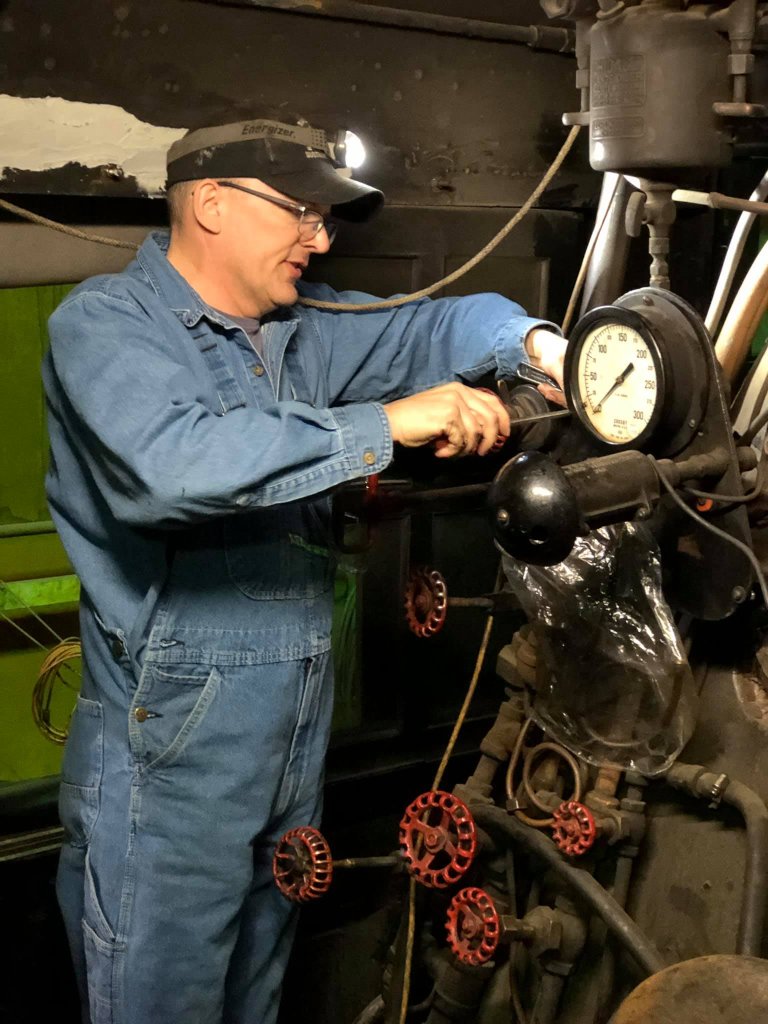
Above are some of the first results including sections of the cladding, that make up the covering of the boiler backhead in the cab, and the mounting plate for the pressure gauges. · on the tube fitting there was significant progress, more in the areas of developing processes for the next steps than in fitting large numbers of tubes. o While I was at the meeting, Collin and the guys completed removal of the rogue tube from last Saturday and put a new one in. o The new roller has arrived and we spent a good deal of time working out how best to use it. This roller is designed to both expand the end of the tube and simultaneously flare the projecting end of the tube, ready for beading. We used this to start work on the smokebox tube ends. The size of this roller should allow it to be used on both the firebox ends and those tubes at the smokebox end that require beading. Because it is a great deal easier to work in the smokebox we decided to work out how best to use it on smokebox tube ends. This proved to be a very good decision. It certainly does expand and flare the tube ends quickly and effectively. Once in place and properly driven, the process is complete in maybe 30 seconds. The snag that became obvious was that the additional force required to turn this roller, as it not only expands the tube but flares the ends at the same time, is more than our smaller air motor can provide. This is a significant issue. The smaller air motor weighs about 30 pounds and can be reasonably controlled by one person. The bigger one drives the expander with no problem but weigh 50 pounds or more. Manually supporting and locating this beast on to the expander for every hole, which we can easily do with the small motor, is pretty exhausting work for two people, as Phil and I found out. Some more development is required. While we certainly could expand the smokebox ends this way it would be slow. The operators require frequent breaks!!. Next week we will need to explore other options. We probably need to find ways of supporting the motor in places from which we can drive the expansion of multiple tubes using the flexible drive shaft, rather than attaching the motor directly to the expander and therefore carrying the full weight of the motor to every tube end. Clearly we need to develop methods that can also be used in the firebox. ... If the big motor is tough to handle in the smokebox it will be a nightmare in the firebox with the arch tubes in the way!. o Despite this we successfully expanded a number of smokebox ends. I have changed the progress measures to reflect the way we now expect to work. At the smokebox end only some tubes need to be flared (those that will subsequently be beaded) and we will do this simply by using a different roller for the expansion. So this weekend we actually flared 7 and left 4 un-flared as they will not be beaded. However in all cases this did all that we need to do to the tube before the first hydro test. At the firebox end, flaring will be a separate step. Beading will not be done at either end until after the first hydro test (so that any leakage can be corrected by additional rolling). Here you can see the results on the tubes directly below the super heater flues from column P and to the right where the ends are now flared when compared to the raw tube ends in the rows below. o At the firebox end we continued to fully seal tubes that were previously set into place. Unfortunately we still hit an occasional one that shoots out the ferrule in this process and needs to be replaced. This seems to happen with those tubes that were originally set with the roller rather than they expander. At least we are now largely thru the ones that were set in this way. · The sight feed lubricator was located and Jerry started work on cleaning and checking this essential component. · The ring spacer required for the one super heater flues with an extra large hole was completed ready for refitting of the super heater flues. In other areas: · Jerry and Mike made good progress on clearing the shelving at the South West corner of the shop to make an area against the wall to store the McCabe flanger. This will be a major improvement. The flanger is, on occasions, a critical machine and had a major role in producing the patch. However, between those occasions, it a huge lump of metal that cannot readily be moved any great distance and takes up a lot of useful space!!. So the objective is to provide a storage space against the wall to free up useful space in the fabrication area when it is not required. It would be really nice if we could store it out of the shop in a container. However, it is so heavy that only the large Buildings and Grounds forklift can handle it .......... and that does not fit thru the doors of the shop! · Mike started on rebuilding the air pump for #428. He has been doing a lot of research on the cross compound air pumps and will look after all of them. He also checked out the valves on 1630's pump which looks to be in good shape after the work done a couple of years back. · Tom continued with machining the shoes and wedges for 428. Above shows one of the shoes that will position the axle boxes in the frame. These are new iron castings as the originals were worn beyond repair. Each must be planed to exact dimensions to enable the eventual refitting of the axles. A slow and tedious process as each axle box requires one shoe and one wedge. So, overall another week of good progress. Nigel Sunday, February 3. 2013
Steam Department Update 02-02-2013 Posted by Nigel Bennett
in Steam Department at
10:41
Comments (0) Steam Department Update 02-02-2013(With a couple of corrections 2/4/2013. Thanks to Bob for spotting that one of the links was wrong !!) The snow resulted in a limited turn out at the steam shop this weekend but a small and determined group kept things moving forward. On 1630 I worked with Phil, Dave and Cameron to continue the tube fitting: · All the remaining ends were fully expanded on the fireman's side. · We also removed one remaining tube where the ferrule had slipped, replaced it, and fully expanded the firebox end. · This leaves a number of tubes in the center, below the super heater flue holes that were set but not fully expanded. Unfortunately, while expanding these, one moved forward removing the ferrule from the back sheet. It will have to be replaced and, having been substantially expanded, proved a bear to remove. By end of day we have largely cut the end off to enable removal and should complete that next weekend. For the first time we were able to get clear pictures of the tube expansion process so can now show rather more clearly what we have been doing for the last few weeks.
This is the expansion tool. The central steel pin is octagonal and drives the segments outward as it is driven between them. Several tools of this general type are used in the overall tube fitting process but this one is unique in having projecting "feet" on alternating segments. When in use, these bear against the tube sheet. This means that, as the tool is hammered, outward force is applied to the walls of the tube but the substantial forward force is not applied to the tube, but born by the tube sheet thru these feet. There is a careful process of adjusting the projection of the tube to 1/4 inch minimum thru the rear sheet then, before anything else, the tube is locked at the front. Here Dave is applying the clamp.
This tube is now clamped into place to, hopefully !, prevent it shifting as the rear end is expanded. This clamping should hold the tube against a certain amount of forward pressure as the tube expands against the ferrule. However, the feet noted above are critical in ensuring that the force of the air hammer itself is not applied to the tube. Were that to happen, this clamp would be thrown off at the first impact !. The expander is then inserted in the firebox end after confirming, by shining a flashlight down the tube from the smokebox end, that we are working with the same tube at each end. Important as it is a real bad idea to hammer a tube that is not the one secured at the smokebox end.
The pin is then hand hammered to expand the segments sufficiently to lock the expander into the tube end. The air hammer is then applied
... and power applied until the pin is fully driven home. You can see by comparing this to the previous view that the travel and therefore the expansion of the segments, is quite substantial. Then the pin is hand hammered at the end to loosen it. Regular application of lard to the pin is important to ensure that it releases. It is a finely balanced process. Substantial force is required to release the pin, which is initially locked into place by the force of a substantial; air hammer. It can often take many substantial blows to initially free the pin but, when it does free, the slope of the lubricated faces of the pin tend to drive it out. So it is real important to listen for the change in sound as the hammer it the pin. There is a real change in tone as the pins starts to free and if you do not notice this and keep hammering the pin can easily shoot out. Then you have the fun of groveling in the bottom of the firebox to recover the tool and pin!. The tool is then turned in the tube, secured and air hammered twice more and you have another tube fully expanded into the rear tube sheet. On 428: · Jerry continued grinding old braze metal from the boxes to prepare the surfaces for Dennis to weld in the reinforcing plates; · Tom continued planing the wedges used to adjust the axle boxes in the frames. So a good day's progress with a small team. Nigel Sunday, January 27. 2013
Steam Department Update 01-26-2013 Posted by Nigel Bennett
in Steam Department at
15:43
Comments (0) Steam Department Update 01-26-2013Steady progress on a number of fronts in the steam shop this weekend. There are no photographs this week as I spent most of the afternoon inside the firebox with an air hammer !. On 1630 it was a case of pushing on with the same key tasks: · We had a setback in the morning when the new tube roller, that had finally arrived, proved to be too small in diameter for the firebox tube ends. The intent with the new roller had been to simultaneously seal the tube end into the tube sheet and make the flare, which is the first step towards beading the end of the tube. Plan B was therefore adopted !. The expander can be used to fully seal the tube ends into place. It is just a slower process requiring a good deal more heavy work from the operator, which my wife would probably say is a darn good thing in my case !. Essentially, instead of air hammering each tube once to set it into place, fully sealing the end requires that you do this three times. Each time the expander must be released by hammering the central pin, turned a little, hammered back into the tube end to seat it and then air hammered again. Using this method, by end of day, we had set all but a few tubes higher up on the fireman's side. All the tubes we set this weekend were subject to the full process so they are sealed and ready to rolled in the smokebox to seal them into the front tube sheet. (The firebox end must be fully sealed to ensure that the tube cannot move before the front end is rolled ). In addition a number that had been set last week were fully sealed. The objective of this approach is that we now have a substantial number of tubes that can be sealed into the smokebox tubesheet, so that we can keep on working in the smokebox when the patch team needs access to the firebox. · This week we had free access to the firebox as Dennis and Mike were finalizing the remaining holes in the patch away from the firebox. The patch should be ready for final fitting next weekend. · Ed continued with the pipe fitting. We have now reached the stage where I have to locate the pictures of how the cab fitting looked before stripping so that the cab end of the new pipes can be set up correctly. · Richard and Lorne removed the timber supporting the cab awning. That became a fairly brutal process. Since it was held to the cab by coach bolts and the timber had rotted, allowing the bolts to turn, cutting the nuts off in the cab was about the only method of getting the timber off the cab; · Vince was setting up for machining the spacing ring that we need to fit one of the super heater flues. No one is real clear why but the hole for the top right super heater flue is about 1/4 inch bigger than all the others so requires a spacing ring when the flue is rolled into the sheet. In other areas: · The decision was taken to set up the new compressor as a direct replacement of the existing one. That means we will not set it up fully until the weather improves. However we will need to ensure that it is fully tested before we start the replacement as we will have nothing but the Sullair as an air source while we do the switch; · Lorne continued the cleaning of the Shay truck. Hopefully we should be able to finally inspect and repaint that shortly; · The new high pressure line for the planer was assembled; · A number of tasks were progressed on 428: o Tom is working on machining the new axle box wedges on the shaper; o Jerry continued grinding out the axle box channels in preparation for welding in the reinforcing plates; o Work restarted on reassembling the air pump. Nigel Sunday, January 20. 2013
Steam Department Update 01-19-2013 Posted by Nigel Bennett
in Steam Department at
12:19
Comments (2) Steam Department Update 01-19-2013We had a good turnout at the steam shop this weekend and I am glad to say that there is major progress to report On 1630: · The new tube roller has not yet arrived but we did establish a reliable "production line" expanding ends into place with the punch expander. Once the new roller arrives, hopefully in the coming week, it should have the ability to both finally seat the tube ends and flare the projecting end piece in preparation for beading. The number expanded this weekend was more than in all previous sessions combined. We could probably have done all the expansion this weekend but gave possession of the firebox whenever needed for the more critical work described below. All the ends are now expanded on the engineer's side. This was done as we should be able to work on the fireman's side when much of the work is being done on the patch ...... just not the heavy work done this weekend. The punch expander avoids almost all the issues of ferrules moving. However, just when we thought we were safe, having done 60 tubes without incident, one ferrule shifted. After much cursing the tube was extracted and a replacement squeezed back in. The problem child was then fitted with a new ferrule and successfully expanded. · The other major progress was on the corner patch. After all the careful bending and drilling to get it tight to the mud ring we got to the stage of introducing the three dimensional shaping to fit to the side and front sheets. This is a pretty brutal exercise requiring Dennis to work close up and personal with a large heating torch then rapidly switch to wield a range of heavy hammers in a confined space. Early in the process you can see the basic heating technique and also that, at this stage, the patch stands substantially proud of the front and side sheets along the top. The patch is of thicker steel than the existing firebox sheets so will always be proud by the distance that can be seen at the bottom, where both patch and sheet are tightly bolted to the mud ring. Once it is suitably hot, Dennis applies a little "gentle persuasion". It is a slow and hot job. The heat reflects from the sheet and there is quite limited room to swing hammers in the confined space of the firebox. Despite the brute force involved it must also be accurate. The gap between the patch and the sheet, where the welding will be done, must be small and even. There was a long pause during the day when it became clear that grinding was required where the patch was contacting the firebox sheet. Once you have the patch red hot, it is quite a long wait before it cools enough to grind. Later in the day, once clearance had been adjusted by grinding, the process resumed.
By end of day the patch was pretty much aligned with the firebox sheets. You can see that the edge against the side sheet now shows an even projection from top to bottom. Checking the back of the sheet thru the mud ring access hole shows the patch pretty much flush with the sheets at the back. The intent was not to get it quite flush as it was still VERY hot and it may move back marginally further as it cools. The next stage is to drill the remaining rivet holes in the patch, refit it and finally adjust as necessary. More tasks are now progressing to prepare for assembly of the locomotive once we have the boiler work completed. · Brian and others worked on producing a cardboard template of the smokebox front ring (where the smokebox front is bolted to the smokebox drum). A gasket must be produced to seal this joint and the template is the basis for this. While this joint may seem pretty mundane it is actually critical to effective operation. In service the smokebox operates at a significant vacuum and at high temperature. Air leaking in can cause loss of power and damage from burning, if the air allows cinders to re-ignite in the smokebox. · Phil continued with the cab curtains. He has enlisted his mother to make the new ones. Many thanks. Sewing skills are in pretty short supply in the steam shop !. The job grows the more that you take apart. Having removed the awning from above the engineer's cab window it is now apparent that the wooden beam attached to the cab side has substantially rotted away and will need to be replaced. In other areas: · Stu and Bob continued work on the planer. Unfortunately it was not clear if they were further forward at the end of the day. While the valve block is now back in place, it was found that the large diameter hydraulic connection was not in great shape. Since this carries a 2000psi pressure, it will need to be reconstructed before the unit can be further assembled; · Work continued on the compressor. This demonstrated the problems of stopping a job for several years. A few short test runs demonstrated an interesting tendency to produce a strange light brown froth from the oil pump. Opening and inspecting the crankcase revealed about 2/3 oil floating on 1/3 water !. As Collin said, I REALLY thought I had changed the oil when I rebuilt the valves 3 years ago !. So, after a through clean of the crankcase and oil galleries, followed by new oil and filter, operation looks much more normal. Once we can mount it properly and set up basic connection to the reservoir, we should be able to test it under load for a period. So a very successful weekend. Let's hope we can keep up the momentum next week. Nigel Sunday, January 13. 2013
Steam Department Update 01-12-2013 Posted by Nigel Bennett
in Steam Department at
13:04
Comments (8) Steam Department Update 01-12-2013There was a good deal of progress in the steam shop this weekend. It was a rather shortened day as I attended the Board meeting in the morning and the development of the winter storm had a number of people who live to the North leaving earlier than usual. On 1630: · First priority was that Dennis worked with Mike and Jerry on the corner patch. Completing the patch is the critical path item as we cannot plan even initial hydro testing of the tubes until the boiler is water tight in this area!. A few adjustments were necessary to get the edges to align exactly where Dennis needs them to provide the correct spacing for welding. Once this is complete they will move on to heat the patch in situ in order to finally bend it into the complex shape needed to match the inner firebox. The trick with forming the patch is that it must be formed accurately in 3 dimensions as it must fit not only to the obvious bend around the mud ring but to align with the tubesheet, which is not vertical but slopes forward. · The statistics on tube rolling do not look impressive. We are now about 25% thru rolling the firebox end. However this conceals some critical progress. The time spent rolling tubes was limited as Dennis and the team working on the patch had first call on access to the firebox and the new tube roller will not arrive until the coming week. However, we did manage to roll all the tubes that had been problematic last week. · We do now believe that we have the issue of the "walking" ferrules solved. It seems that, when fitting ferruled tubes at the firebox end, they should not be simply rolled into place. The essential tool is a segmented punch similar to that used to expand the ferrules into place. The difference is that this one has projections that seat on the tube sheet around the tube (to stop it driving the tube forward). When driven by an air hammer, the segments expand with sufficient force to expand the tube. The major difference from the roller is that the punch expands slightly more on the boiler side creating a taper which prevents the ferrule moving forward (the roller would tend to taper the other way encouraging the ferrule to "walk"). Apparently some railroads fitted the firebox ends solely using these punches, normally applied three times to each tube to ensure an even seal. Given that we have the roller, we will now fit the tube with one application of this expander then roll briefly to ensure an even seal. This should be more efficient as the toughest part is getting the punch back out after it has been air hammered into place. · Ed and Phil progressed steadily with the replacement pipe work along the boiler. In other areas · Richard and Bob test wired the new compressor to its control panel. This allowed us to run the motor and compressor briefly and confirm that the electrical supply works as planned. (It should start at a reduced power and then step up to full power after a short delay, which this test proved it is doing correctly.) The reservoir was moved back to the compressor area so, in the next couple of weeks, we should be able to mount the compressor to the floor, fabricate a new air intake filter (as one is missing) and then connect the compressor to the reservoir, which will enable full testing. · Jeff is finalizing the layout for the pipe work and we should get the scissor lift in shortly so that we can start fixing the pipe work into the roof of the shop. · Bob continued with rebuilding the control gear for the planer. No pictures this week as most of what was happening was continuing existing activities (and I was too busy doing the job to photograph the tube expander in operation !!). However significant progress was made on a number of important tasks. Nigel Sunday, January 6. 2013
Steam Department Update 01-05-2013 Posted by Nigel Bennett
in Steam Department at
18:17
Comments (6) Steam Department Update 01-05-2013There was continuing progress this weekend although we did encounter some issues that made progress a good deal slower than we would have hoped. On 1630: · The central focus was on rolling tubes. A further 17 tubes were successfully rolled at the firebox end. However this was far less than we had hoped as a result of an occasional problem which causes the ferrule to move along the tube as the tube expands into the sheet. When this happens, the tube and the ferrule must be removed and replaced. This is very time consuming and cannot be allowed to happen often as we have only a limited number of spare tubes. · After a good deal of testing and investigation of possible causes we will acquire a new tube roller during the week and are hopeful that this will cure the problem. Once we can overcome this issue progress should be a good deal faster. We probably rolled the 17 tubes in less than an hour and the remaining six hours were spent in removing and replacing the damaged tubes a s well as trying to resolve the issue. · Ed continued fitting the replacement pipe work along the boiler and has now completed the most difficult runs. · The patch is now bolted into place and we are waiting on Dennis's availability to finally heat shape it into alignment with the existing inner firebox sheets ready for welding. · Work continued on cleaning out the cab for refitting. The canvas curtains are now off and will be measured for production of the replacements. Canvas has a finite life after which it falls apart very easily. I think we can safely say that the finite life of these curtains has been reached!!. In other areas: · Stu and Bob made good progress on the planer. Most of the major assemblies have now been cleaned and prepared. The bed is ready for them to be refitted and the new electrical control system is being assembled. The various connecting pipes were measured to order replacements. Let's just hope the guys have a good plan of what connects to what !; · The area around the new compressor was cleared ready for final positioning. Once we have it positioned we can install the vibration isolating mounts and prepare to wire it up. · Work also started on preparing the Shay truck for re-assembly. The bolster must be drilled as the central hole, thru which runs the mounting pin, had developed an interesting oval shape. Purists believe that a round pin is best located in a round hole so this has been built up with weld and will now be drilled to produce a hole of the correct diameter. So reasonable progress on a number of fronts. Hopefully next week we can get tube rolling to progress more reliably and move on with that. Nigel Sunday, December 30. 2012
Steam Department Update 12-29-2012 Posted by Nigel Bennett
in Steam Department at
18:36
Comments (2) Steam Department Update 12-29-2012It is a "second-hand" update this weekend, courtesy of Phil Cwikowski. I did not make it to Union this Saturday as we had family visiting. Unfortunately, absent anyone who had experience with the tube roller, we were not able to roll more tubes into 1630 but a good deal of other progress was made. On 1630: · measurements were taken to fit the ferrules for the super heater flues. It looks as if we have enough for the firebox but will need to find or make some more for the smokebox; · the flues are now alongside the locomotive ready for refitting when the fire tubes have been secured; · the scaffolding and spare tubes have now been cleared so that we have free access to the front of the locomotive again; · needle chipping of the cylinder covers was completed and primer was applied to protect the cleaned surfaces; · the valve chambers were checked for sand blast material that could have been carried over from the boiler cleaning. The good news is that they appear clean and free of debris. In other areas: · Major progress was made on the wheel lathe. Air pressure was applied for the first time in decades to release the lock holding the back head. With this done, attempts were made to move the back bead on its slides ........... and it moved!!. This is critical as the back head weighs several thousand pounds and, were it jammed, it would require very heavy equipment to free it. After this the gear for turning the shaft of the back head was investigated and this was also turned. All of this checking is critical as these parts are normally moved under the power of substantial geared motors. Since it has not operated in many years it is critical to ensure that these huge parts are free to move before we apply power as major damage could occur if they are jammed when power is applied. The tricky part is judging the difference between jammed and normal resistance when it is normally moved by a large motor thru substantial gearing !!. · Stu and Bob returned to work on the planer and further progressed the cleaning and reassembly of this machine; · We gathered the information to calculate the total weight of the new air compressor and motor assembly so that Rick can now identify the vibration isolators that we will need to mount it. So progress on a number of fronts. Hopefully next week we can continue with the tube rolling. Nigel |
Blog AdministrationFind us on FacebookCategory TreeCalendarQuicksearchArchivesSyndicate This Blog |
Powered by s9y.
Comments
Sun, 05-19-2013 22:13
Hello again. I had an idea that was (somewhat rudely, mid-sentence) dismissed in talking to a museum volunteer a few years back, but here it goes [...]
Thu, 05-16-2013 21:52
Looking good Bob! I hope to come out soon once I'm done with school.
Wed, 05-15-2013 21:28
I was not around at the time. General discussion suggests that it was "pretty marginal" in a number of areas. Nigel
Mon, 05-13-2013 11:08
"THUMBS UP!"
Fri, 05-10-2013 02:15
No, it will not be necessary to hold any of the work waiting for the plow to be turned, end for end. Weather will be the major factor, but there will [...]
Thu, 05-09-2013 19:54
The CGW X-38 plow is really coming to life. Bob Kutella and Vic and crew need to be very proud of your collective efforts. I am very appreciative of [...]
Thu, 05-09-2013 15:20
The snowplow looks great! Are you going to apply the door and upper windows befor it is turned to continue work?
Thu, 05-09-2013 09:09
Max, Is there any progress to report yet, in regards to the installation of the poles and overhead wires? Have a good day, sir.
Wed, 05-08-2013 18:40
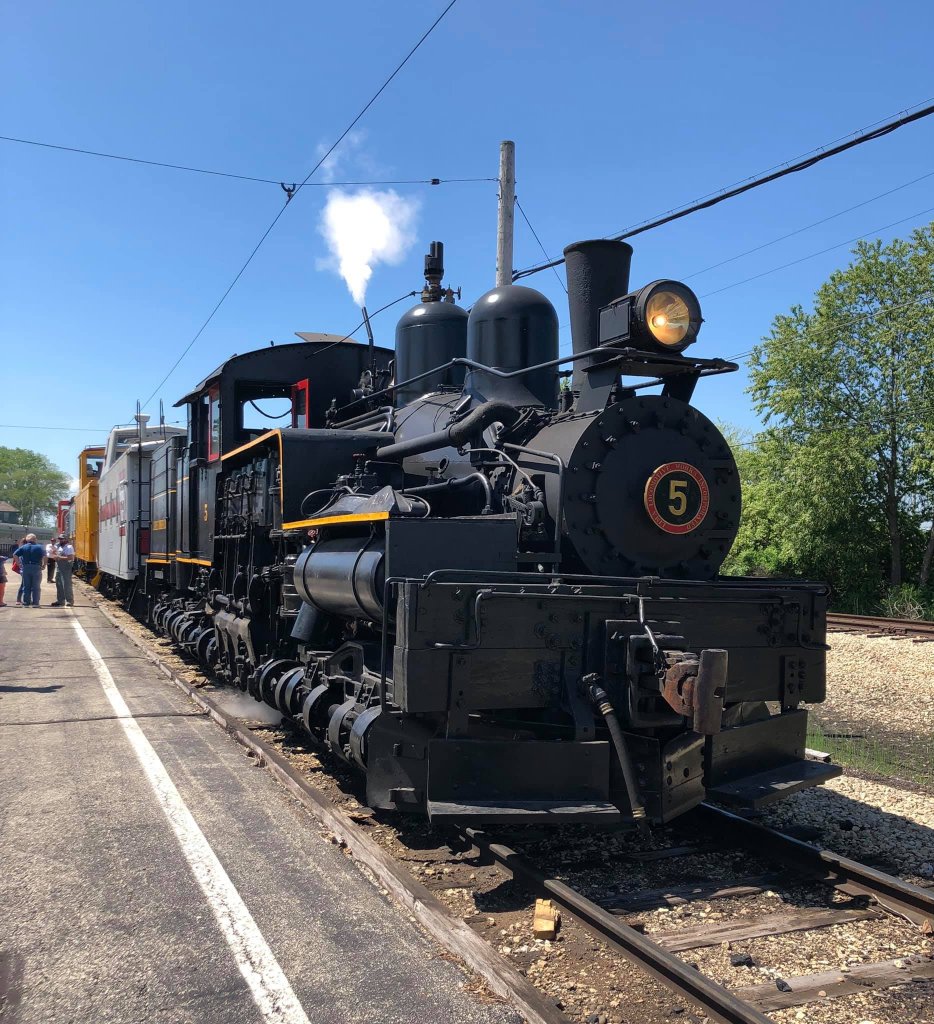
Thanks for the update! I still don't understand why Commonwealth #5 was removed from service. Do you know why?
Tue, 05-07-2013 09:28
Mr. Kolanowski.....I was just wondering if the Spaulding webcam will be up and running soon for us stay-at-homes. Thanks!2FP
Mon, 05-06-2013 23:04
Max, Has work begun yet on the construction phase of erecting the poles and putting up the wire? Wish I could be there to watch it happen.
Mon, 05-06-2013 23:02
Keep up the good work, Bob. Wish I could be there to help!!!!!!!