

|
|
Thursday, October 4. 2012B&O Boxcar Update - October 3, 2012This was a very productive day for accomplishing a much needed repair to the car. There were a lot of players including some of our SKILL LEVEL experts. The problem: the door on what is now the south side of the car could not be opened. 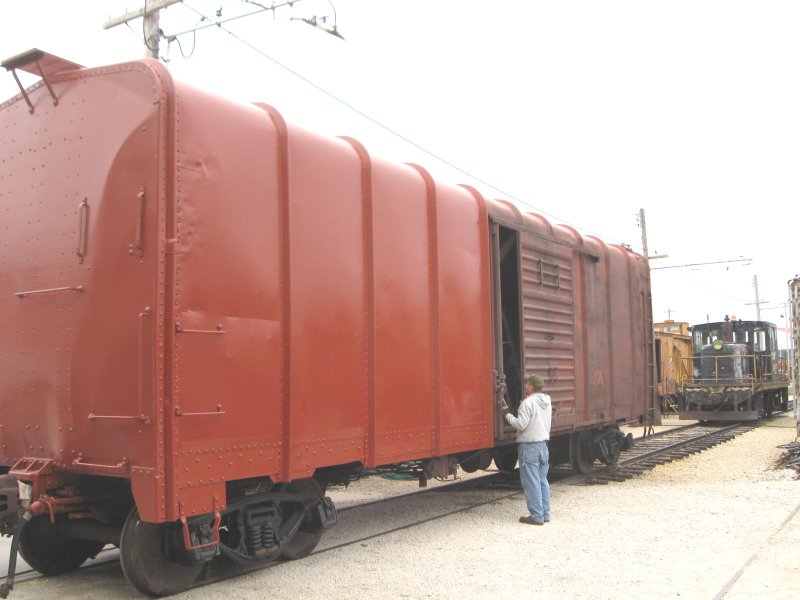 It Moves The roof framing and door track on the top of the car had been bent downward and inward at some time in the past, resulting in a bind that prevented the door from moving at all, at least with the resources available to mere mortals. Lots of cribbing, timbers and a heavy duty pneumatic jack on the inside of the car got some upward pressure to free it up. John Faulhaber is marveling at the open door, an unseen mystery of the ages. And of course not be missed is the rare shot of this car on Track 41 at the east end of Barn 4. 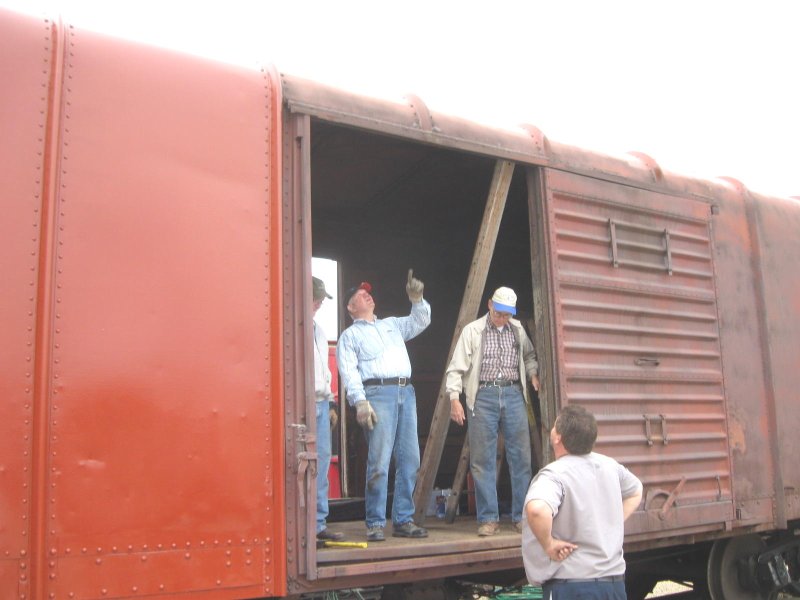 Fully Open With the door fully open, it was time to make 'adjustments'. The crew is here engaged in a further tweak of the frame and door track upward, more jacking, a little heat from the torch, and it is much better. Sunday, September 30. 2012B&O Boxcar Update - September 29, 2012SEE THE MAGIC HAPPEN!! After a summer of brutally hot weather the temperatures seem to have become more moderate. The past few months the car work has continued although the order of certain tasks had to change to protect the health of the volunteers. Body repairs continued in the form of removing rust, cleaning old paint, repairing dents and dings, repairing the interior car floor, emptying the car of much stored equipment, cutting away rust outs, fabricating new steel panel plugs, welding them in, grinding, installing new rivets, and prime painting. If you were to walk by the car, much of this progress might not be noticed except by a very detailed look by a trained observer. 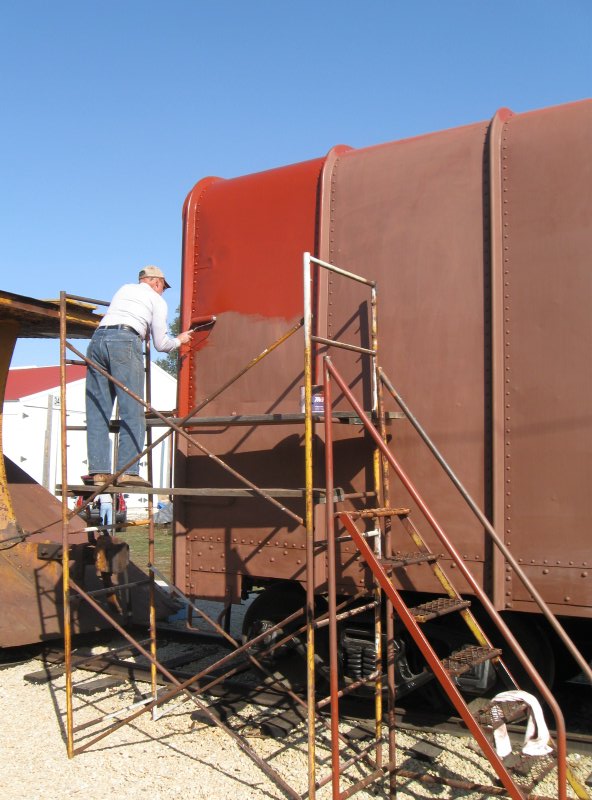 The Magic But the day dawned clear and Victor Humphreys was on hand early in the day, cleaned and wiped down sides, and in short order the first finish paint was being applied to the south side of the car. It was an almost instant transformation from an ugly duckling to a swan of princely stature. 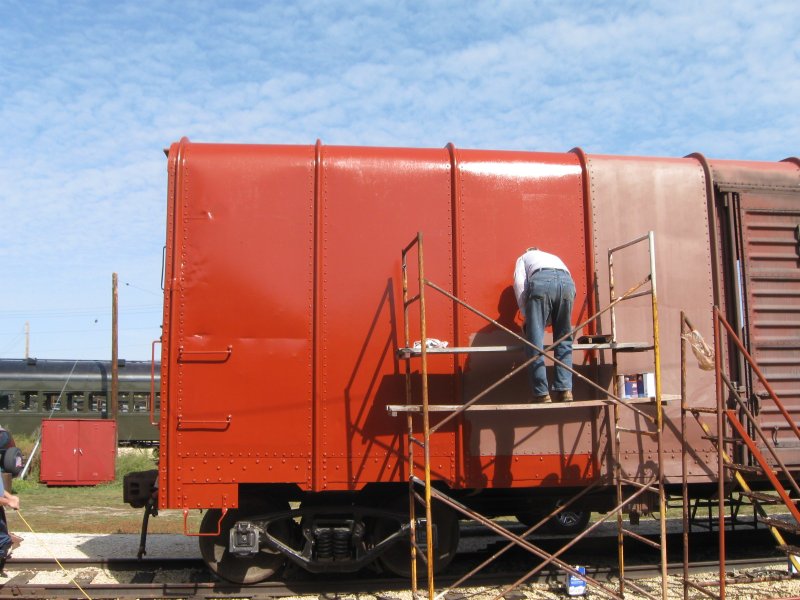 Third Panel Three of the panels on that side were painted with the correct finished color and the effect is spectacular, and gratifying to see the work. Thank you Victor for being the champion on this project and doing much of the work yourself. Thursday, September 27. 2012B&O Boxcar Update - September 26, 2012Progress continues with the pleasant weather, although heavy ground fog early today made one question how it could turn out so nice.  Sanding The first two panels are finally ready for finish paint. The welding, rivets and priming are done, and Victor Humphreys is sanding and touching up the primer. 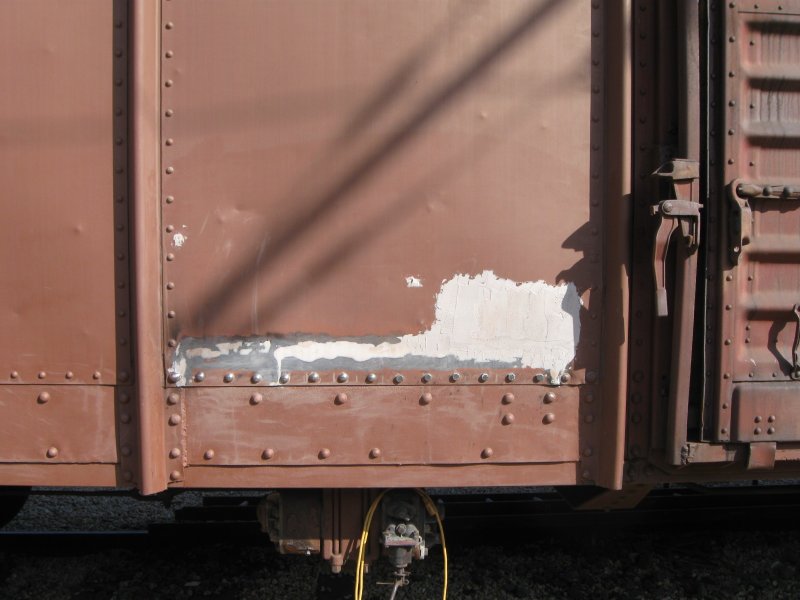 Fourth Patch This is the last patch to be done along this half side of the car. One more day of work and priming, and then it is off to the races with more paint. The car is looking really nice with the rust outs gone and sides smooth and intact, bulges gone. The large area of filler to the right and above the new steel is an area that had severe pitting in the original steel side, some sort of badge or board having resided there at some date in the car's past. |
Blog AdministrationCalendar
QuicksearchSyndicate This Blog |
|||||||||||||||||||||||||||||||||||||||||||||||||


Comments
Mon, 09-08-2025 08:22
Good job on the Burlington Nortern 9976. OK.
Tue, 08-12-2025 12:56
No new news that I have heard of thus far.
Tue, 08-12-2025 12:53
I'll also be doing another update on it soon. Keep en eye out for that.
Tue, 08-12-2025 12:47
A little work was done to it for Diesel Days this year. You'll see photos floating around for the temporary short term job that was done to make it [...]
Wed, 08-06-2025 13:01
Is steam car CN 15444 going to be coming to museum several times it was to be moved to muesum
Sat, 07-19-2025 18:56
Yeah, sadly it's still there as of 7/19/2025
Thu, 06-12-2025 19:14
Its been 14 years guys, where is the unit? Like really? Did you guys misplace it? Or are repairs taking that long? At this point be might we will have [...]
Wed, 04-09-2025 17:40
Jamie Thanks for the update. She's gonna shine like every thing else you guys do! Smeds
Thu, 03-06-2025 16:28
Yes, there is a wye. Those two have been MU'ed on diesel days a year or two ago.
Wed, 03-05-2025 14:04
7009 number boards look good. Is there a way to turn a locomotive around at IRM? In case you ever had a mind to connect 7009 and 6847?
Fri, 03-29-2024 21:26
We're slackers and spend more time working on the equipment in the shop than keeping all you readers updated. We'll work on it, but I'm sure updates [...]
Thu, 03-14-2024 08:02
What happened to the Department Blog? It's been over 2 years and I still regularly check for updates, but nothing comes...