

|
|
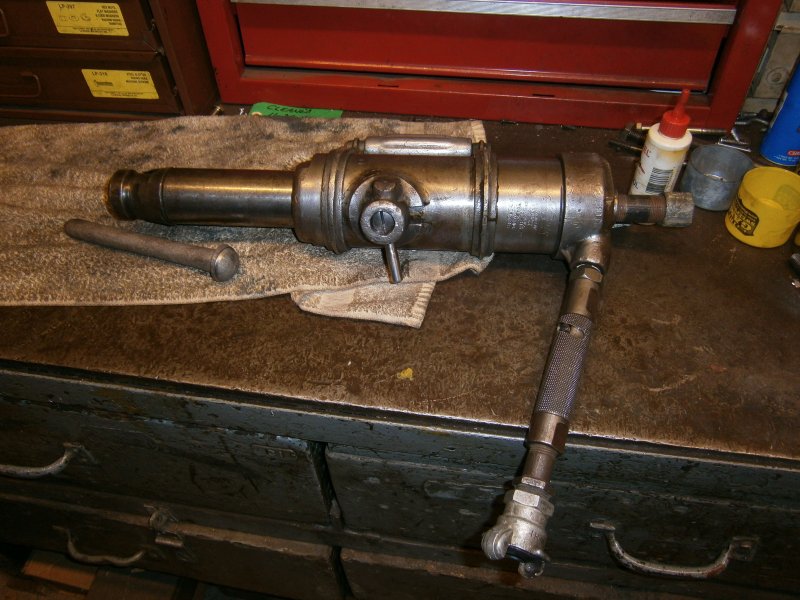
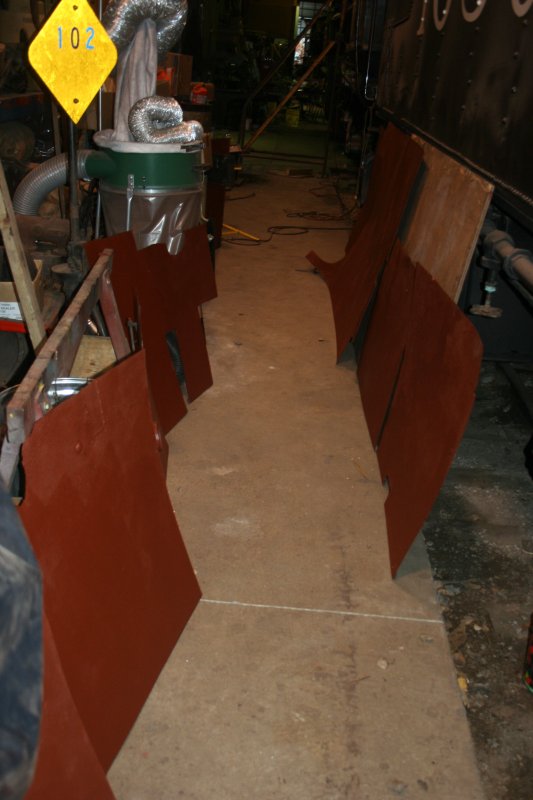
Wednesday, May 15. 2013Steam Department Update 05-11-2013A short and second hand update this week, courtesy of Phil and Collin, as I was enjoying myself in New York City last weekend. It sounds as if good progress was made on a number of fronts. Unfortunately everything else is overshadowed by the news that Glen, one of our regular team, was seriously injured in a motor bike accident last week. From what we can gather, he is in the ICU at Rockford Memorial and the path forward is unclear at present. Our thoughts are with him. On 1630: · The flue removed last weekend, that has to be reworked, was cleaned up and prepared. · The jacketing painted last week is now back in store and the last of the jacketing is now down in the shop for cleaning and painting. · Mike reassembled the bucker, which is critical to riveting the patch into place. It was hooked up to the air supply and works!.
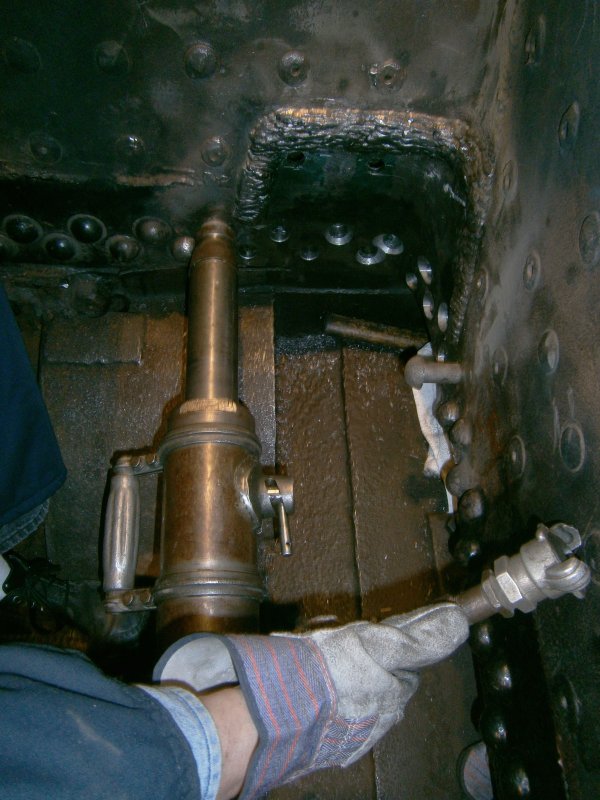
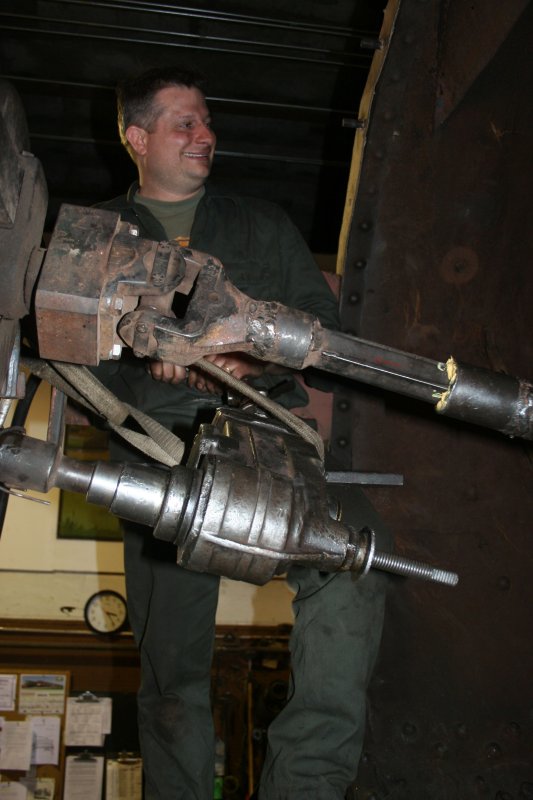
· Phil, Tom and Mike started working with the bucker in the firebox to determine how it can best be supported to provide a smooth and reliable position when riveting. This is essential as the core of the riveting process is that the yellow hot rivet must be passed into the firebox, put into the hole and the bucker accurately and firmly applied in a matter of 15 seconds. If the rivet cools too much or the bucker moves, you will get a badly formed rivet and the need for many hours of work to drill it back out again and re-prepare the hole. So there will be a LOT of planning and practicing ahead of driving the rivets
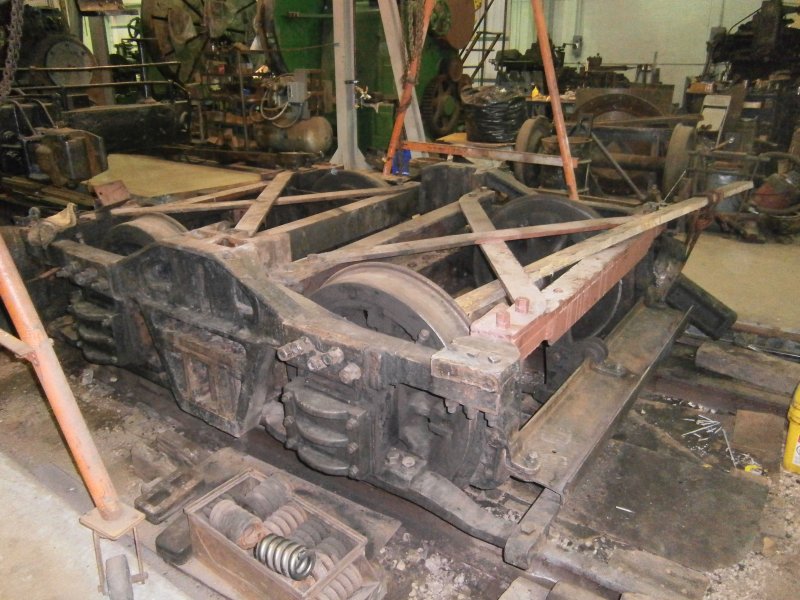
A rivet must be set in each of the holes. So we need to be able to place the bucker quickly and firmly and use it in each position, while still allowing room to place the hot rivet. On the Shay: · Alex used the degreaser and put it on the front truck. (Sounds like I had better make plans to borrow the steam cleaner from the car shop to finish the process)
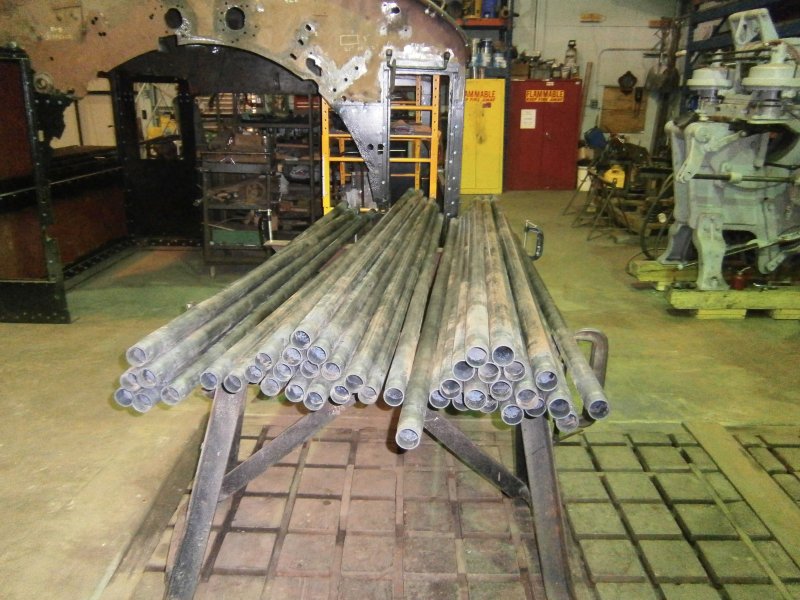
· Alex, Brian, Cameron, and Phil fired up the furnace and annealed the last of the flues. They are now ready to be put back in the box car. This was a very positive sign for the future. The whole team was young guys all in their lower 20's or teens, which makes a big change from the reliance on us old codgers!.
In other areas: · Bill, Stu, and Bob worked on the water supply in the boxcar and started on the modifications to the pumping system. The objectives are to ensure that the locomotive crew can reliably get water with minimum knowledge of the system without risk of damage and that treatment chemicals can be added automatically. · A key piece of the planer was refitted. The directional control lever was reassembled. As is common with rebuilding old equipment, this was much more difficult than it sounds. A pin had sheared off in the shaft and Bob had worked much of last weekend to get it out without damaging the shaft. So, a good day, from the progress point of view. Nigel (as scribe for Phil and Collin !)
Sunday, May 5. 2013Steam Department Update 05-04-2013A fairly short update this week. It was a long and hard day's work. But, while we made reasonable progress, not much of it was visible. On 1630: · Most of us focused on the issue, identified last weekend, of the flues that moved forward as the ends were rolled into the front tube sheet. All but one were moved sufficiently to provide the required projection at the rear to allow beading. The one that could not be moved was removed and will be reworked. Having reduced the issue to one flue, we should be able to keep the delay to a couple of weeks. · The remaining flues were rolled additionally in the rear sheet to reduce any likelihood of movement when these are rolled at the front end. · Sean made great progress on priming the cladding sheets. After his efforts, a satisfying number were standing in the shop to finally harden before being put back into storage ready for refitting.
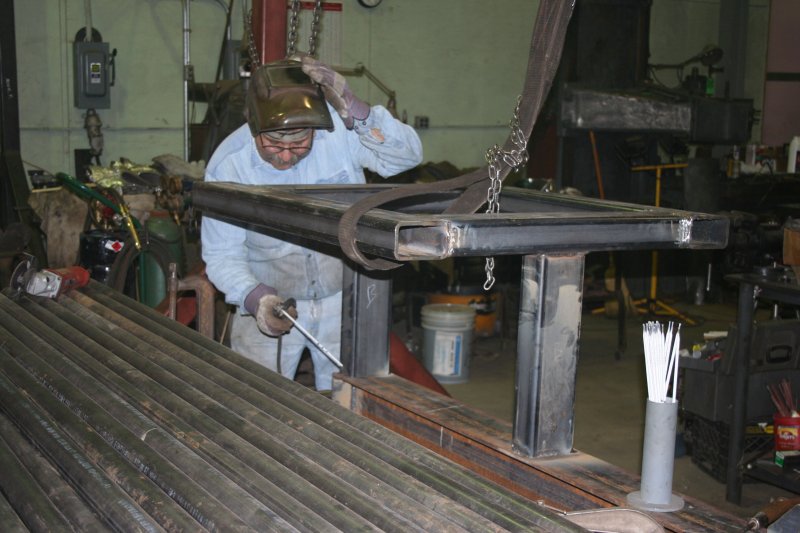
· Tom was working on the lathe to produce the guides that will be used to drill and tap the holes for the two stays that are to be fitted into the firebox patch. These screw into the caps of the flexible stays, that are already part of the outer firebox wrapper. They guide the drill to make an accurate hole in the inner firebox sheet, into which the stay is then threaded. · Having checked to confirm that everything is working correctly in the water supply boxcar, Ed was working on refurbishing the pipe work for the boiler backhead fittings. · The specially made seals for the bucker have arrived at last, so, once they have been softened by soaking in oil, work can begin during the week to get this reassembled and ready for the riveting to begin. In other areas: · Dennis completed the boom for the fork lift. Here it is upside down to allow the main beam to be welded to the frame that fits over the forks. This will hopefully be used before long to lift parts such as the dome cover back on to the locomotive.
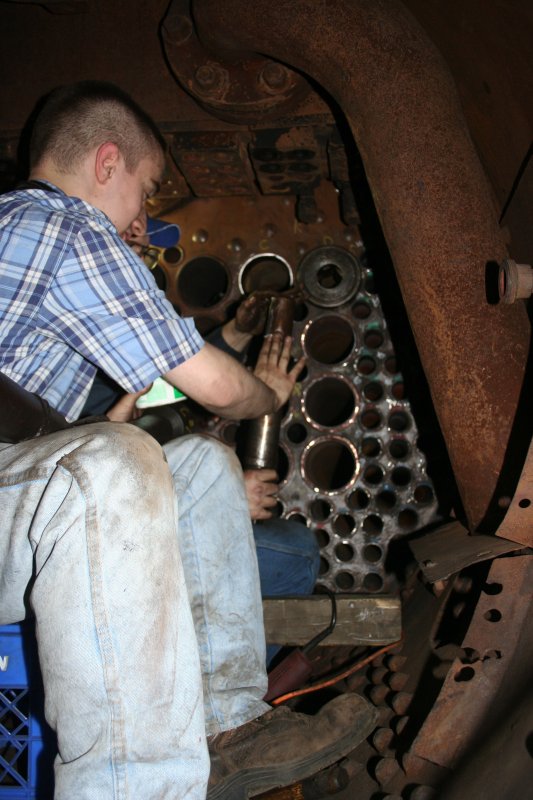
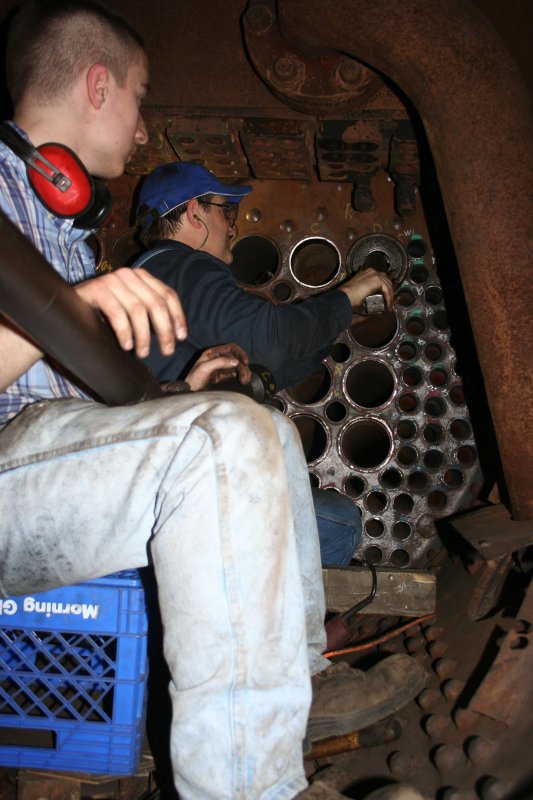
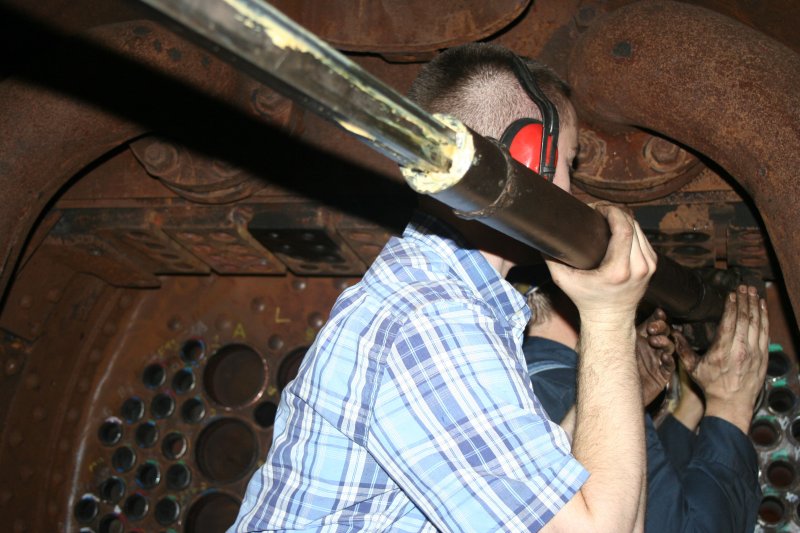
· Bob and Mike continued work on the planer. · Glenn continued building the guards for the drive belts on the new air compressor. · Jerry did a great job on clearing the front of the shop. For those visiting us, we can no longer be identified as the shop behind the stack of debris, drums and disused "A" frame !!. Next week I will be in New York on vacation, so I am looking forward to finding a lot of progress when I get back in two weeks time !. Nigel Sunday, April 28. 2013Steam Department Update 04-27-2013Turnout was a little thin this weekend at the steam shop and maybe the museum in general. I think the sudden good weather may have resulted in a lot of calls for yard work !. It was really nice to be able to open the doors at both ends of the shop and have the warm breeze blow thru. There was a great deal of activity in the shop and elsewhere. The central focus is obviously on 1630. · Collin, Phil and I managed to complete the rolling the super heater flues at the firebox end. This provided the opportunity to takes some shots of the process inside the firebox to give a clear idea of the method of operation. First the projection of the tube is carefully adjusted to provide the required 1/4 inch minimum required for the end to be beaded once we have proved that the seal is tight.
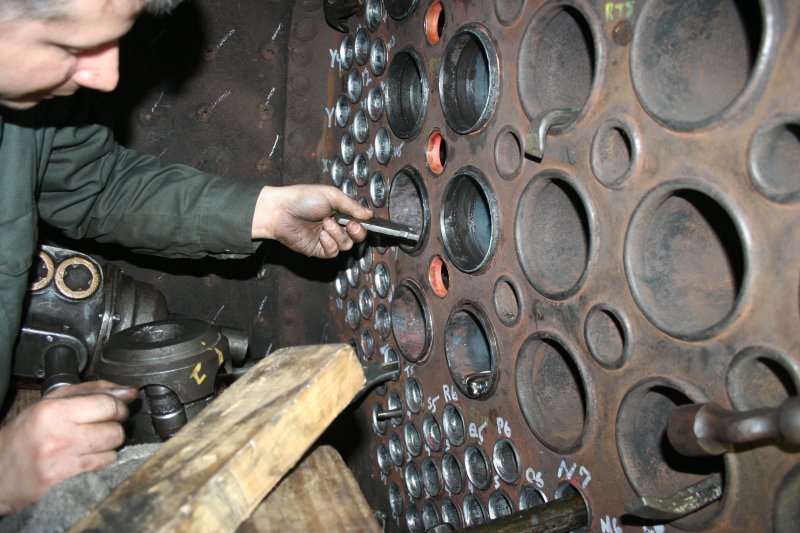
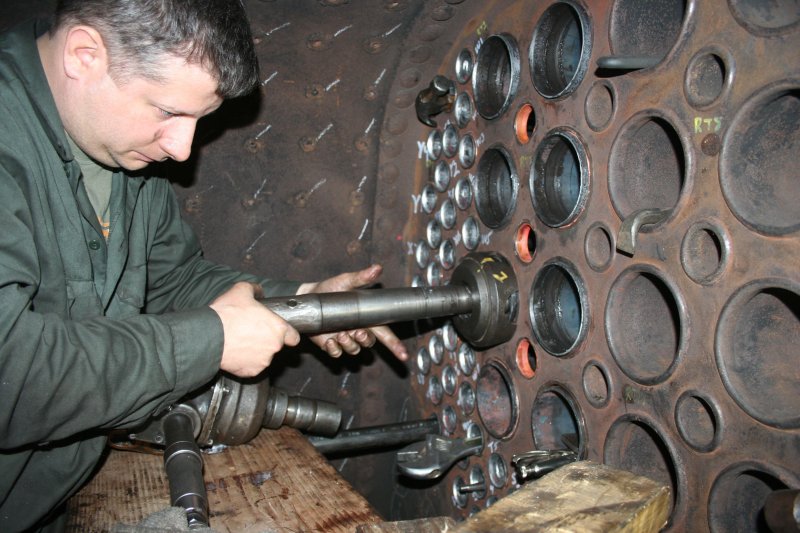
The roller is placed in the tube (after Phil has locked the tube into the front sheet as shown last week).
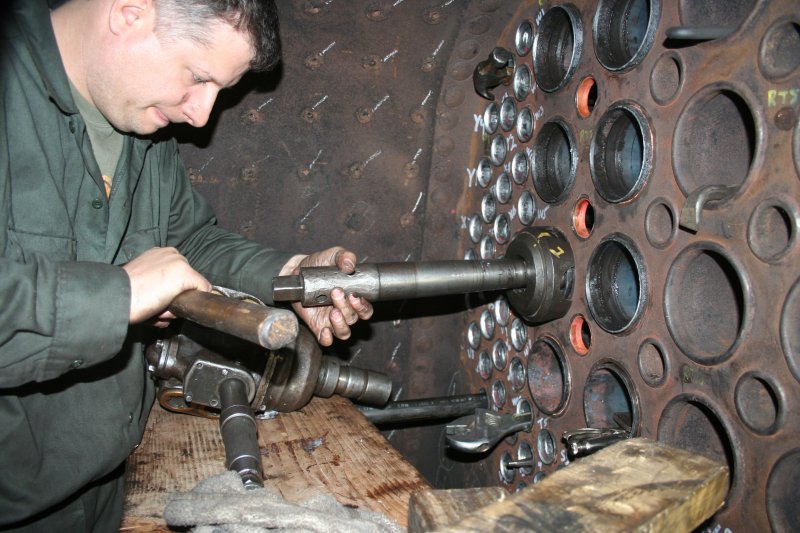
The pin is pushed into the roller. Notice that the pin is well covered with lard, the recommended lubricant for these old rollers.
..... and then hammered to tighten it into place between the rollers.
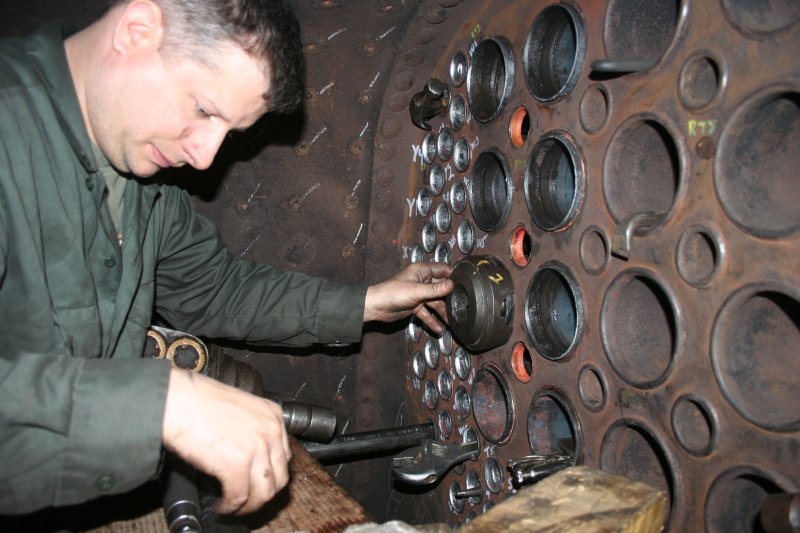
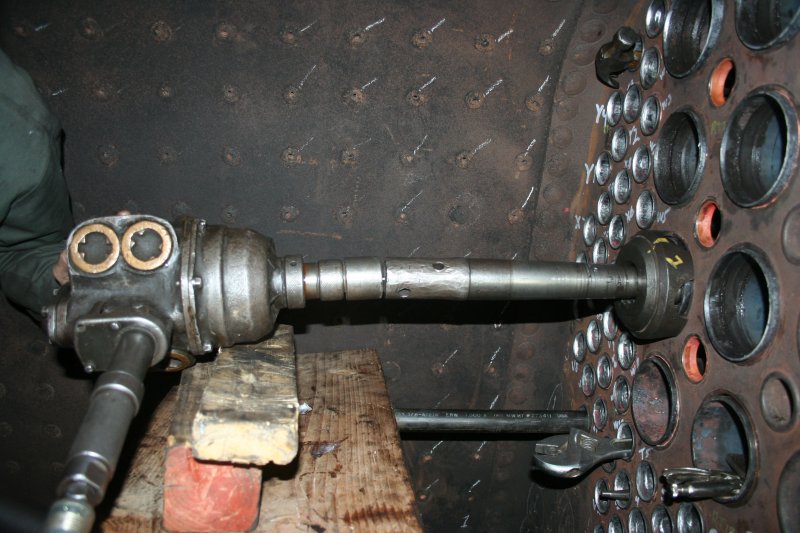
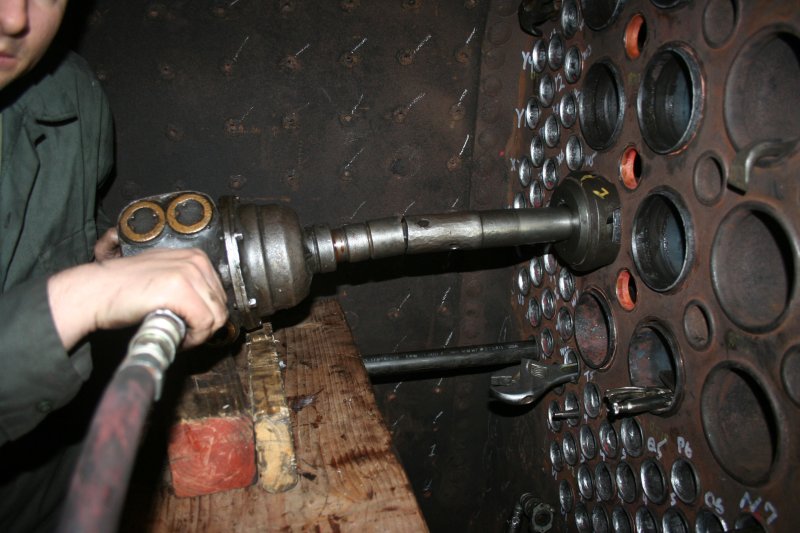
The air motor is attached to the pin and rested on cribbing set on a scaffold supported on tubes lower in the tube sheet. The air motor then powers the pin, which is drawn into the roller as the tube is expanded. This step is not shown as I had to operate the motor while Collin kept it in place and there is no space for more than two people.
The pin is drawn substantially into the roller, as can be seen in this shot. As it is drawn in it forces the rollers out, increasing the diameter of the tube end as they rotate.
The motor is then reversed to free the pin and the effectiveness of the expansion is checked. Once expanded, the tube end can be hammered with no sign of movement and a good solid note that indicates it has become solid with the tube sheet. · We then moved on to the front tube sheet. Collin, Jason and Phil made substantial progress in rolling the tube ends at the front. The process is very similar except that the greater space allows the motor to be mounted on a reduction drive.
A good coat of lard is essential here too,
There is rather more space to set the roller and pin into place. Attaching the long and heavy shaft to the roller while keeping it straight in the tube is less easy
When rolling, Jason checks the progress of the rolling while Phil bears the weight of the shaft to stop it pulling on the roller.
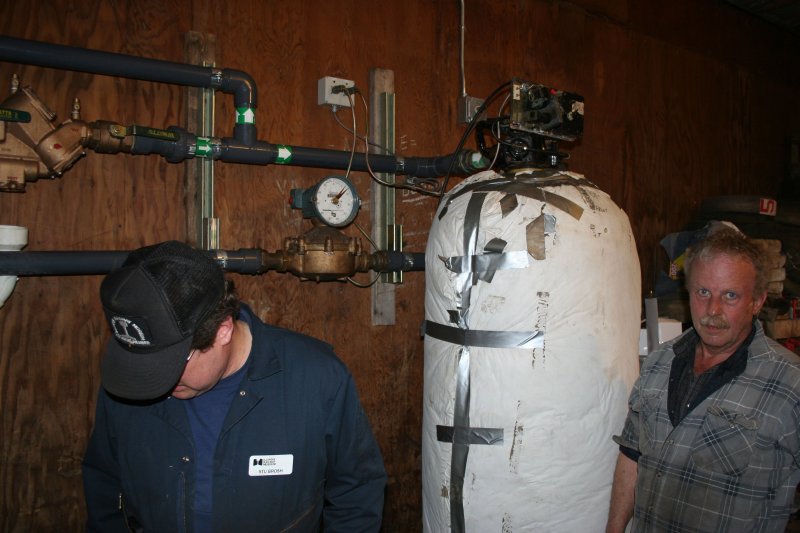
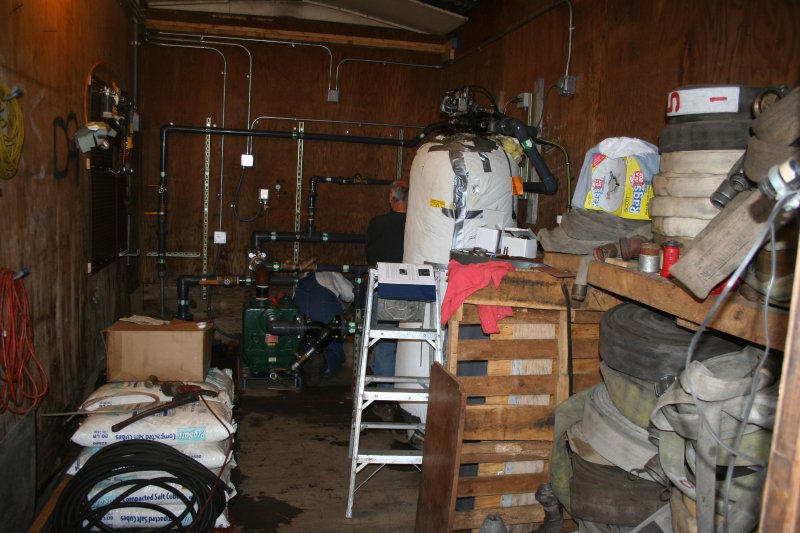
While progress initially appeared extremely good, we detected a problem that has the potential to set us back several weeks. After 10 of the 16 tubes had been expanded, it was found that two had been pulled toward the front by the expansion process. This was completely unexpected as the rolling into the rear tubesheet appeared to be solid and also creates a flare on the outer end of the tube. These tubes are now rolled at both ends, which makes any movement very difficult. However, if we are not able to drive them back sufficiently to allow proper beading at the back, we will have to cut them out and repeat the safe ending process. We will try to move the tubes enough to get the length for beading next week but if we are not able to do so this will be a significant set-back. · Blanks were found for the two stays that must be machined and fitted to the corner patch and work started on machining these ready for fitting. In other areas: · The good weather also enabled another essential task to be undertaken. The water system in the box car was brought back into service. Stu, Ed, Bob and Jerry carried out this work and a difficult repair that was detected during the process. This system provides to water for any steam locomotives running on the site and will be needed initially to provide water for the hydro testing. It is a multi stage process. First water is taken from the well and run thru a softening process before feeding into large underground tanks. The pump system draws water from the tanks thru large diameter pipes to supply the locomotive. The softening is essential given the mineral content of the well water. The capacity of the well and softening system is such that it must run most of the week to provide the water for 1630 to run over a 3 day period. Unfortunately, as the system is located in an old boxcar that could not be effectively heated, it must be extensively stripped over winter and recommissioned in the Spring. We wanted it operating now as we hope that it can be simplified and made more reliable as the crew supporting Leviathan had problems getting water last year. Anyway, after a hard day's work the team were able to put on a satisfying show with water firing across the tracks to the road. Unfortunately when I was not there to record the event !. Stu and Jerry reaching the end of re-assembly. All of the metering equipment on the wall and the softening system on top of the tank beside Jerry has to be removed over winter and refitted in the Spring.
During the reassembly a leak was discovered in the piping leading from the softener down to the underground tanks. A lot of work at arms length down the shaft was required to cut out a section of pipe and fit a connector to replace the leaking section. With all the equipment reconnected the large pump that drives the high volume supply could be primed and tested. This is the large green machine in the center.
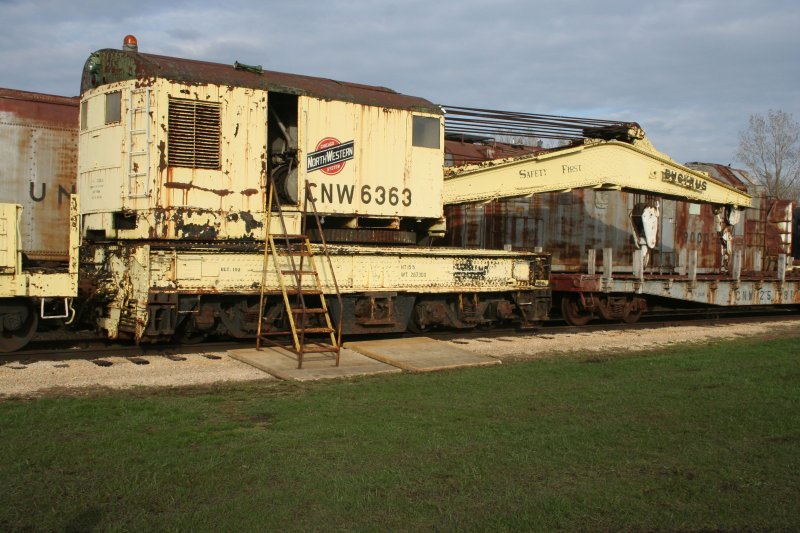
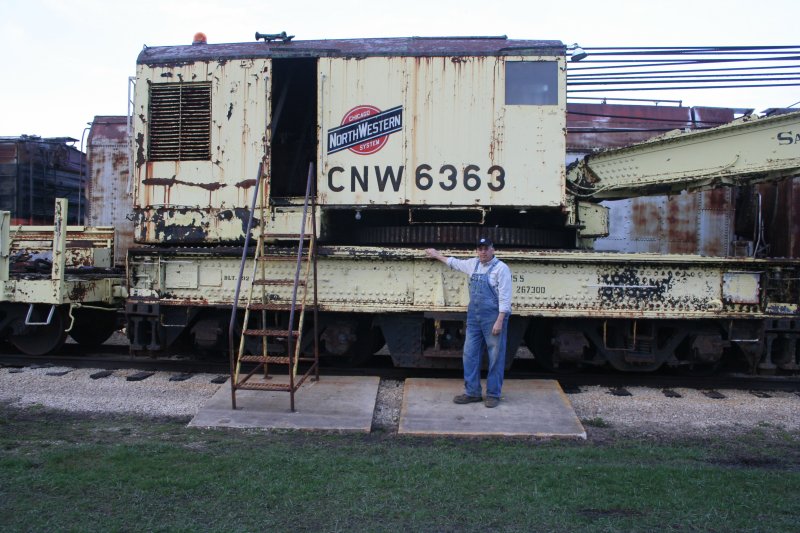
· Another project that I was able to see for the first time was the renovation of the wrecker, that Mark Secco has been carrying out. This was originally a steam wrecker but converted to diesel in the 1960's. This very useful piece of equipment has been out of service for a number of years. While there is only rarely lift work to warrant its 100+ ton capacity, when there is a requirement for such a lift, it can cost the museum many thousands to hire in such capacity.
Mark has been working steadily thru it. The main motor is now running smoothly and reliably. It is of such a size that it has a decent sized gasoline motor as a starter. The operation is controlled by air pressure with most of the clutches being double acting (powered both ways). Most of the air controls have had to be rebuilt. Some more work is required to enable the secondary hook and refurbish the cables, but it is good to hear it running again. Having got it fully running, Mark hopes to give it a full repaint and refurbish the runner, the deck of which is currently in poor condition. · Meanwhile Dennis started work on the boom for the forklift. This is one of the projects funded from the benefit concert last year. It will enable us to use the forklift to put heavy objects over the center line of the locomotives. This will be a big benefit when we come to put the dome cover and throttle back into 1630.
So a reasonable week but a lot of nervousness for next week about the tubes. Nigel |
Blog AdministrationCalendar
QuicksearchSyndicate This Blog |
|||||||||||||||||||||||||||||||||||||||||||||||||


Comments
Mon, 09-08-2025 08:22
Good job on the Burlington Nortern 9976. OK.
Tue, 08-12-2025 12:56
No new news that I have heard of thus far.
Tue, 08-12-2025 12:53
I'll also be doing another update on it soon. Keep en eye out for that.
Tue, 08-12-2025 12:47
A little work was done to it for Diesel Days this year. You'll see photos floating around for the temporary short term job that was done to make it [...]
Wed, 08-06-2025 13:01
Is steam car CN 15444 going to be coming to museum several times it was to be moved to muesum
Sat, 07-19-2025 18:56
Yeah, sadly it's still there as of 7/19/2025
Thu, 06-12-2025 19:14
Its been 14 years guys, where is the unit? Like really? Did you guys misplace it? Or are repairs taking that long? At this point be might we will have [...]
Wed, 04-09-2025 17:40
Jamie Thanks for the update. She's gonna shine like every thing else you guys do! Smeds
Thu, 03-06-2025 16:28
Yes, there is a wye. Those two have been MU'ed on diesel days a year or two ago.
Wed, 03-05-2025 14:04
7009 number boards look good. Is there a way to turn a locomotive around at IRM? In case you ever had a mind to connect 7009 and 6847?
Fri, 03-29-2024 21:26
We're slackers and spend more time working on the equipment in the shop than keeping all you readers updated. We'll work on it, but I'm sure updates [...]
Thu, 03-14-2024 08:02
What happened to the Department Blog? It's been over 2 years and I still regularly check for updates, but nothing comes...