

|
|
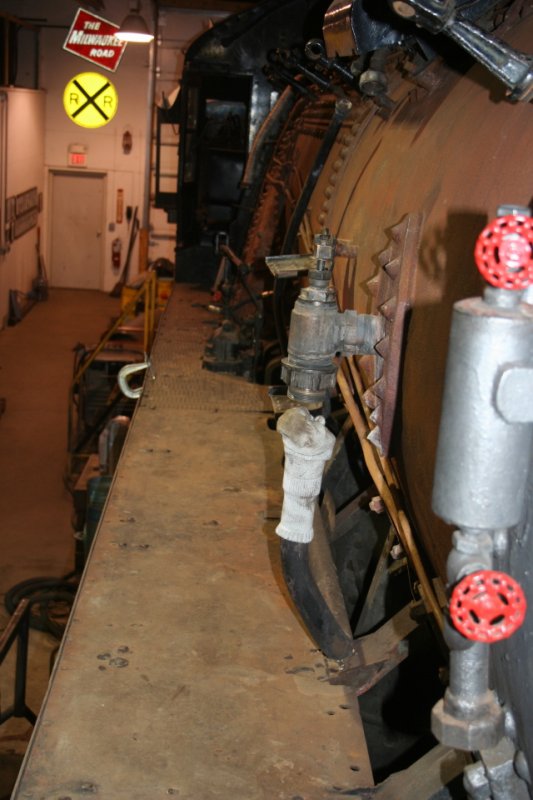
Sunday, April 8. 2012Steam Department Update 4-7-2012A good deal of progress was achieved on 1630 today despite a low turnout that was to be expected at Easter weekend. The main effort was heavy duty cleaning. The objective was to clear the abrasive and associated dust from the locomotive top down so as to minimize the amount above the wheels and motion before the sheeting could be removed. This was achieved and she now looks recognizable again with the wheels and rods uncovered ready to shunt next weekend.
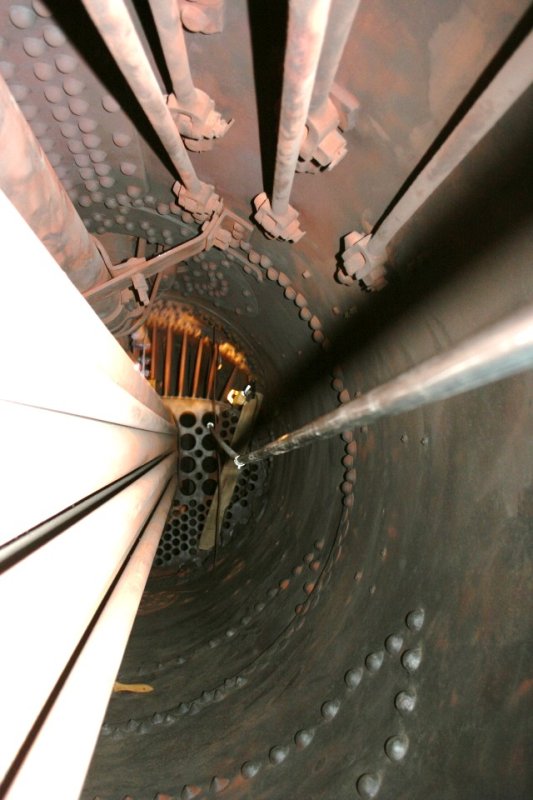
Matt spend several hours inside the boiler sweeping, shoveling and finally vacuuming the sand from the boiler barrel. There is still some more to remove from the sides and top of the firebox but the barrel itself is now clear and open again at both ends. Looking in from the front the view is open thru to the firebox again. The tubes are clear of the sand that could be seen in the views last week. The strange rod running between the tube sheets was being used to measure lengths for the super heater flues.
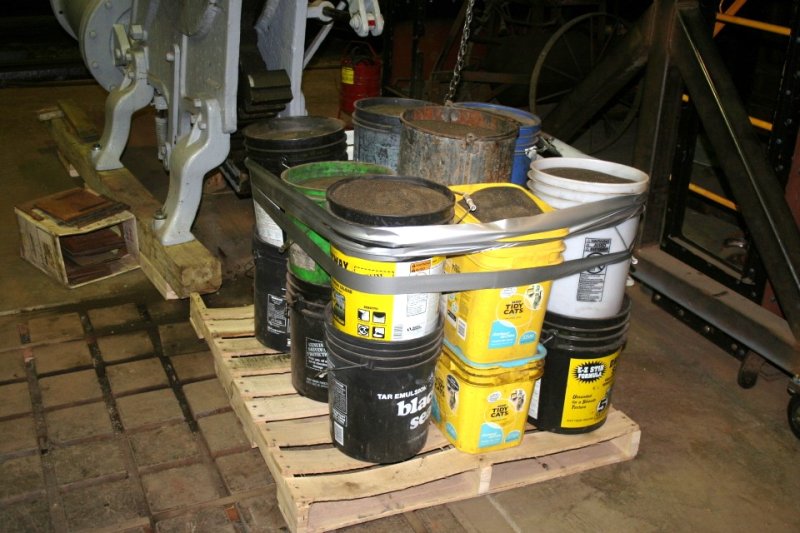
The scale of the effort over recent weeks can be judged from the medium removed. Each of these tubs is about 80 pounds and there are several more that did not fit on the pallet!. Paul, Ed and I were kept busy shifting the material that Matt pushed out while also cleaning the outside of the locomotive, tender and surrounding areas of the shop.
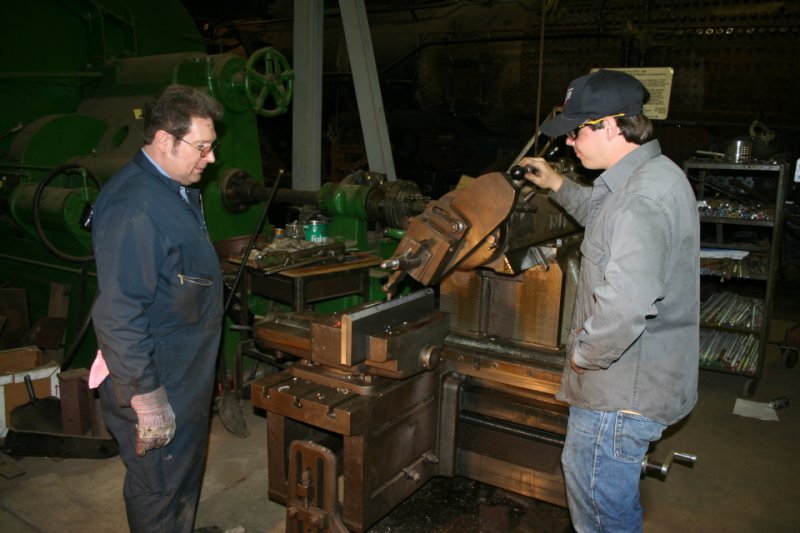
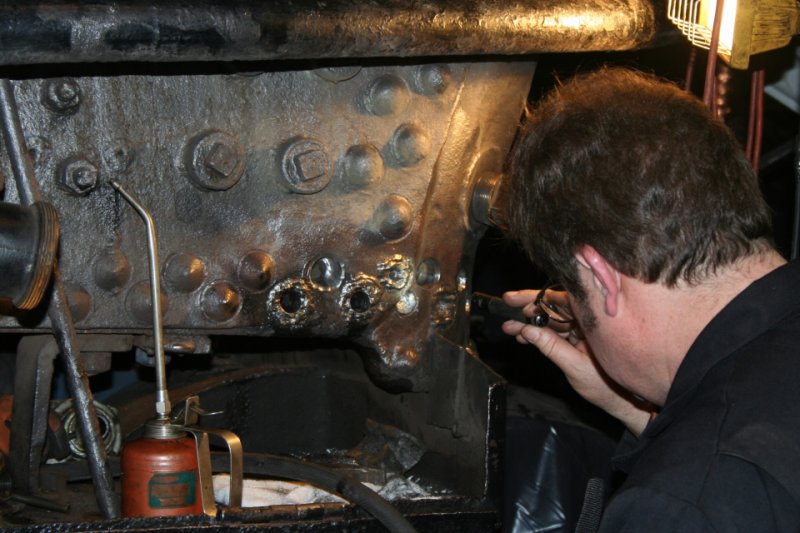
The decision was taken not to use sandblasting on the footplate. We will needle chip the back head as the effort of removing the medium would outweigh the gains of quicker cleaning. The diesel department moved the rotary snow plough from in front of the shop so, weather permitting, we are now ready to shunt outside next Saturday. The objectives then will be steam cleaning to remove any remaining residue and prepare for painting as well as lifting out the throttle valve body for lapping. We were also able to start work on preparing the super heater flues for refitting (safe ending). The preparation is complex because there are small but significant length differences between different areas of the tube sheets so the final length of individual flues will vary by about 1/2 inch. The length of each flue is currently different depending upon how much was lost in cutting each one out of the boiler. There is a limit to how long the narrow section can be so each flue must be measured to determine if it can be fitted by attaching a safe end just at the narrow end or if it must be extended at both ends. Once this is done work will begin on cutting the required extension pieces matched to each flue. After we had removed the sand blast material from the area, Mike was able to restart work on the firebox patch. Progress here will depend upon availability of our welding expert to build up the mud ring. In other areas: · Steve, Bob and Ed were working on the hydraulics that will drive the planer. This machine will significantly increase our capability to machine axle boxes and wedges, which is currently a very slow process. · Cameron was using the shaper to prepare the sections that will be used to build up the axle boxes for 428.
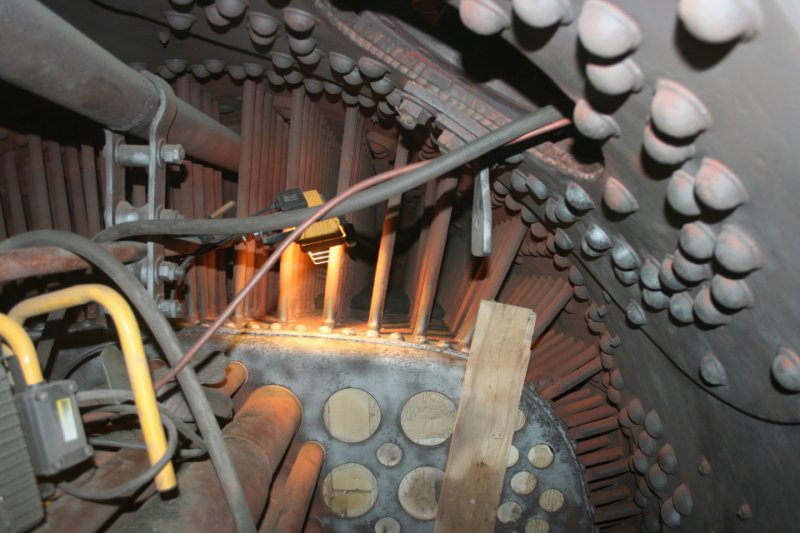
Nigel Sunday, April 1. 2012Steam Department Update 3-31-2012A rather limited turn out at the shop this Saturday with several people helping at the book store to catalog and prepare a large collection of model locomotives recently received thru a donation. However the key target on 1630 was achieved. The sand blasting of the boiler interior is now complete and a few of us were able to start removing all the ply that sealed the boiler and cleaning the dust and sand from the locomotive. Despite all the sealing the process creates a vast amount of dust and some escape of the abrasive. We now need to remove as much as possible of this from areas close to bearings etc. before we can move her outside to sand blast the back head. At that time we will aim to give her a thorough cleaning. The interior of the boiler shows the progress that has been made and also provides some unusual views of the inside of a locomotive boiler. Here you can see the top and part of the side seam of the firebox. The many long vertical and shorter horizontal stays hold the inner and outer fireboxes together. In use the inner firebox must always be completely covered by water but most of the height above the firebox crown would be steam. The water and steam are all at a pressure of 180 psi. The extensive stay system is required to hold the inner and outer firebox together against that pressure. On the left you can see one of the super heater flues and two of the smaller fire tubes that have been left in place. On the right are the holes from which other flues and fire tubes were removed to allow access to the boiler for cleaning and inspection. In this picture they are still blocked by the ply sheet used to contain the blasting abrasive but soon they will again be open to the fire space.
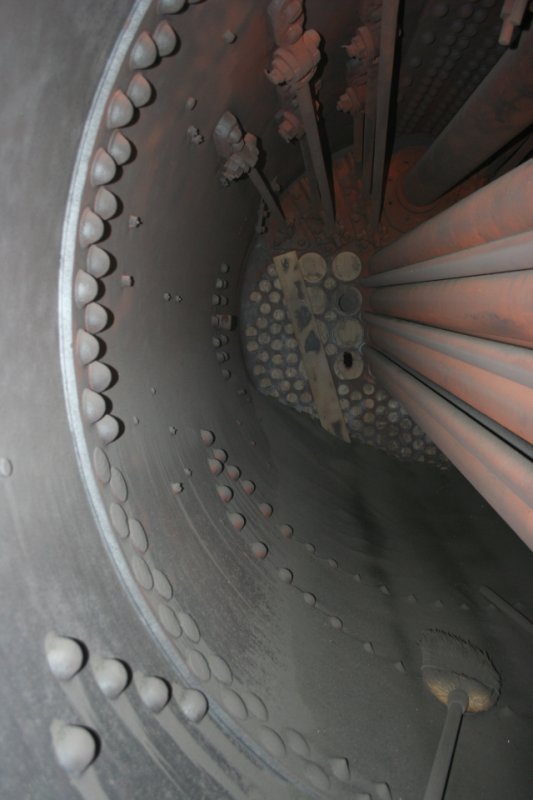
In this shot we are looking forward toward the front tube sheet. Here you can clearly see where the majority of the tubes had to be removed to allow access to the sides and bottom of the boiler and only a few remain in the center. At this point the holes were still blocked by ply sheets but, by end of day, they were again open to the smoke box. Above you can see the long braces that secure the top section of the tube sheet to the boiler barrel. Again the whole structure is built to resist a pressure of 180 psi. The tubes themselves brace the lower part of the tube sheet but above the level of the tubes (an area that would be full of steam, when in operation) the braces are required to prevent the tube sheet being pushed forward by the pressure.
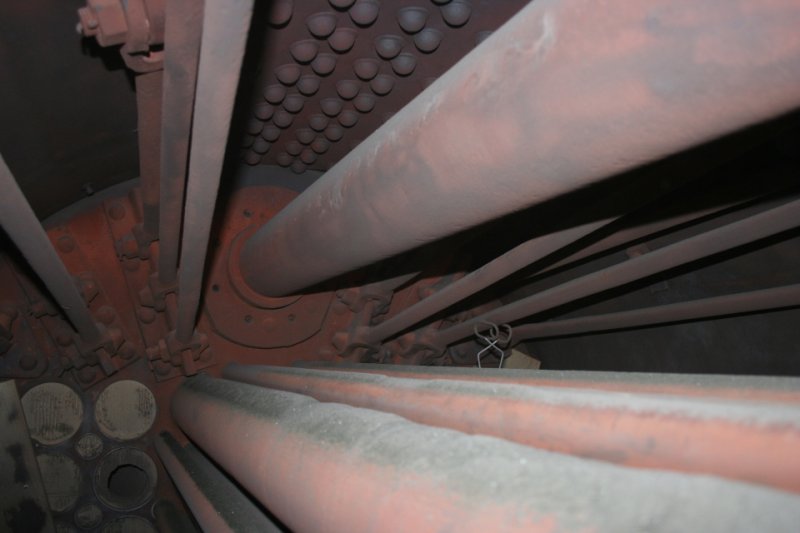
This view shows the top of the front tube sheet more closely. Here you can see the heavy attachment of the braces to the tube sheet. To understand why they are so heavy do a quick calculation. At 180psi the load on an area about 10 inches square is around one ton!!. In the center can be seen the dry pipe. This carries steam from the throttle (high in the dome) forward to the super heater header (in the smoke box on the other side of the tube sheet) and then on to the cylinders. It is called the dry pipe as the steam that it carries is now separated from the water in the main space of the boiler. This view also shows the work still to be done in removing the abrasive that still sits on top of the tubes and other surfaces within the boiler.
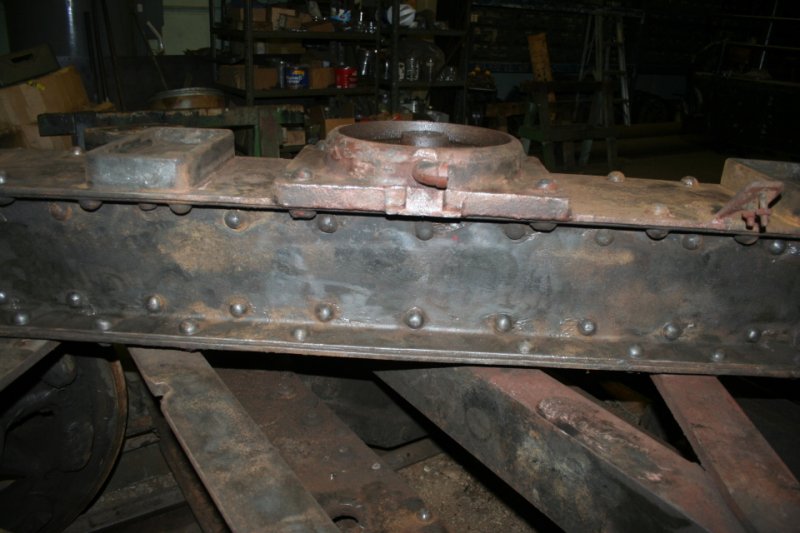
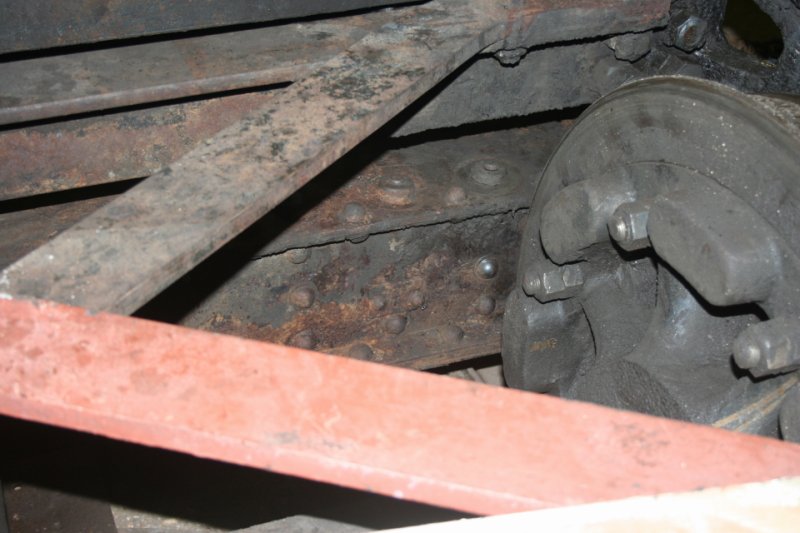
Meanwhile Paul made good progress on needle chipping and wire brushing the truck of the Shay. With the thick crud removed it can now be taken down to clean metal for final inspection and then repainting. The bolster now looks pristine after Paul's efforts.
This makes an interesting comparison to the shot of the same part 11/26 last year.
Nigel Sunday, March 25. 2012Steam Department Update 3-24-2012Hopefully this is only a partial report on progress this weekend at the steam shop. On 1630 we were not able to progress the sand blasting on Saturday as our critical volunteers (i.e. those who can fit thru the inspection hole and work inside !!) had other commitments. However, Collin and Jason are able to work Sunday so this vital job is being progressed as I write. Update - Collin and Jason did indeed make major progress on Sunday. The front of the barrel and tube sheet are now complete and the equipment moved to the rear ready to complete that end on Saturday. Good job guys. Mike and Stu made considerable progress drilling the holes for the rivets that will hold the firebox corner patch.
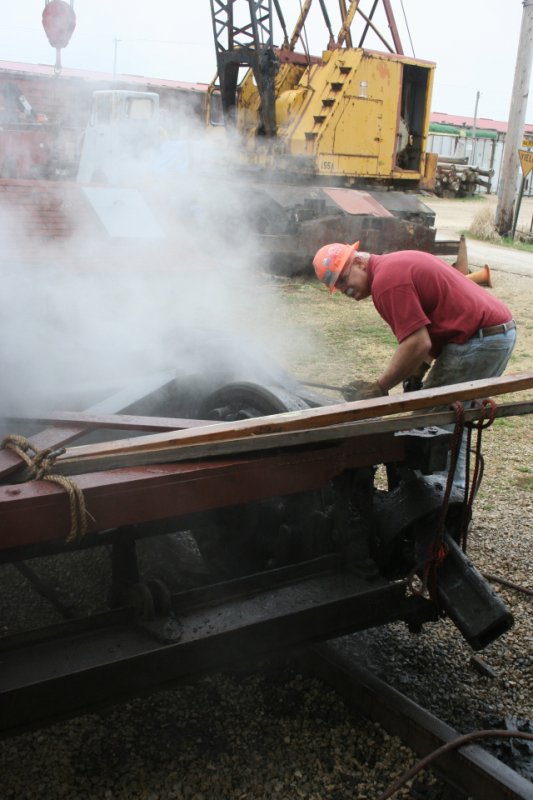
In addition we started to plan the process of safe ending and testing the super heater flues. Those of us too large to fit thru the manhole did however make substantial progress on the Shay. The truck was again shunted out of the South end and steam cleaned, first with the steam shop equipment and then using the far more powerful machine kindly loaned by the car shop. With several of us taking it in turns over about 5 hours the truck is now probably clean enough to inspect. It was an interesting job. Hard grease, softened by steam and blasted by high pressure tends to fly in all directions - including back at the operator. Cleaning yourself after several hours of this is not a trivial exercise !!.
This makes an interesting comparison to last week. Now we can now needle chip the frames for final inspection and painting.
Nigel |
Blog AdministrationCalendar
QuicksearchSyndicate This Blog |
|||||||||||||||||||||||||||||||||||||||||||||||||



Comments
Mon, 09-08-2025 08:22
Good job on the Burlington Nortern 9976. OK.
Tue, 08-12-2025 12:56
No new news that I have heard of thus far.
Tue, 08-12-2025 12:53
I'll also be doing another update on it soon. Keep en eye out for that.
Tue, 08-12-2025 12:47
A little work was done to it for Diesel Days this year. You'll see photos floating around for the temporary short term job that was done to make it [...]
Wed, 08-06-2025 13:01
Is steam car CN 15444 going to be coming to museum several times it was to be moved to muesum
Sat, 07-19-2025 18:56
Yeah, sadly it's still there as of 7/19/2025
Thu, 06-12-2025 19:14
Its been 14 years guys, where is the unit? Like really? Did you guys misplace it? Or are repairs taking that long? At this point be might we will have [...]
Wed, 04-09-2025 17:40
Jamie Thanks for the update. She's gonna shine like every thing else you guys do! Smeds
Thu, 03-06-2025 16:28
Yes, there is a wye. Those two have been MU'ed on diesel days a year or two ago.
Wed, 03-05-2025 14:04
7009 number boards look good. Is there a way to turn a locomotive around at IRM? In case you ever had a mind to connect 7009 and 6847?
Fri, 03-29-2024 21:26
We're slackers and spend more time working on the equipment in the shop than keeping all you readers updated. We'll work on it, but I'm sure updates [...]
Thu, 03-14-2024 08:02
What happened to the Department Blog? It's been over 2 years and I still regularly check for updates, but nothing comes...