| BLOG | DIRECTIONS | SCHEDULE | STORE | |
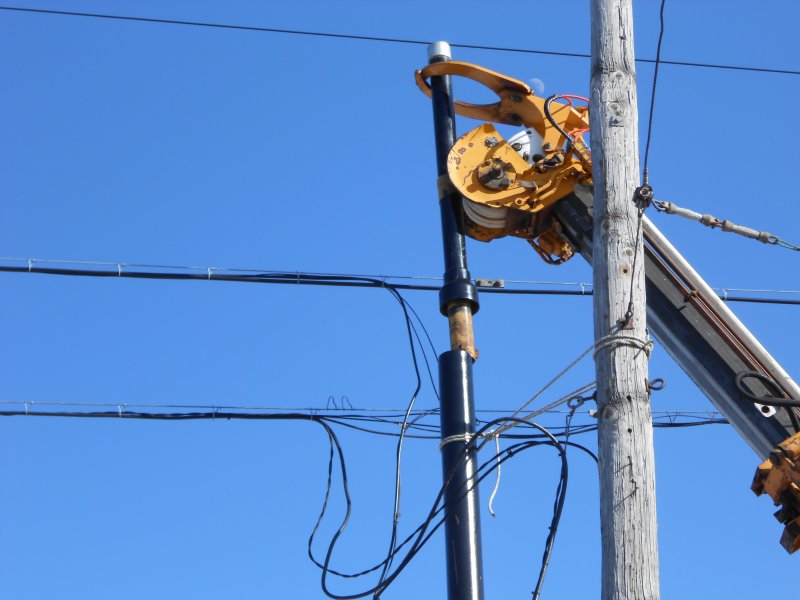
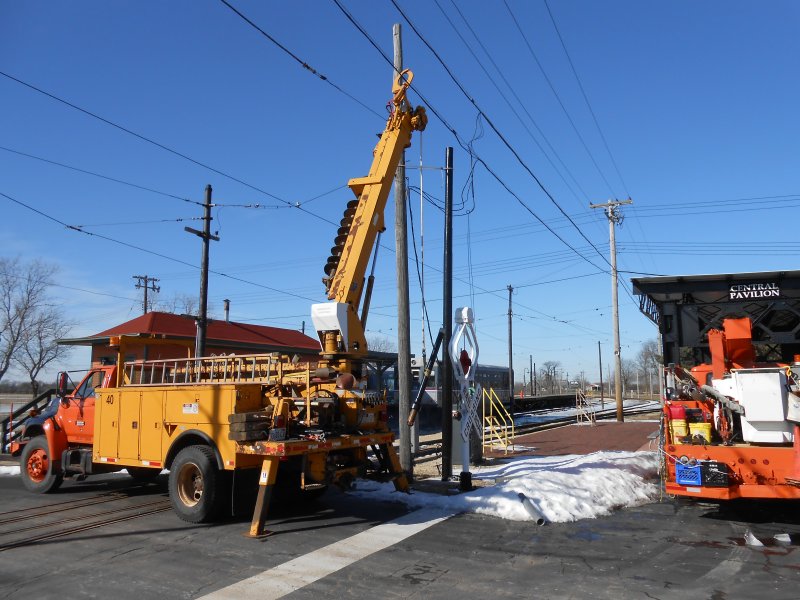
Monday, March 4. 2013NEW TROLLEY BUS LOOPConstruction of a new trolley bus turning loop has begun with the acquisition of poles from Dayton Ohio. I unloaded 12 steel strain poles Friday afternoon with the line truck. The driver was the only help available which made unloading a bit of a challenge. The assortment of poles are in excellent condition and just what are needed for the project. As the weather improves the poles will be spotted near their installation site cleaned up, painted and prepared for setting. Thanks to Doug Oaks, Nick Kallas, Dr. Henry and Randy Anderson for their help in this acquisition. Also, thank you to the doner (who will remain anonymous for now) who is making this project possible. Saturday was spent searching and gathering parts for the project. Enough 16" woodstrains were found in the storage trailer to build the curved segments required. These along with many other parts need to be reconditioned. This is good winter work. The curved segments themselves need to be "dug out" of the material yard when the snow melts and ground dries out enough to allow access. Other materials will need to be ordered. Some have long lead times. I don't expect to set poles until mid April. The local roads are now posted with weight restrictions. This will be the case until May 1st or if the ground dries out, sooner. No concrete deliveries until then. But there is lots to do in the mean time. With luck and good weather we may get this in service by July, but I could use some help if there are willing volunteers.
Monday, March 4. 2013
Winter work in the line department Posted by Max Tyms
in AC/DC Line Department at
09:44
Comments (0) Winter work in the line department
There's always something to do. Outside work on the yards project has slowed to a crawl but the parts that came down in the fall are ready to go up in the spring. It's nice and warm inside the B&G Building, no wind eather. A good place to recondition parts for the yards and build up stock.
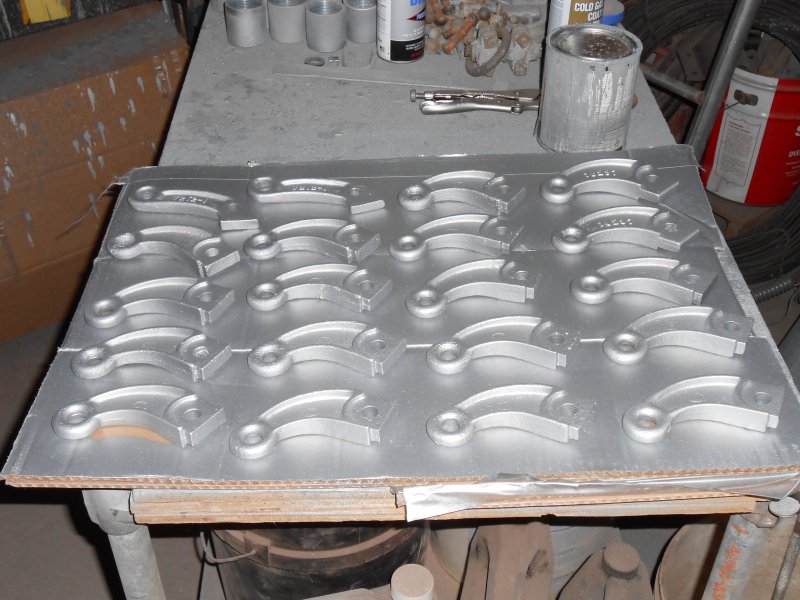
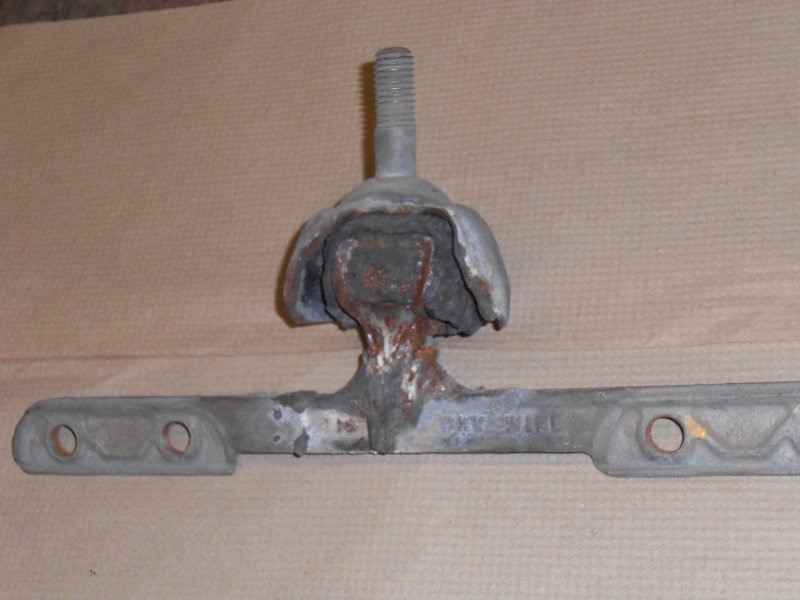
I fixed up the media blaster with a new air supply hose from the compressor. The 75 foot run was too much for the 3/8" air hose. Too much pressure loss. I doubled the size to 3/4" and that works Great! Now I can actually adjust the pressure at the blaster's regulator. It now makes quick work of rusty woodstrains. A new window and supply of window film means I could see what I'm blasting. When the weather is tolerable I work on accessible outside projects. Work continues on moving equipment to the steel pole from the rotted wood pole by the pavilion. I set the pole extension and transferred the signal and phone cables. I finally got power into the second ART TRAIN car. That initiated a new project. Replacing the old transformers by the office which are now overloaded by the addition of the 2nd ART TRAIN car and additional lighting in the car shop. In order to facilitate that future transformer replacement without an extended power outage, I need to install a secondary tie between two transformer banks. This tie will also serve as an emergency backup in the event of a transformer failure involving the office or diner annex. I had planned such a tie for years but now it's installation is necessary. Other winter work involves getting ready to do other projects. Like a new display sign near the admission booth. I want to get the platform lights on 50th ave station working this year. These will be D/C cluster lights operating off the 600v railroad traction power but with new wire. Circuits will be rewired to a safety switch on a pole outside. The old open blade 600volt fuse box will remain undisturbed as a display but will be disconnected and not functional for obvious safety reasons. There are issues with the R33 rectifier which must be repaired when the weather warms. Spring maintenance must be done on the railroad, there are several broken insulator pins and dozens of catenary hangers to replace. Jole Ahrendt (car dept.) has been busy fabricating replacement catenary hangers. I understand these are ready waiting for a warmer day.
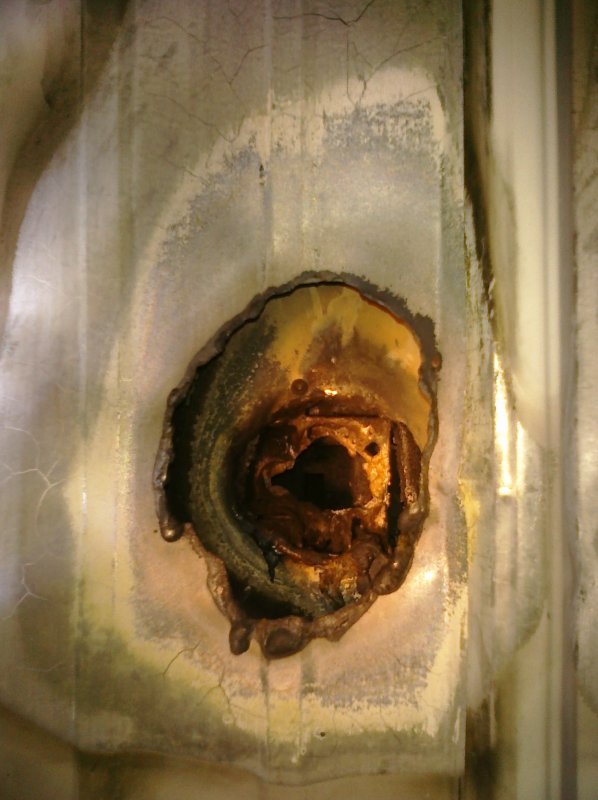
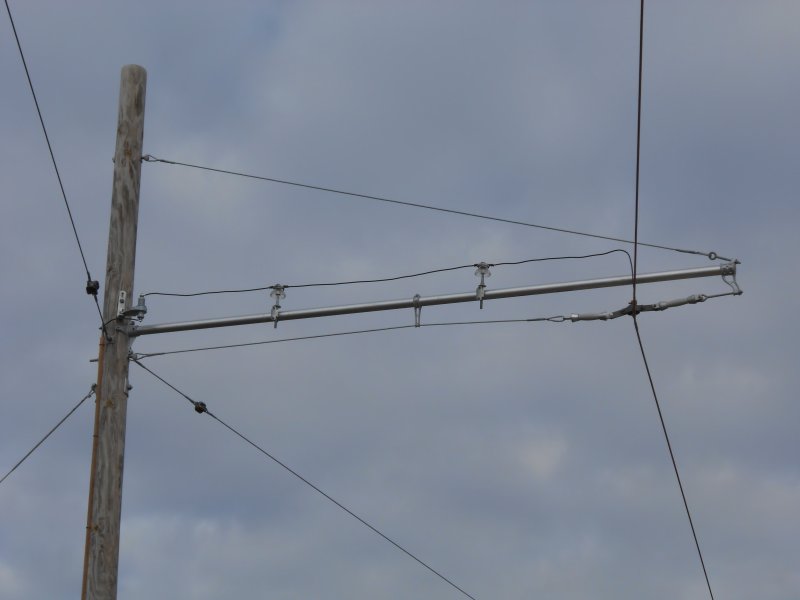
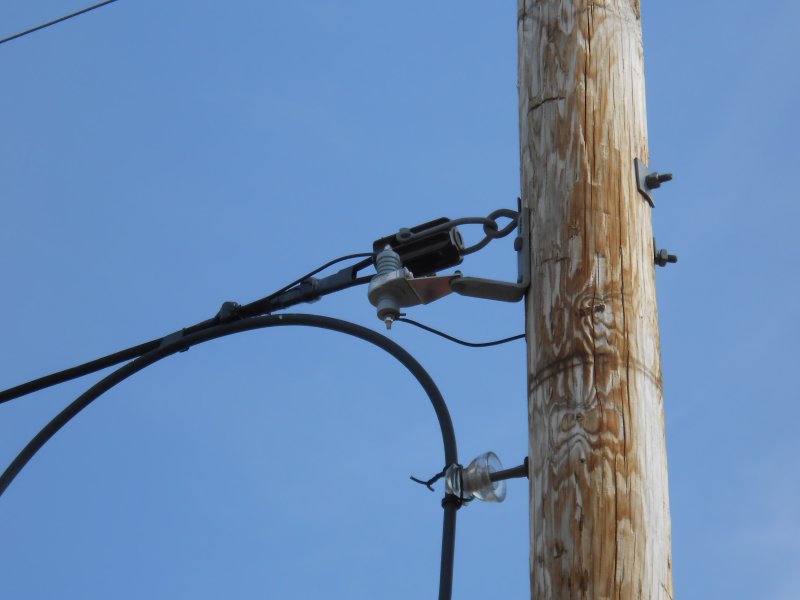
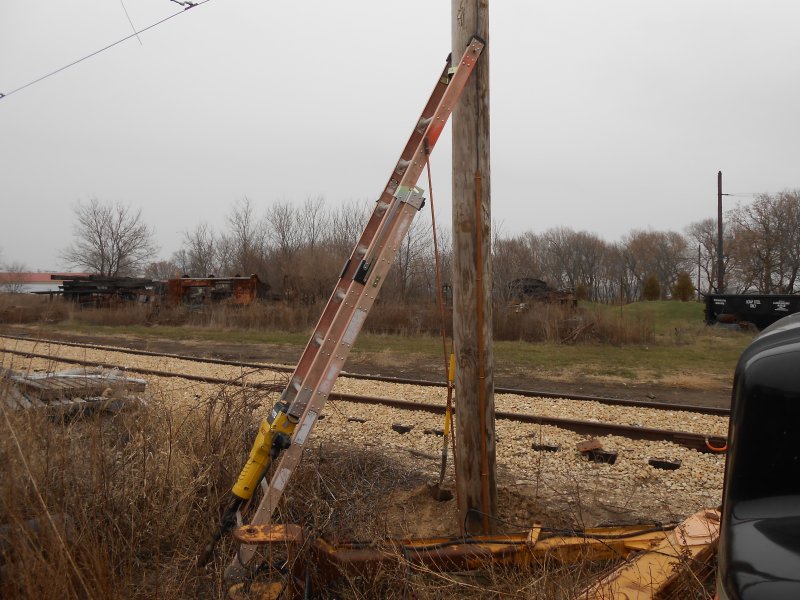
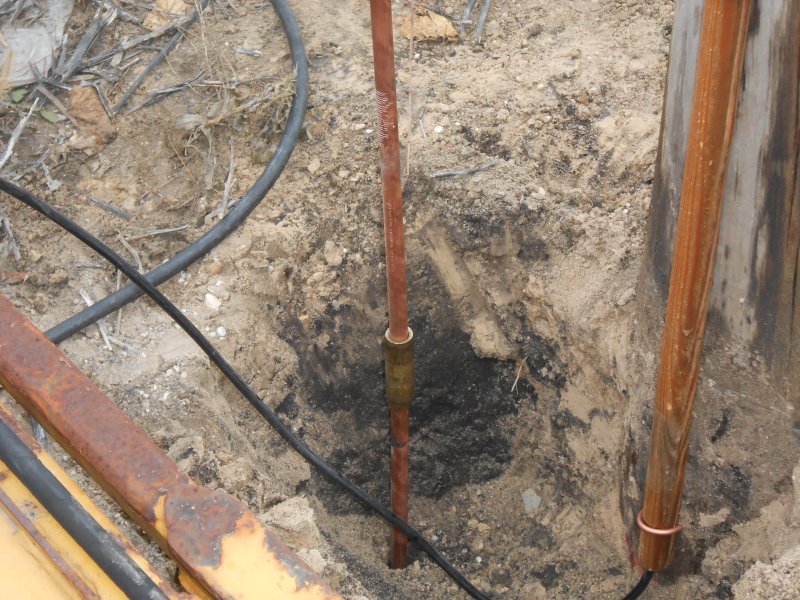
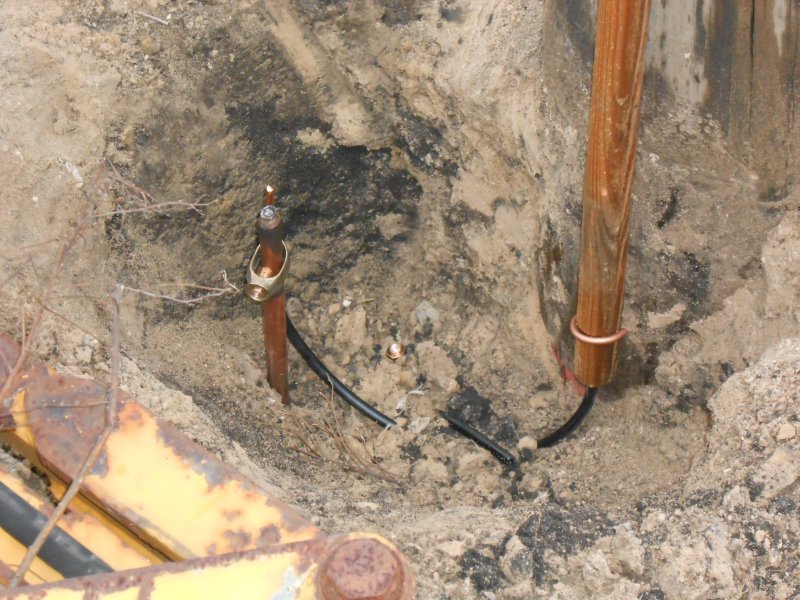
Tuesday, January 22. 2013Preventing lightning damageLightning protection is a very important aspect of an overhead traction power system. Substantial damage can occur without such protection. To avoid such damage lighting arrestors are installed at regular intervals. Arrestors are like a pressure relief valve for electricity. If the voltage (pressure) gets too high, the arrestor drains current to ground. Most damage caused by lightning is the result of it seeking a path to ground. The severe damage is the result of normal power current following the path the lightning surge created. Hole through wall of barn 8 behind traction power disconnect caused by lightning and subsiquent power arc. At IRM I use metal oxide varistar (MOV) arrestors on both the A/C and D/C systems. These provide State-of-the-art protection. The arrestors are rated for the application voltage 175 Vac, 3KV ac, 1KVdc etc. All MOV arrestors function the same way. In this story we will deal with D/C arrestors. The MOV material conducts current at high voltage and has a high insulating value at low voltage. This "discharge" voltage is dependent upon the thickness of the MOV material. The thicker the material the higher the discharge voltage. When a surge exceeding the maximum continuous operating voltage (MCOV) rating reaches the arrestor the MOV material (valve) becomes conductive and discharges the surge to ground. As soon as the surge is gone and the voltage returns to normal the valve seals and becomes insulating again. 1KV D/C lightning arrestor installed on bracket arm pole. Note use of glass insulators mounted to bracket arm to support arrestor tap. The most important part of an arrestor installation is the grounding. Grounding is simply a connection to the earth. The ground connection must provide a low resistance connection to the earth. There are many methods to accomplish this. A cable or plate can be buried or rods can be driven. Through experimentation, I have determined that four 5/8 inch by eight foot copper clad ground rods coupled together and driven to a depth of 32 feet, work best in our soil. This type of installation consistently provides a resistance of 13 ohms or less. Driving more rods to increase the depth did not lower the resistance enough to justify the effort. To drive 32 feet of ground rod I use an electric pavement breaker with a special tool bit for driving ground rods. The breaker is light enough so it can be thrown on my shoulder and carried up a ladder then placed on the ground rod. A hardened steel cap is placed on the rod to prevent "mushrooming" the end. The rod is driven, then the next rod is placed in position. The rods are connected together using a threadless coupling. The hole in the coupling is tapered so that they are wedged together tightly when pounded into the ground. A #4 solid covered copper wire is used to connect the arrestor to the ground rod. The connection at the rod is made with a special clamp called an "acorn". It has a special "torque head" bolt. The head of the bolt is designed break or shear off when tightened to a predetermined torque value. This ensures a tight tamper resistant connection. The ground wire is covered with wood molding. This protects the wire from damage and protects both linemen working on the pole and people on the ground from contacting the ground wire. groundwire connected to rod with acorn type connector. Head of bolt breaks off when proper torque is reached.
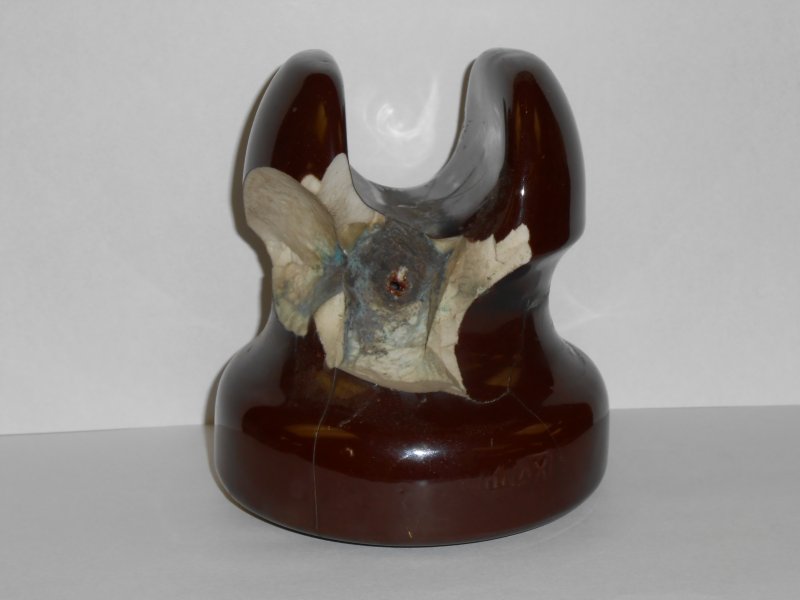
Monday, December 17. 2012LINE DEPT. UPDATE 12-17-12Friday, I installed the connector to 84 track trolley frog and removed some old span wire in yard 8. A rainy Saturday: BOD meeting, Cleaned up my area in the B&G building. Sunday brought better weather. Two poles were pulled and one installed. One pole was removed on the North side of the connector track now that new spans were installed on the new pole and trolley wire transferred to them. At the Central Ave. crossing at yards 6,7,8, one old pole was pulled on the Northeast corner and a new 30 ft class 4 pole was set on the Southeast corner. The new pole is replacing an old rotten one and will help support the crossing. Max Tyms Tuesday, December 11. 2012Connector track electrifiedTrolley wire has been installed on the connector track. This allows electric operation from barns/yards 6, 7 and 8 directly to South Junction and the carline. The zig zag moves using the tail track and crossing the Carline at the diamond with the movement against normal traffic flow can all be avoided. I know it may appear that nothing is getting done in D/C line, that is because often the work being done is invisible to the visitor. Parts need to be reconditioned. Budgets are better than what they were 30 years ago but these projects are expensive. I am running out of some parts. Projects like this one take several budget-years to accumulate materials before anything tangeble can be seen. The volunteers are spread so thin now days that I am usually working alone. I hope this "bloging" will encourage some new volunteers to A/C-D/C line. I am proud of what I get done here. Come join me. You don't need an appointment... just show up. New anchors, down guys and frog pulloffs at Central Ave. This is the main anchorage for wire in yards 7,8 and connector track. I began work on this project over two years ago when poles were set and guy anchors installed. Completion of the connector track overhead directly effects improvements to the mess of loose overhead in yards 6,7 and 8. It's all a big spiderweb of span wire, most of it not properly served. The yards 6,7,8 project is another story. Those yards are already much improved by the replacement of rotten poles and installation of several new tight cross spans. Several of these cross spans support wire on the connector track and all three yards. New anchors, down guys and several frog pulloffs were installed North of Central Ave allowing the wire in all three yards and connector track to be pulled up tight. This also straightened the "groink" in the trolley bus line at the crossing. Good tight overhead wire starts with solid anchorage. That, has been a problem. In the early days of IRM we had to "make do" with whatever materials we could procure. This often meant not too rusty second hand parts, old but still sound poles and crossarms. Occasionally, our friends at the local electric utility would "lose hardware" in the field or "clean" the storeroom and we would get some good stuff. Often we had to make do with smaller or less hefty material than what was preferred Materials we couldn't get for free we had to buy with the little money we had. We bought cheaper materials, the smallest that would do the job. Combined that with a lack of experience and you get guy anchors creeping out of the ground over time, down guys getting loose, used poles rotting. Those practices in the past resulted in loose sagging overhead today. Fortunately, thanks to our visitors and supporters IRM has grown to the point where we can afford to buy the right materials and with our dedicated volunteer we can begin fixing the problem areas. The first part of the project involved providing a good anchorage. Over a couple of years new 30 and 35 foot class 4 wood poles were purchased and installed. Some were replacing rotted poles along the South side of yard 8. Wherever poles were replaced that required guying, new anchors and down guys were also installed. The typical guy installation consists of a 4" square curved washer, 3/4" machine bolt, a guy hook (hog ear) with lag, 5/16" EHS galvanized guy wire, 1 porcelain strain insulator(johnney ball), 5/8"x7' anchor rod with thimbleye nut and a single 8" anchor helix. Attachment to the anchor is made with 2 three bolt clamps( this allows future adjustment). Attachment to the hog ear and johnney ball are made with preformed deadends. Normally, guy and span wire attachments to insulators and hardware,here at IRM, are made by the serving method using softer Siemens Martin grade wire. This is in keeping with our desire to maintain a historical motife. Experience has shown that down guys here at IRM are subject to such abuse that the strength of EHS wire is necessary. EHS wire is too stiff to be served so, preformed deadends or guy clamps are used. A fullround steel guy guard is attached at the ground end to both protect the guy from damage and make the guy wire more visible to pedestrians. At the South end of the track was a slight curve. Span wire was installed between three poles on the outside of the curve this is the "backbone" for pulloffs which guide the trolley wire around the curve. Four bracket arms were installed on the new 35 foot poles. 4/0 grooved hard drawn copper trolley wire was pulled in and tied off. A new trolley frog and section insulator were cut in on the carline at the South end of the first "S" curve. The new trolley wire was deadended on the section insulator. Now the new trolley wire could be pulled up close to sag and tied off at the North end. Before the wire could be brought up to full tension, the pulloffs on the curve had to be installed and pulled up to near final position. Also, the track 83 trolley frog had to be removed so that a section of the track 84 wire could be unspliced and swung over to the connector track. Doing this would avoid having to make several splices. With the former track 84 wire over the connector track, the new wire could be sucked up to final sag and spliced together thus energizing the new wire. Next the pulloffs on the curve were adjusted to their final position and all spans were served up permanent. The last thing to do was clip the tangent poles allowing the track to be put into service.
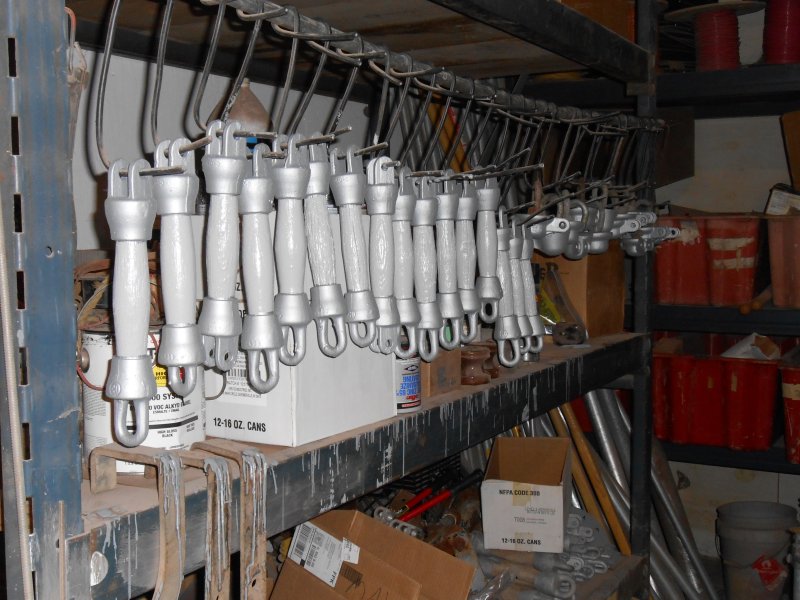
Saturday, December 8. 2012Serving spanwire, part 1NO! this is not a recipe for Christmas dinner. The skills and knowledge used to build trolley overhead are being lost to time, especially the historic methods. In an effort to preserve these methods and possibly bring some youthful new volunteers to IRM's Line Department, I present a series of "how It's done" stories. It combines My experience in over 40 years of linework, what I learned from my predecessors at IRM, what I learned from talking to "old timers" that actual built the stuff and from my own research. The methods I describe are NOT the only correct ways to do it. There are many variations. These methods are how I do it at IRM. They are standards that work best at IRM. Serving is a term given to a method of dead ending or attaching wire to hardware and insulators where the wire is formed in a loop or eye and each strand is then separately wrapped back around the wire. This method can be used on copper or aluminum conductor or steel strand ( span wire). It can also be used to splice wire. The only requirements are that the material is soft and malleable enough to be bent around itself without breaking and you have the time to do all that wrapping. Serving has lost it's preference because newer high strength wires are harder and break when bent sharply. But mainly because clamps, preforms and automatic dead ends are faster. If your paying for time, buying and using those devices are cheaper than labor intensive serving. To complete a served attachment takes about 10 to 20 minutes. A served attachment works like "chinese fingers". The wire is passed around the attachment and brought back on itself , then each strand is tightly wrapped back around the wire and remaining strands from 4 to7 times( IRM standard is 6 wraps). This is repeated until all the strands are wrapped. When tension is applied the wraps will cock and grip the wire tightly. The harder the pull the tighter the grip. If not done correctly the serve will slip and choke up. If on hardware this will cause the wire to become slack. if on a johnney ball, not only will the wire become slack but the insulator will twist and may break. You begin the attachment by forming a U in the wire. The tail should be at least 18" long. About 4" down from the U both legs are bent outward slightly. The wire is now slid into the hardware. Now you need to secure the assembly. Bolt the hardware to the pole or your helper can hold it. Since I don't have a helper, I use a vise. Unwrap one strand to the center of the slight bend. The best strand to choose is the one that will be on the outside of the loop at the slight bend. With pliers, grasp the wire in the jaws including the strand you just unwrapped. Sharply bend the strand until it is perpendicular to the wire, the base should be in the center of the slight bend. Grasp the strand with pliers and using the wire as a pivot pull the strand around the wire and remaining strands bringing all tightly together. Go clockwise or with the lay of the strands. Hold the strand with one hand so it doesn't unwrap. Reposition the pliers so the strand is in the cutting knives with the nose of the pliers against the wire at the base of the strand. Control the "squeeze" on the handles. You want to grip the strand not cut it. The first few times you do this you WILL cut the strand. We all did. You need to practice then you'll get the feel for it. After a hundred or so serves you'll be fine. Push the pliers clockwise controlling the squeeze and cinch up the strand tightly around the wire and remaining strands. Continue wrapping and cinching untill 6 wraps are done. Do not take the pliers off or release pressure until all 6 wraps are done. When you get to the 6th wrap stop and nick the strand with the pliers. Continue into the 7th wrap. The strand will break off at the nick. Unrap the next strand. You want the one that butts up to the end of the first one. Bend this one perpendicular to the wire with a sharp bend at the base. Tapping with pliers helps make a sharp bend. With the second strand positioned in the plier cutting knives, wrap and cinch 6 turns. Remember to control the squeeze. Nick and break after 6 wraps. Repete the wrapping with the remaining strands. Your done! This takes lots of practice. Guys that are really good can wrap two strands at once. Thursday, December 6. 2012Reconditioning overhead partsIRM has accumulated overhead parts from everywhere over the years. A small amount are old but never used but most are old used parts. Many are styles that are no longer made and therefore have historical value. A good example are wood strain insulators (wood strains). This is one item we have in abundance, in varying conditions from never installed-still-in-the-box to outside rotting in a barrel. Wood strains are insulating tension members installed in span wire to electrically insulate two sections of span wire or hardware and span wire. They are also used as insulation between pieces of hardware and in specialwork. They come in various sizes, lengths and end fitting configurations. The typical woodstrain is made of a section of turned hardwood rod with a mallable iron end fitting crimped on each end (eye-eye, clevis-eye etc.). The modern equivelant uses fiberglass rod instead of wood. Because of the wood which will rot, woodstrains are a high maintenance item. Because of this, my policy is to recondition used woodstrains before putting them in service. I have spent many weeks reconditioning parts to build up an inventory. First, they are stripped of bolts, pins and wire. Then, they are inspected for soundness. After passing inspection the metal ends are sand blasted to white metal. The wood is lightly sand blasted to remove loose paint and foreign matter. After another inspection, the end fittings are dipped in cold galvanizing compound and allowed to dry. One end must be dry before dipping the other end. Next, two coats of grey oil base house paint are applied to the wood. Once the paint has thoroughly dried the metal ends are given a final dip in galva-bright. Now they not only look like(better than) new, but will last for years. This process takes six days per batch (20-25 pcs). Other parts are reconditioned in a similar fashion. Round top and pulloff hangers that have durego or composition insulation have the exposed insulation sand blasted and are given one coat of insulating varnish. These are also dielectric tested to ensure insulation integrity. |
Blog AdministrationFind us on FacebookCategory TreeCalendarQuicksearchArchivesSyndicate This Blog |
Powered by s9y.
Comments
Sun, 05-19-2013 22:13
Hello again. I had an idea that was (somewhat rudely, mid-sentence) dismissed in talking to a museum volunteer a few years back, but here it goes [...]
Thu, 05-16-2013 21:52
Looking good Bob! I hope to come out soon once I'm done with school.
Wed, 05-15-2013 21:28
I was not around at the time. General discussion suggests that it was "pretty marginal" in a number of areas. Nigel
Mon, 05-13-2013 11:08
"THUMBS UP!"
Fri, 05-10-2013 02:15
No, it will not be necessary to hold any of the work waiting for the plow to be turned, end for end. Weather will be the major factor, but there will [...]
Thu, 05-09-2013 19:54
The CGW X-38 plow is really coming to life. Bob Kutella and Vic and crew need to be very proud of your collective efforts. I am very appreciative of [...]
Thu, 05-09-2013 15:20
The snowplow looks great! Are you going to apply the door and upper windows befor it is turned to continue work?
Thu, 05-09-2013 09:09
Max, Is there any progress to report yet, in regards to the installation of the poles and overhead wires? Have a good day, sir.
Wed, 05-08-2013 18:40
Thanks for the update! I still don't understand why Commonwealth #5 was removed from service. Do you know why?
Tue, 05-07-2013 09:28
Mr. Kolanowski.....I was just wondering if the Spaulding webcam will be up and running soon for us stay-at-homes. Thanks!2FP
Mon, 05-06-2013 23:04
Max, Has work begun yet on the construction phase of erecting the poles and putting up the wire? Wish I could be there to watch it happen.
Mon, 05-06-2013 23:02
Keep up the good work, Bob. Wish I could be there to help!!!!!!!