

|
|
Sunday, November 20. 2011Steam Department Update 11-19-2011Two good weekends of progress since the last update. While I was not at Union on 11/14 at least I had a chance to see working steam.  When can we have one? This is a 1934 Stanier mogul built by the UK London Midland & Scottish Railway in the UK and one of 2 locomotives running 11/14 on the Severn Valley Railway. A very interesting comparison to our #26. She looks a lot smaller but this is actually due to the height restriction (12ft 6in vs 14ft). Actually she has a slightly greater tractive effort despite bigger wheels and a fairly advanced superheated boiler for a substantially better continuous horsepower. On 1630 we are now hopefully reaching the end of the "destructive" phase. Eric, Collin and Jason have established a good technique for knocking out the ends of both the small tubes and now the larger superheater flues. The large ones were really tough as the metal is thicker so hammering on its own does not collapse them. Careful grinding is needed to weaken the ring before hammering will work. Great care is needed to avoid damage to the tubesheets. Anyway, they have the process refined to the point that the ends are popping out fast now. The front tubesheet is now clear of all cut ends, large and small, while a substantial number of both types were removed from the back sheet yesterday - no photographs of the back tubesheet, your scribe was too stiff and lacking in dedication to crawl into the firebox with a camera at the end of day!!. Interesting to compare the view now with that a few weeks ago. All the ends are now gone. A small number of flues and smaller tubes can be seen still in place in the center. It is hoped that the inspection can be completed without removing these.  Front sheet now clear Every one of these was hammered out by the guys using an air hammer inside the boiler ... and this is by no means all of them as the pile would have blocked the lower holes.  Result of a lot of work Brian did a great job cleaning off the last of the rust and insulation from the back head so we are now ready to start the thickness testing. 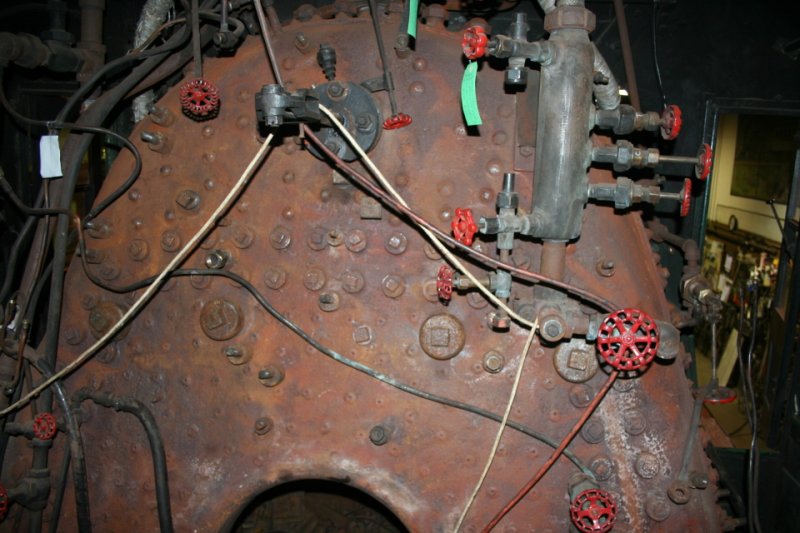 Ready for testing Just to remind ourselves what has been achieved. This is the same area as it was (and what we have to reconstruct !!)  Before stripping and after removing the cladding and insulation.  Stage 1 Mike, Bob, Ralph and others have continued the painful process of driving out the rivets to allow the firebox corner patch to be fitted. They are now working on the last one. Bet they are going to be real dissappointed when there are no more of these to do !!. Cameron and Brian did a difficult but essential job that had become urgent. With winter approaching it is essential that there is no water in the super heater elements now stored in the box car that could freeze and crack the element. The shape of these elements (16 feet long with each tube bent to make 4 passes along this length) makes it very difficult to get water out. So each one had to be man handled and blown thru with compressed air. Good job guys! We are now starting to set up tasks to prepare for the reassembly. The actual assembly is some way out but we want to ensure that parts are ready ahead of time where we can. One major job is "swaging" (shrinking the diameter) of the new tubes at the firebox end ready to fit when we start to retube the boiler. This means setting up a production area where the ends of 200+ tubes can be heated to red heat then quickly put into the swager where a compressed air cylinder shrinks the end of the tube against a die to the correct size. Substantial progress has been made in clearing the area at the South end of the shop for the swager and furnace to be mounted in the next couple of weeks. 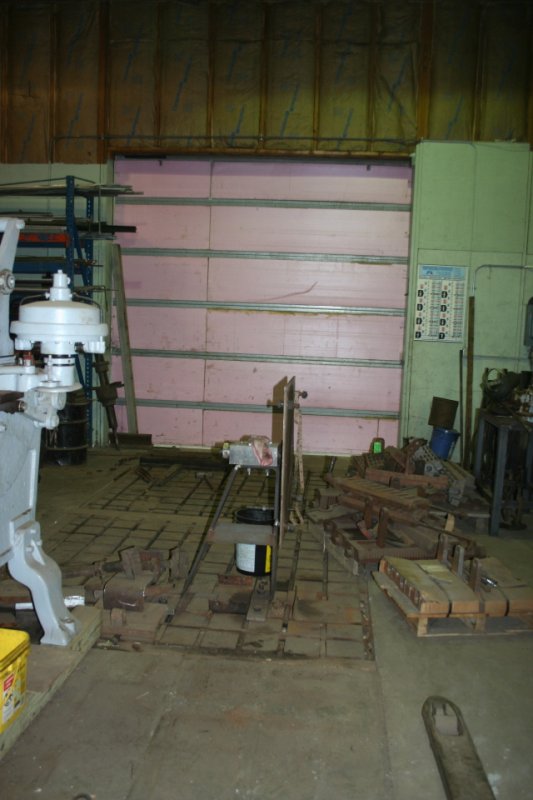 Swaging area under construction The pallets are ready for Jeff to move out to the boxcar on Sunday and then we can think about setting up the swager.  So this is a swager Hopefully before too long we can demonstrate what this does!. There has also been major progress on the Shay. Last weekend Tom and the team achieved what has been the target for quite some time, jacked the front of the loco and pulled out the truck. So yesterday it stood with a large gap where the front truck fits.  Think something is missing ! The truck now sits in front of the locomotive and work has now started on cleaning it to allow the bolster to be removed and the springs to be accessed.  Working on the truck This gives a good idea of how the Shay is constructed. The front of the locomotive sits only on the bearing in the "cup" that can be seen in the middle of the bolster at center of the truck. The weight is transfered from the bolster to the frame and wheels by the springs that are currently hidden under the bolster. Altogether a good couple of weeks progress. Nigel Comments
Display comments as
(Linear | Threaded)
Add Comment
|
Blog AdministrationCalendar
QuicksearchComments about Illinois Central Gulf 2002, a Paducah SD20 Tue, 06-02-2026 19:38 Always a treat when a new diesel comes to IRM! Only wish we'd get more diesel department news from week to week, I always wonder what's going on in [...] about Indoor storage after Barn 15 completion Wed, 03-25-2026 18:21 Exciting to see a new barn going up! What's next, after the RAIL project is complete? about New Acquisation: What is CN 15444? Tue, 08-12-2025 12:56 No new news that I have heard of thus far. about Burlington Northern 9908 body work Tue, 08-12-2025 12:53 I'll also be doing another update on it soon. Keep en eye out for that. about Burlington Northern 9908 body work Tue, 08-12-2025 12:47 A little work was done to it for Diesel Days this year. You'll see photos floating around for the temporary short term job that was done to make it [...] about New Acquisation: What is CN 15444? Wed, 08-06-2025 13:01 Is steam car CN 15444 going to be coming to museum several times it was to be moved to muesum about New Acquisation: What is CN 15444? Sat, 07-19-2025 18:56 Yeah, sadly it's still there as of 7/19/2025 about Burlington Northern 9908 body work Thu, 06-12-2025 19:14 Its been 14 years guys, where is the unit? Like really? Did you guys misplace it? Or are repairs taking that long? At this point be might we will have [...] about Milwaukee Road 33C update 3/23/2020 Wed, 04-09-2025 17:40 Jamie Thanks for the update. She's gonna shine like every thing else you guys do! Smeds about Diesel Shop update 3/5/2025 Thu, 03-06-2025 16:28 Yes, there is a wye. Those two have been MU'ed on diesel days a year or two ago. Syndicate This Blog |
|||||||||||||||||||||||||||||||||||||||||||||||||

