|
|
Sunday, July 21. 2013Steam Department Update 07-20-2013
It has been a really busy week for me at the museum hence a
rather late blog update!!.
I spent Wednesday at the steam shop with Phil and Ed. The main focus was on sealing all significant leaks at the tube ends that showed when the boiler was filled with water. By end of Wednesday we were to the point that , when filled well above the crown sheet, we had only minor dribbles and drips.
Saturday was a normal and fairly successful work day at the shop and Sunday I spent working with the Jim West and the Operations Department on switching for the Diesel Days event. So the blog is a little late this week !.
So what happened Saturday at the steam shop?. Overall a great deal was achieved although there was one set back which meant that we were not able to get as far as our most ambitious targets.
On 1630 I guess I had better try to answer one question I was asked a lot at the event on Sunday - when will you be hydro-testing the boiler?. The answer has to depend upon what exactly you mean by hydro-testing. As the pre-requisite for moving on the steam testing we must demonstrate that the boiler can be pressured using heated water to 125% of operating pressure (so 225 p.s.i. in our case) and sustain that pressure with minimal leakage for a period. Our current expectation is to reach that point in about 3 weeks. However our path to that involves using water, at first simply filling the boiler, then applying increasing pressure to identify and test the correction of any leakage. This is the process that we are currently following. On Saturday our objective was to finally seal any leakage at the tube ends on simply filling the boiler and then seal the boiler to allow some pressure to be applied.
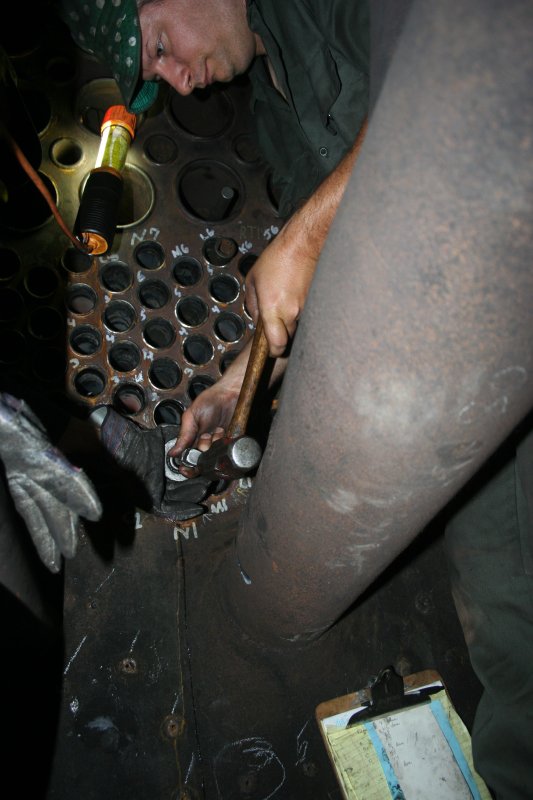
· Following on from the work that Phil and I did on Wednesday, a team including Phil, Collin, Eric and Sean took it in turns to identify and seal the last little leaks that showed by carefully rolling the identified tube ends slightly more. This was hard and tedious work but, by early afternoon, the tube ends appeared to be dry with the boiler full of water.
· Dennis annealed the copper sealing rings for the two covers.
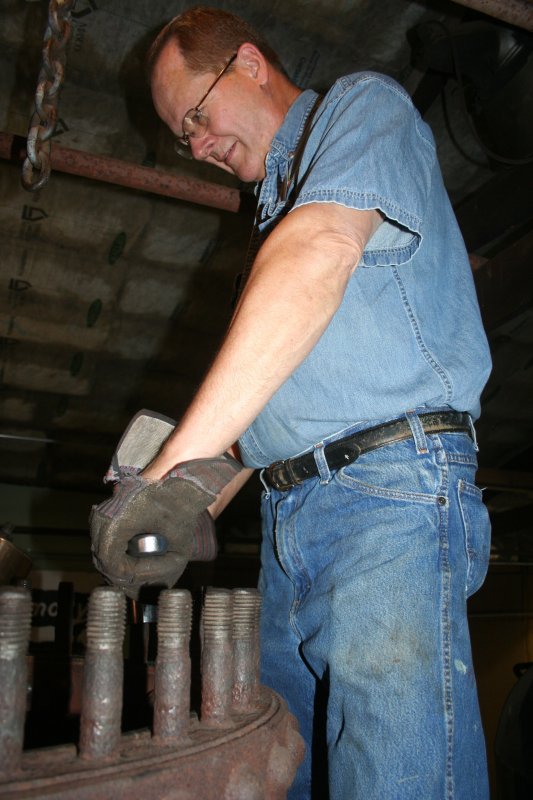
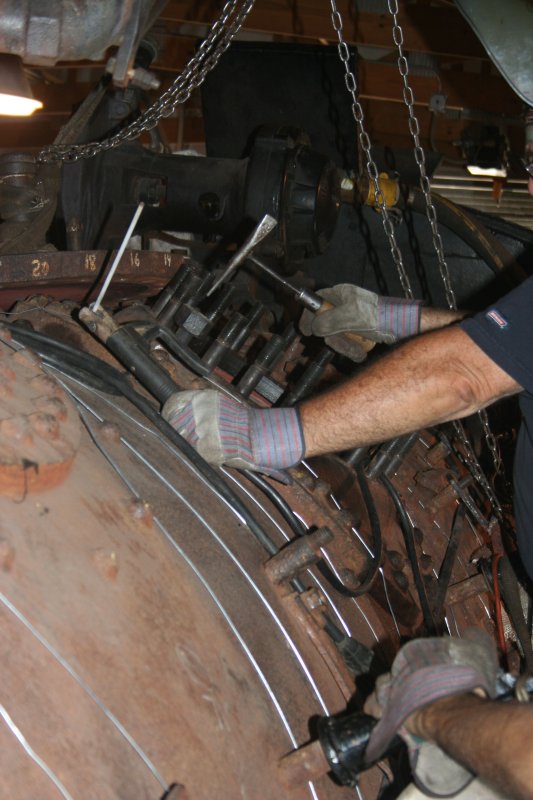
· In parallel with this one team worked on cleaning the threads of the studs that attach the dome cover and another on fitting the cover of the inspection hatch. These are the last two components required to seal the boiler and allow pressure to be applied.
· All seemed to be going well until one of the studs securing the inspection hatch sheared off during tightening.
Luckily everything seems to be shaping up well on replacing the stud. Dennis was in the shop and did a great job of welding a nut onto the broken stud and, to our great relief, this stood up to several of us pulling on a large wrench and the stud unscrewed from the seating. In this view you can see the broken stud with the nut welded onto it.
This was very good news as the alternative, had it failed to extract, would have been to grind it flush and drill it out, potentially a day's work. The studs screwing into a boiler are quite unusual. The thread into the seating is tapered and must be specially machined. However, by end of day, Tom, Cameron and Bob had substantially machined the new stud and, when I dropped by on Sunday, work was progressing. We should have it replaced ready to fit the cover next weekend.
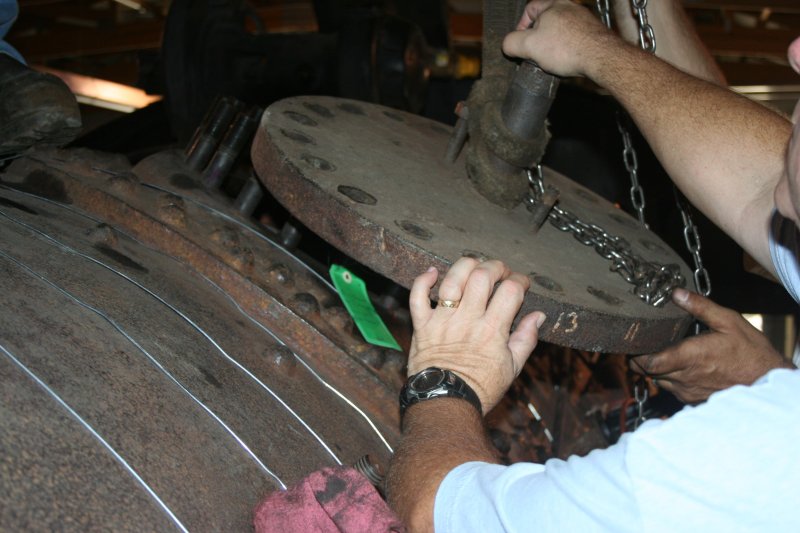
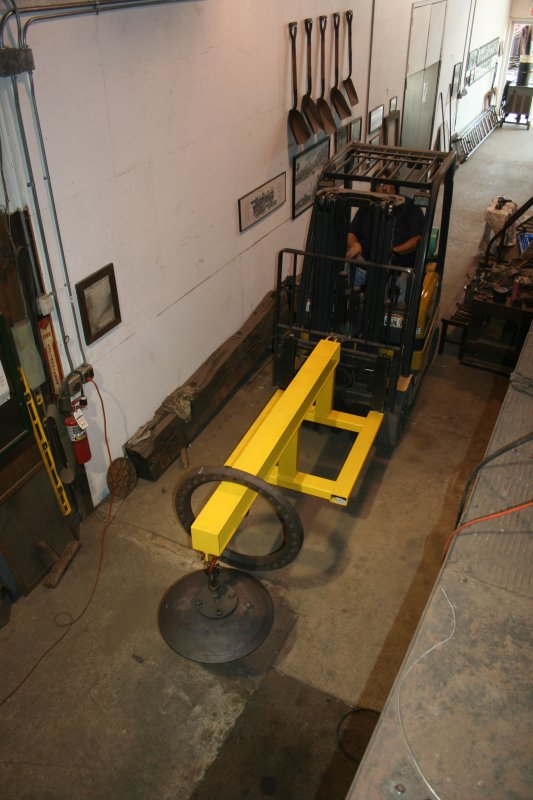
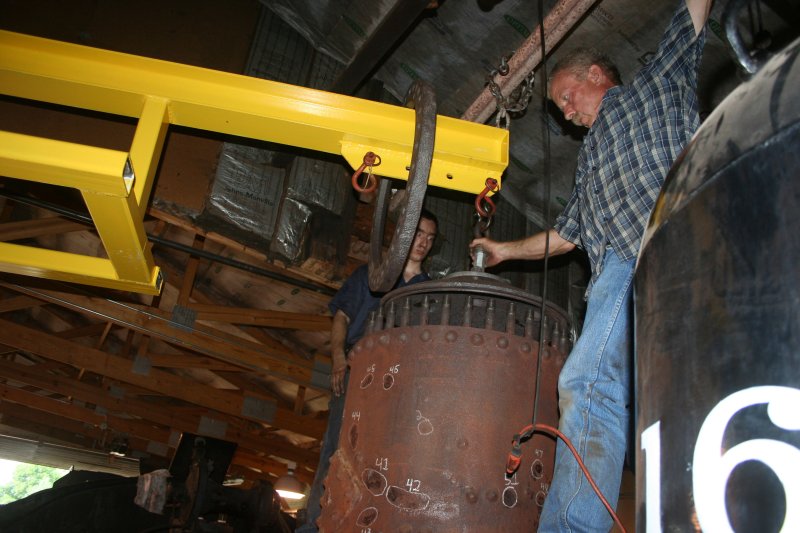
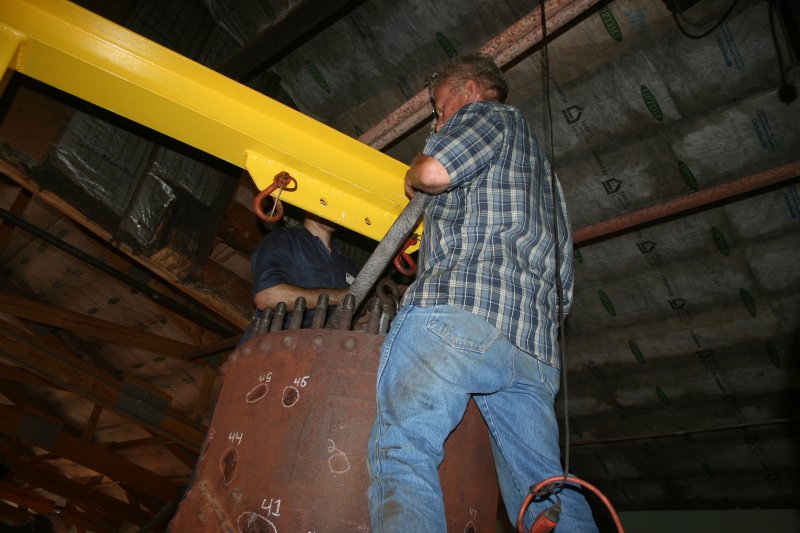
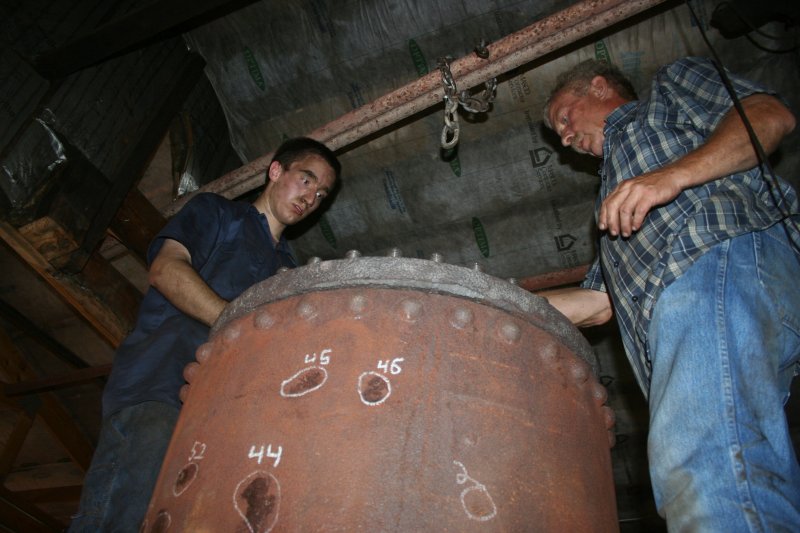
· With the stud out, work focused on fitting the dome cover. This was the first time that we had used the new boom for the forklift, which was made with this type of lift in mind. It was highly successful. The cover was lifted by the forklift in the shop and placed fairly easily.
It was then tightened down without issue. This was a great deal easier than the previous method that required the locomotive to be pulled outside to use the boom truck to place the cover.
· Jason tested the remaining gauges, which all proved to be accurate, so these are now ready for refitting.
· Jane finished stripping the air tanks. These are now ready for painting.
· With Jim West's assistance we refilled the milk car so should now have a water supply sufficient to support testing under pressure. We have now run about 9000 gallons of water thru the boiler which should have removed most of the debris from sand blasting. From now on we should be able to re-circulate the water.
In other areas:
· Stu and Bob ran the wiring for the planer. The one remaining requirement is to locate a breaker to fit our old style supply panel.
· Dennis was rebuilding the damaged grease keeps for the axle boxes on #428.
So a lot was achieved this week. Hopefully next weekend we should be able to fit the inspection hatch and start testing under pressure.
Nigel
Comments
Display comments as
(Linear | Threaded)
Hi, I'm new to the area and plan on making a visit during labor day weekend in the hopes that I'll get to see some steam. Do you have any updates on what steam, if anything, should be operating? Thanks.
#1
James M.
on
2013-07-23 14:08
(Reply)
My understanding is that two visiting steam locomotives are scheduled for the event at Labor Day weekend. One is Leviathan the other I believe is a tank engine.
Nigel
#1.1
Nigel Bennett
on
2013-07-25 19:17
(Reply)
Will 1630 run for the 60th anniversary
#2
Andrew Ossler
on
2013-07-26 13:23
(Reply)
Nigel has stated that the steam department is trying to get 1630 steaming in 2013 but the timeline isn't very clear at this point. Hopefully yes, realistically iffy for the 60th.
#2.1
NICK
on
2013-07-27 09:16
(Reply)
Nick,
Could not put it better myself. Thank you.
Nigel
#2.1.1
Nigel Bennett
on
2013-07-29 15:39
(Reply)
Add Comment
|
Blog AdministrationCalendar
QuicksearchComments about Illinois Central Gulf 2002, a Paducah SD20 Tue, 06-02-2026 19:38 Always a treat when a new diesel comes to IRM! Only wish we'd get more diesel department news from week to week, I always wonder what's going on in [...] about Indoor storage after Barn 15 completion Wed, 03-25-2026 18:21 Exciting to see a new barn going up! What's next, after the RAIL project is complete? about New Acquisation: What is CN 15444? Tue, 08-12-2025 12:56 No new news that I have heard of thus far. about Burlington Northern 9908 body work Tue, 08-12-2025 12:53 I'll also be doing another update on it soon. Keep en eye out for that. about Burlington Northern 9908 body work Tue, 08-12-2025 12:47 A little work was done to it for Diesel Days this year. You'll see photos floating around for the temporary short term job that was done to make it [...] about New Acquisation: What is CN 15444? Wed, 08-06-2025 13:01 Is steam car CN 15444 going to be coming to museum several times it was to be moved to muesum about New Acquisation: What is CN 15444? Sat, 07-19-2025 18:56 Yeah, sadly it's still there as of 7/19/2025 about Burlington Northern 9908 body work Thu, 06-12-2025 19:14 Its been 14 years guys, where is the unit? Like really? Did you guys misplace it? Or are repairs taking that long? At this point be might we will have [...] about Milwaukee Road 33C update 3/23/2020 Wed, 04-09-2025 17:40 Jamie Thanks for the update. She's gonna shine like every thing else you guys do! Smeds about Diesel Shop update 3/5/2025 Thu, 03-06-2025 16:28 Yes, there is a wye. Those two have been MU'ed on diesel days a year or two ago. Syndicate This Blog |
|||||||||||||||||||||||||||||||||||||||||||||||||