

|
|
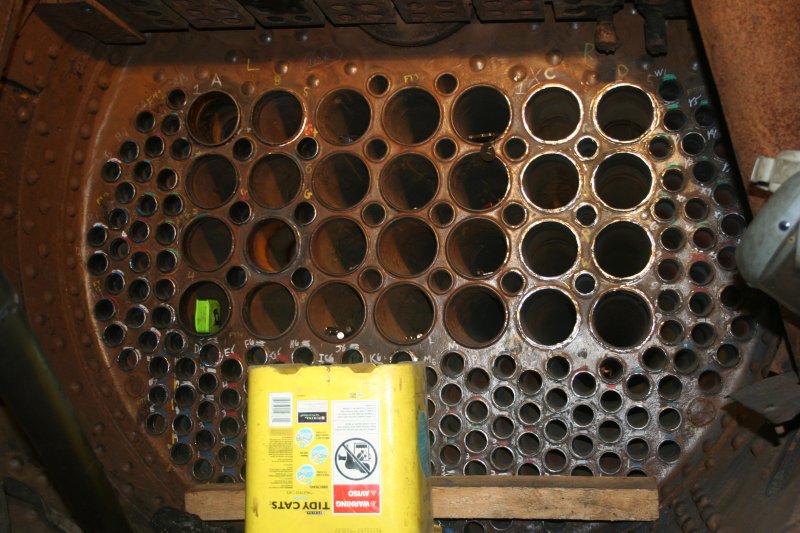
Sunday, June 9. 2013Steam Department Update 06-08-2013I guess we would have to say that it was a reasonable rather than a good day of progress in the steam shop. While we moved forward with the critical activity that we have been planning for several weeks, progress was not as good as we had hoped. There was however real progress on the most critical work remaining to be done. Obviously the main focus remains on 1630 · Eric and Curt worked steadily at grinding the tube ends in the front tube sheet. This is a tedious job, requiring care to ensure that the projection is reduced to 1/4 inch but no less. They have now completed all but one of the super heater flues. Good work guys!.
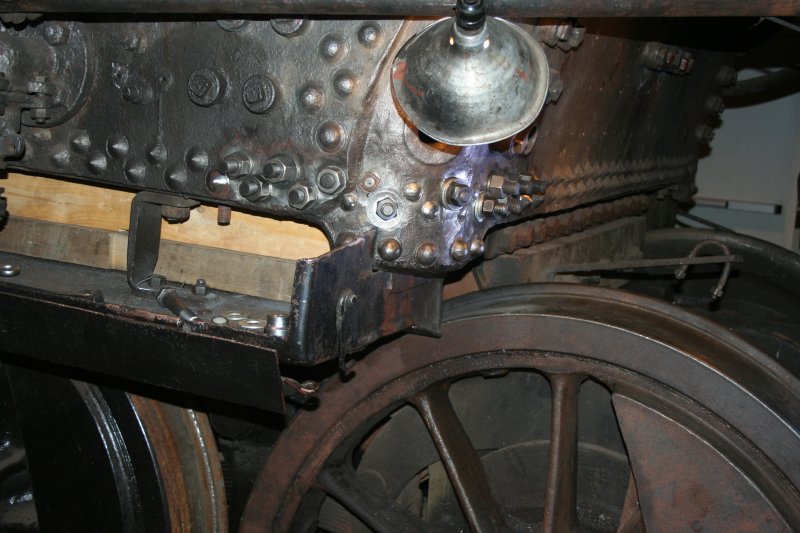
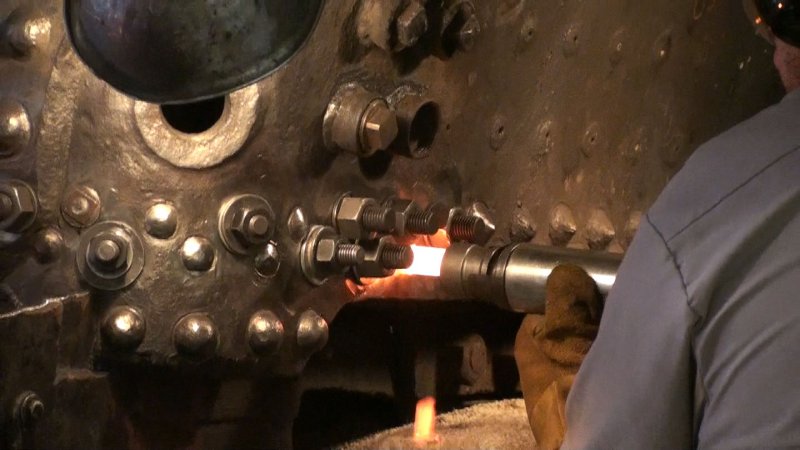
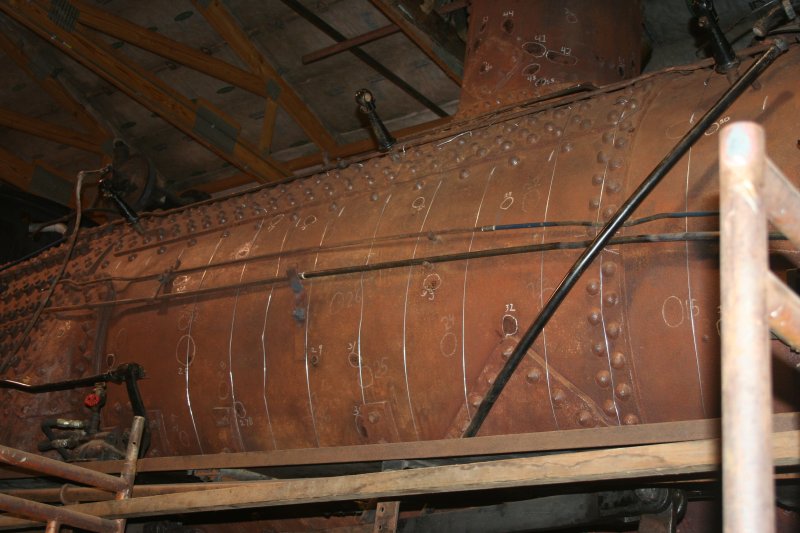
· Brian and David worked with Richard to install the wires to secure the insulation. Wiring of the barrel is now largely complete. · Jane worked on cleaning and priming the small cladding plates. These are used under the large sheets to seal around pipes and rods. Given the number of projections from the boiler, there are a LOT of these, all of which need to be clean and painted ready for fitting. · The remaining large cladding sheets were lifted back onto the top of the machine shop to store until required. · All of which brings us to the main event !. Work started on installing the rivets to finally secure the patch into the firebox corner and so complete the boiler shell. Firstly a correction to last week, which demonstrates the dangers of documenting things that happen while you are not there !. Having read last week's notes, Jerry pointed out that it was he, not Mike and Tom, who set up the timber staging to hold the bucker in the firebox. He even spent much of Memorial Day doing so. Sorry Jerry, my bad. Overall there are 13 rivets to be installed. Of these 6 are not significantly countersunk into the sheets and have conical heads on the outside while 7 (those in and closest to the corner) are substantially countersunk (and have shallow rounded heads on the outside). 11 are ready to install while 2 more require some further welding work by Dennis (after the 11 are in) before they can be fitted. (To avoid confusion, the six domed heads already in place in the corner are not rivets but patch screws threaded into the mud ring.) Bolts were set into each of the holes to lock everything rigidly in place before setting the rivets. One bolt is removed at a time and replaced with a rivet. In this shot the first rivet has been fitted in the front sheet while bolts indicate the 12 remaining to be fitted.
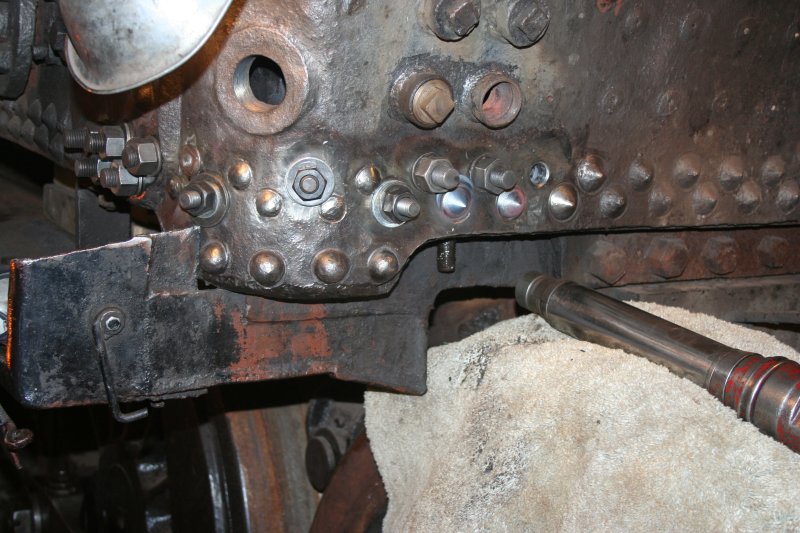
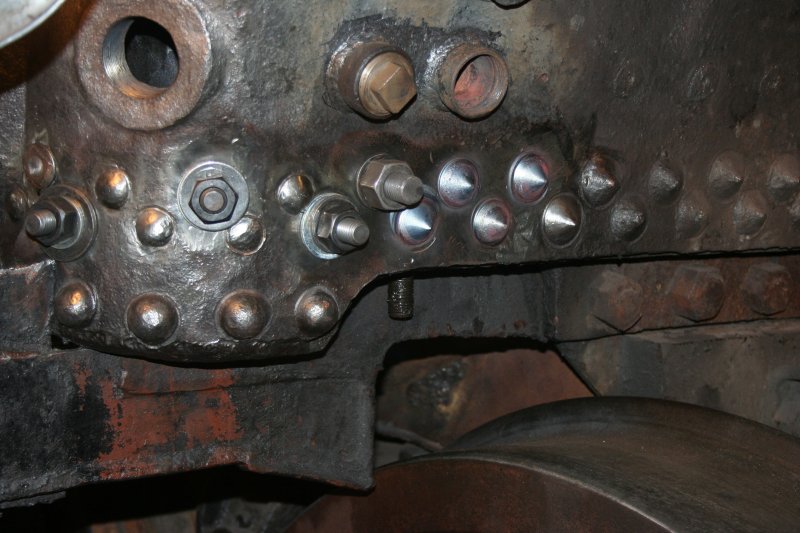
Work started on the cone headed rivets, of which there are four in the front and two in the side. Here two are fitted and the hole is ready for the third to be fitted.
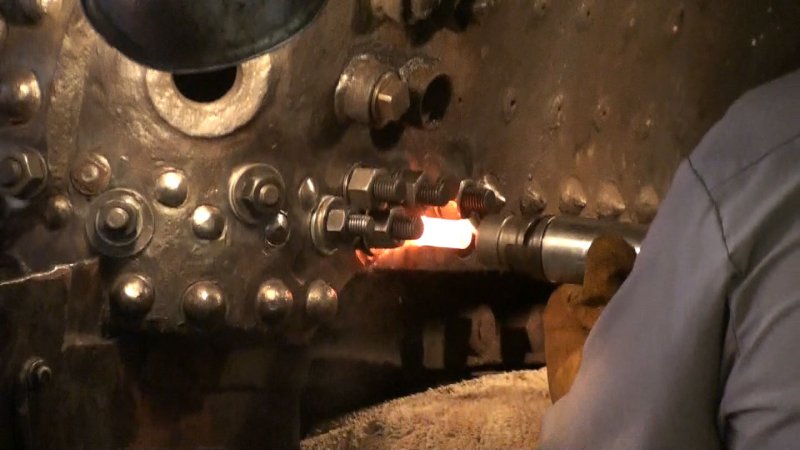
The heated rivet is passed to the team in the firebox and placed into its hole. The end projects substantially thru the outer sheet. The bucker is positioned behind it and activated to start hammering. In this shot you can see the length of rivet that initially projects thru the sheet.
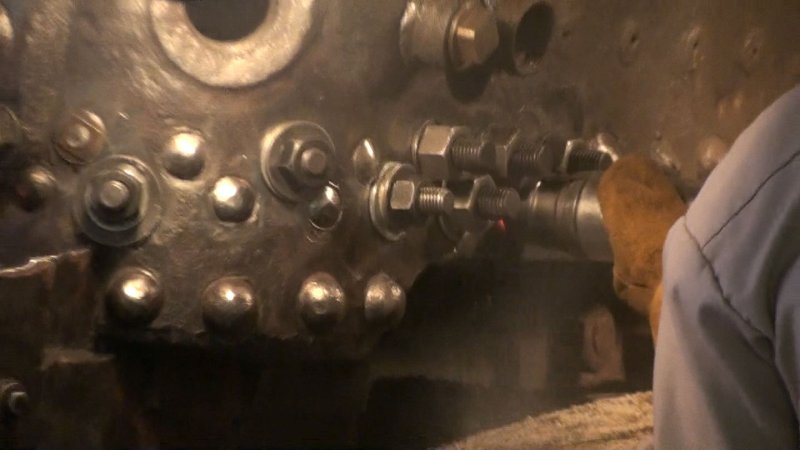
The hammer is carefully positioned on the projecting end.
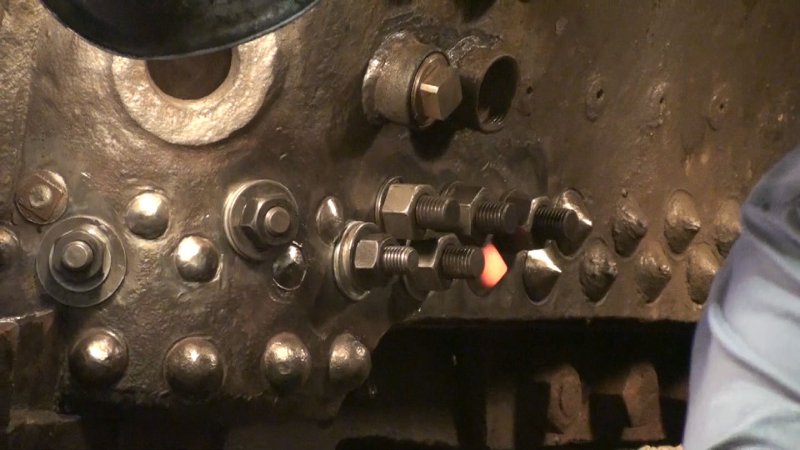
Hammering compresses the hot rivet to form the head. The time to do this is a matter of a few seconds as the contact with the mud ring and hammer cools the rivet very quickly, As the rivet cools from the light yellow, at which it is placed, toward a dark yellow and then red it cannot be further shaped by hammering.
When the hammer is removed we can see the formed rivet head, still red hot.
Forming the head of the rivet is rather like forcing back on a projecting cylinder of putty to form the required shape. The challenge is that it must be driven back accurately so that the head remains centered on the shaft of the rivet. If it once starts to bend, the force of the hammering will tend to accelerate the bending, resulting in a head offset from the body of the rivet that must be removed and replaced. The four in the front sheet went in well with no failures.
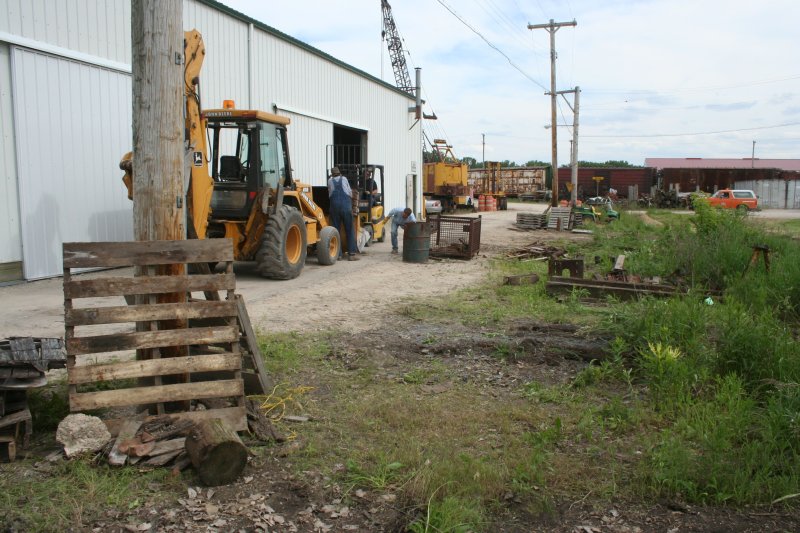
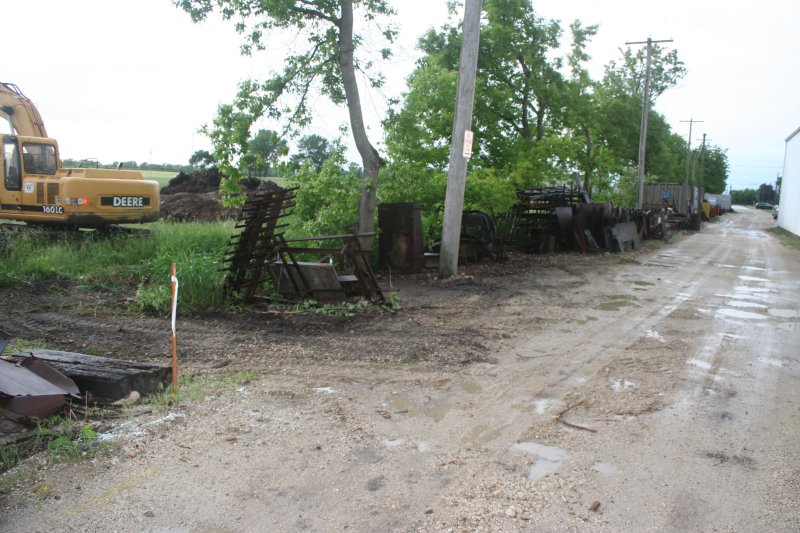
Unfortunately the two in the side proved more problematic. The first did bend in forming and produced an unacceptable result. The head was ground off and, with a significant amount of work using the air hammers, was driven out, much to our relief as the greater concern is that it "mushrooms" in the hole and must be drilled out. This hole will need to be cleaned up during the week before another rivet can be fitted. Installation of the second rivet was attempted twice late in the evening. In both cases we had problems with the air hammer forming the head, as a result of which the process was stopped before the rivet was seriously deformed. So there should not be much problem in removing the rivet. The problems with the hammer were resolved but, by 9:30 at night, operator exhaustion was a substantial risk factor and work was stopped for the day. So nearly 1/3rd of the total are installed. The disappointment is that, based upon initial progress, we had hoped that substantially more would have been completed. So - to be continued next week. The other big exercise was the continuation of work with a large B&G team to relocate the materials from West of the shop access road. The tricky items such as the tank and cab of the 0-4-0 were safely located to a much better area, where they are now standing on more secure supports that will keep them clear of the ground. So we will be back next Saturday with the target of making a good deal more progress with the riveting. Nigel Sunday, June 2. 2013Steam Department Update 06-01-2013A busy weekend as I had a normal day Saturday at the steam shop then spent Sunday in the diesel shop. A lot of work was done in the steam shop on Saturday. Unfortunately a new priority meant that far less of it than we had hoped went toward #1630. During this summer there is to be a major redevelopment of the road on the West side of the site. So alongside the steam shop. This means that one of the major areas of storage for the shop must be sorted and relocated. Certainly not before time as it is a considerable mess !. However we had been putting this off to progress the locomotive. Unfortunately time ran out and B&G are now starting work in the area. So several of us spent most of the day working with B&G to identify and move the useful material while they disposed of the rubbish. This is likely to be a significant effort over the next couple of weeks,
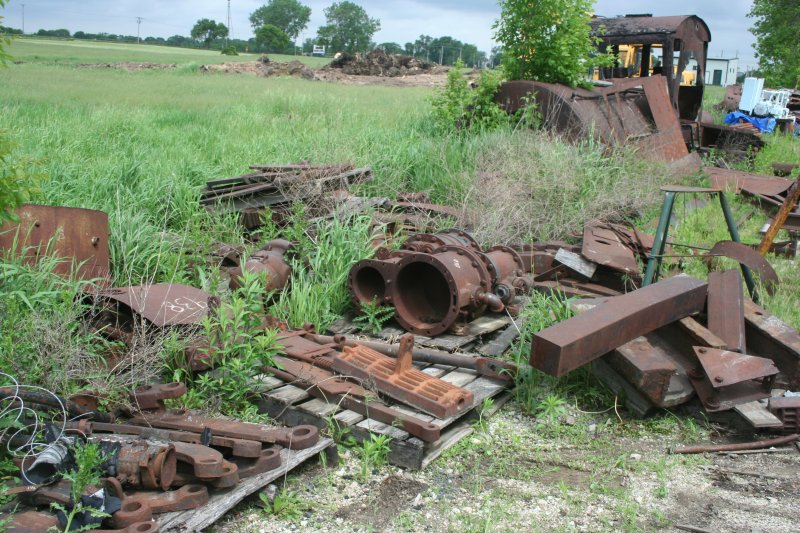
None the less, by the time a thunderstorm stopped work at around 6, a substantial progress had been made. A significant area at the South end has been cleared of parts for #938 which have now been put onto new pallets and moved to the area by the Bay City crane.
Unfortunately looming in the background are the saddle tank and cab of the Navy 0-4-0. These are really awkward items that will have to be moved in the next weeks. Other crews kept work moving on #1630: · Collin, Phil and Richard worked on fitting the wires around the boiler that will be used to secure the lagging. They made excellent progress and most of the wires on the barrel are now in place. It is good to see work progressing on steps that will clearly lead to her starting to look like a working locomotive again;
· Jane finished wire brushing and painting the last of the cladding sheets. This is another important enabling step toward being able to install the lagging, and cladding over it, once the first hydro testing is done; · Eric worked steadily at grinding excess material from the tube ends. Those that are to be beaded must have a fairly accurate 1/4 inch projection all around. Some have a significant excess in places so this is a job that will keep Eric and others busy for several weeks;
· The main activity was the preparation for riveting the patch. A group of us, led by Tom and Mike worked into the evening practicing and testing the roles in passing a rivet into the firebox, getting it safely into the hole and applying the bucker. Mike and Tom have spent a good deal of time during the week setting up the timber staging in the firebox to hold the bucker at the correct level so that it can be accurately applied to the rivet immediately it is in place. After a number of practice passes the process seems to be working smoothly. Hopefully next weekend will see some rivets actually set into place. Sunday in the diesel shop Roger and Jarod introduced me to the many tasks involved in starting the locomotives up for the season. An interesting morning learning the delights of inspecting brushes on motors and generators, pumping large quantities of oil thru the prime mover before it can be safely cranked and many other tasks. 30 minutes lying in a confined space squeezed under a traction motor, to get at the brushes there, certainly convinced me that steam are not the only group in desperate need of an inspection pit. Thanks guys for an interesting day. Nigel Sunday, May 26. 2013Steam Department Update 05-25-2013It was one of those days when a lot of effort was required to overcome unplanned events. However, the key objective was achieved. The main objective was to hydro test and then fit the last super heater flue. By 9:30 we had the Sullair running and linked up to drive the test pump and were nearly ready for the test ....... when the Sullair started spluttering and died !. After about 30 minutes trying to understand what was clearly some sort of fuel supply problem, we decided to cut our losses and use the house air to test the flue, although this would not have the power to test the elements at 1000 psi. Good plan, aside from the fact that the house air compressor, which had been running earlier, would not restart as air was drawn !!. Luckily Bob Olson was able to lend us the track department compressor and, by late morning, the hydro testing could begin. Many thanks Bob. During the day teams worked on the errant compressors. After some hours trying to trace a stream of tiny air bubbles, that appeared in the fuel filter, Jerry, Ed and others found and replaced a small brass union nut in the fuel line which had developed a crack, needless to say out of sight at the back !. Richard and others worked thru the control mechanism of the house air compressor. This seems to have been a case of pure bloody mindedness as the pressure switch worked perfectly well after having been opened, examined, adjusted and found to have no apparent sign of any problem !. Maybe it was an air compressor vacation day as the operating streetcar also suffered a compressor problem. So, while teams sorted out the air compressors, the rest of us got back to 1630: · The flue was successfully pressure tested; · We then tested the two super heater elements that failed last year and have been repaired. Both passed the pressure test at 1000 psi. The ball ended mating surfaces, that will be installed into the header, were all cleaned and polished. Dennis completed a couple of additional repairs were to the protective sheets and the elements are now all ready for fitting once the tubes are proved to be water tight;
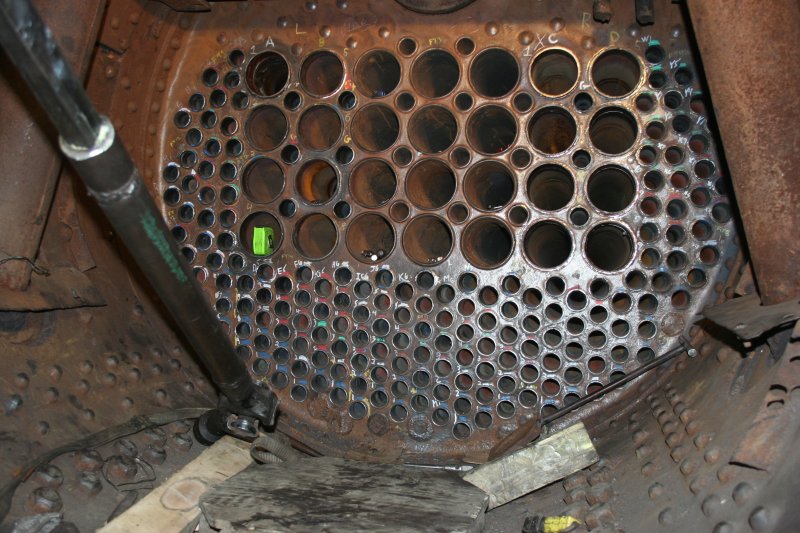
· Eric fitted the copper ferrules for the flue and we then loaded the last flue into position. It was then trimmed to length and rolled into first the rear and then the front tube sheet with no significant problems. ALL THE TUBES ARE NOW ROLLED INTO BOTH SHEETS AND READY FOR TESTING .......... !!. With over 180 small tubes and 16 large ones, all 17 feet in length, we have now re-installed significantly more than a half mile of tube.
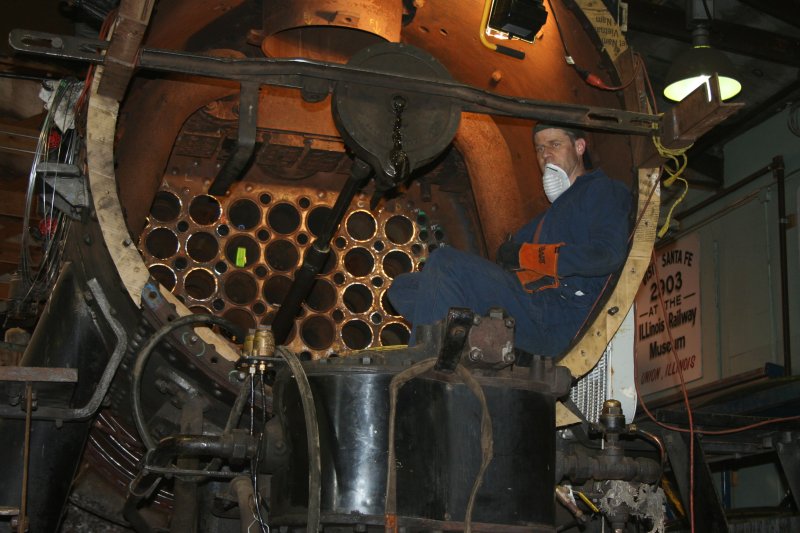
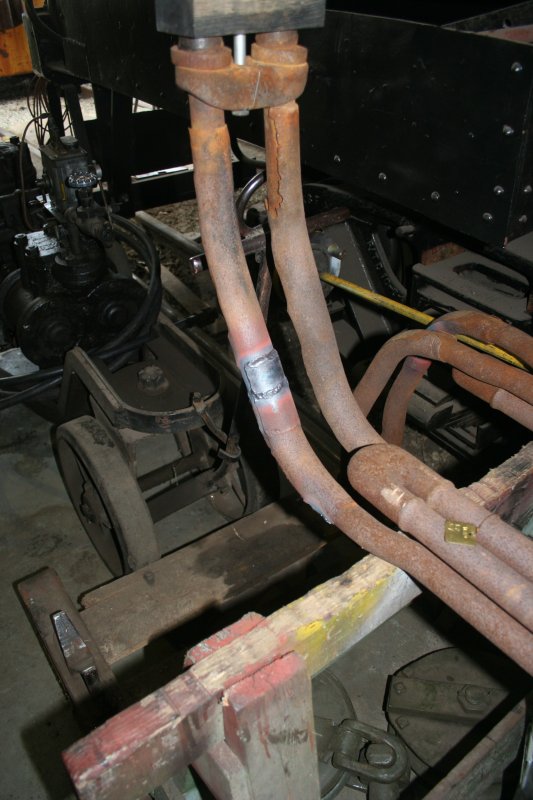
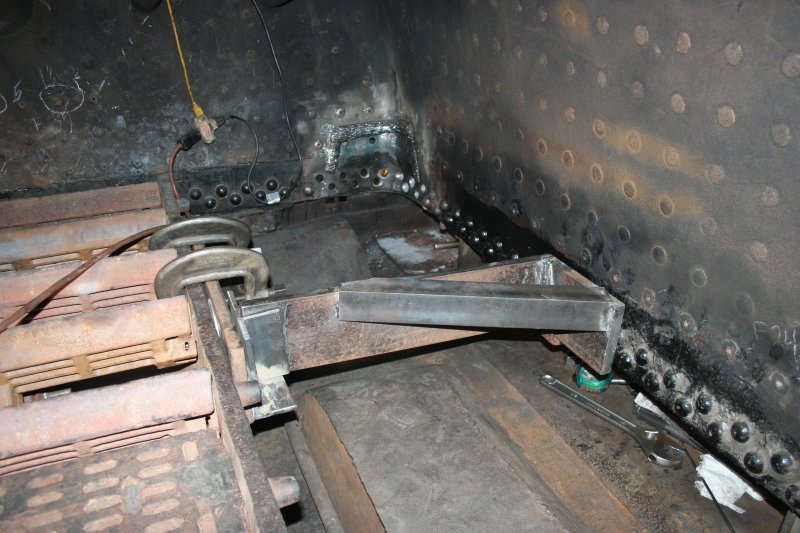
In celebration of this event there was a major clear out of the firebox and smokebox, which no longer look like storage racks for tube fitting tools ...... but that was after the picture!. · Ed has been continuing the job of cleaning and inspecting fittings from the backhead. One assembly formed of 2 inch heavy pipe and valves, that controls the blower, looked suspect due to pitting in the pipe. We took advantage of having the hydro test system working to pressure test it. This detected a bit of seepage thru the pipe, which also did not sound good when hammer tested. So we decided to make a replacement. Ed, Dennis and Richard were well thru this by end of day; · The main focus now is on the riveting: o Jerry and Mike worked with Dennis to plan and fabricate a steel structure to brace the bucker inside the firebox. There is a considerable trade off here as the frame must brace a very substantial air hammer but must also be man handled onto the footplate and thru the fire hole door into position. There was considerable cussing as this was done but it is now in place;
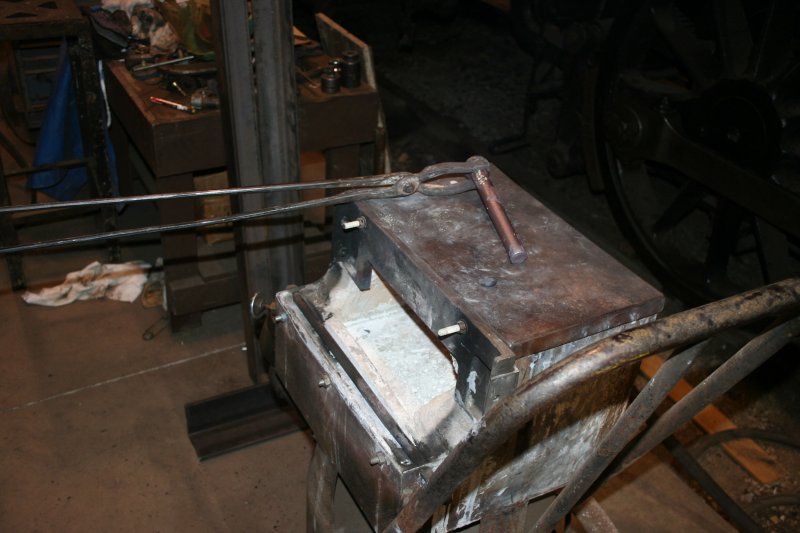
The bracing is designed to support the bucker both front to back (for the rivets in the front of the box) and side to side, when the plate nearest the camera is removed. o We also set up and tested the furnace to heat one of the rivets. Tom had obtained a heat indicating stick (this is wiped on the hot rivet and turns liquid at the required temperature). This seemed to indicate that the small furnace can successfully get a rivet of the required size evenly to the target temperature (although it had cooled substantially by the time I took the picture!);
o So the next stage should be to get together the team that will do the riveting and practice the process to ensure that everything can be done smoothly and quickly before we do it with hot rivets. So we have reached one major milestone. While focusing on the riveting, so that we can get the boiler water tight and carry out the first tests, we will now work on a whole bunch of new tasks to start fitting as many parts as we can ahead of the initial hydro test. Work in other areas (aside from the errant air compressors) was limited. However, Mark provided an update on recent work on the CNW #6323 wrecker: · Andy repaired the lower radiator piping and cleaned out cinders and coal from under the deck plates. Since she was converted from steam in 1961, those have been there a while!. · Bill worked on freeing the outriggers; · Nick helped in clearing rigging from the idler car so that the deck can be replaced; · Mike made a new door and doorway; · Phil crawled into the depths to change grease fittings in areas that no one else could get into; · Tom has been working on getting a custom spring made for the boom dog pawl (which stops the boom from lowering unless released). Unfortunately Mark's inspection under the wrecker reveals 2 axles from 1925 and 2 from 1960. The wheels on the 1960 axles are good but those from 1925 are cracked to varying extents. So a search for replacements is now under way. Nigel |
Blog AdministrationCalendar
QuicksearchSyndicate This Blog |
|||||||||||||||||||||||||||||||||||||||||||||||||


Comments
Mon, 09-08-2025 08:22
Good job on the Burlington Nortern 9976. OK.
Tue, 08-12-2025 12:56
No new news that I have heard of thus far.
Tue, 08-12-2025 12:53
I'll also be doing another update on it soon. Keep en eye out for that.
Tue, 08-12-2025 12:47
A little work was done to it for Diesel Days this year. You'll see photos floating around for the temporary short term job that was done to make it [...]
Wed, 08-06-2025 13:01
Is steam car CN 15444 going to be coming to museum several times it was to be moved to muesum
Sat, 07-19-2025 18:56
Yeah, sadly it's still there as of 7/19/2025
Thu, 06-12-2025 19:14
Its been 14 years guys, where is the unit? Like really? Did you guys misplace it? Or are repairs taking that long? At this point be might we will have [...]
Wed, 04-09-2025 17:40
Jamie Thanks for the update. She's gonna shine like every thing else you guys do! Smeds
Thu, 03-06-2025 16:28
Yes, there is a wye. Those two have been MU'ed on diesel days a year or two ago.
Wed, 03-05-2025 14:04
7009 number boards look good. Is there a way to turn a locomotive around at IRM? In case you ever had a mind to connect 7009 and 6847?
Fri, 03-29-2024 21:26
We're slackers and spend more time working on the equipment in the shop than keeping all you readers updated. We'll work on it, but I'm sure updates [...]
Thu, 03-14-2024 08:02
What happened to the Department Blog? It's been over 2 years and I still regularly check for updates, but nothing comes...