

|
|
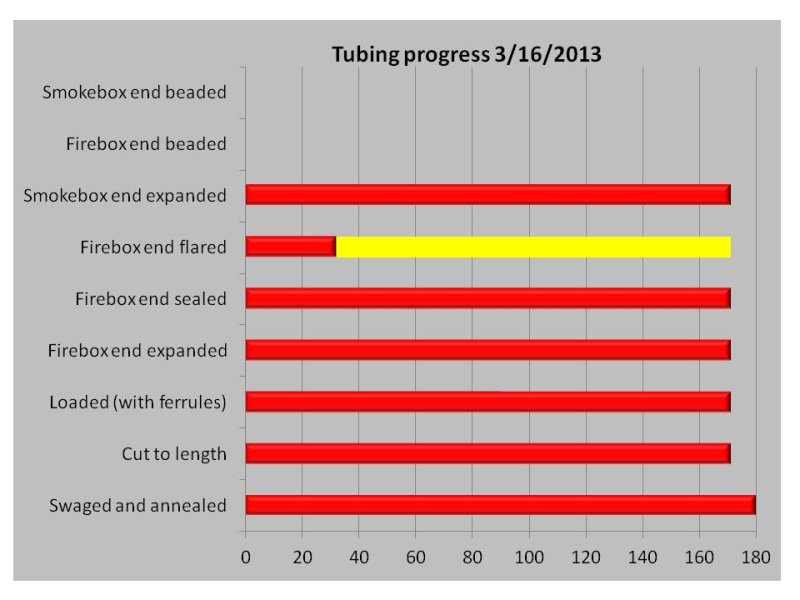
Sunday, March 17. 2013Steam Department Update 3-16-2013After a hard day at the shop it is always good to be able to say that we achieved what we set out to do. Having a major target in sight certainly encourages you to keep going! On 1630: All the small tubes below the super heaters are now completely installed to the point at which we will first test them. (As mentioned previously, they should be water tight after expanding and flaring. So we aim to do an initial hydro test to identify any that need to be tightened before we roll over (bead) the ends of those that need to be so treated).
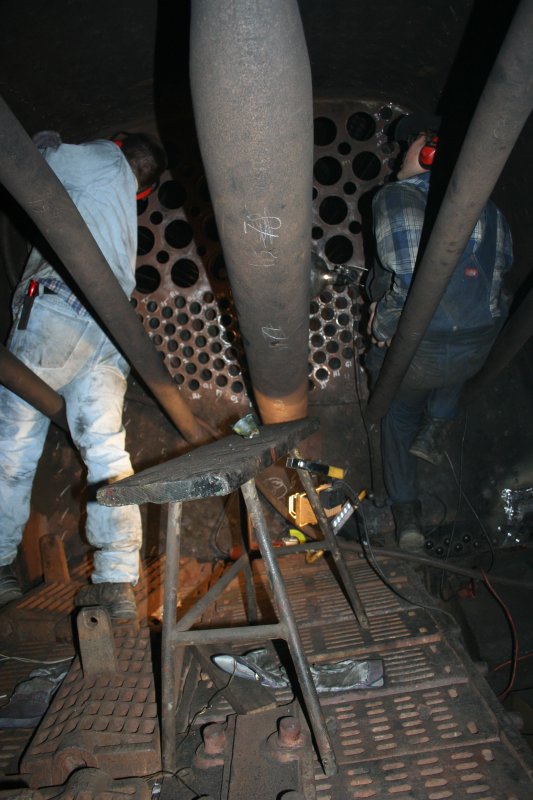
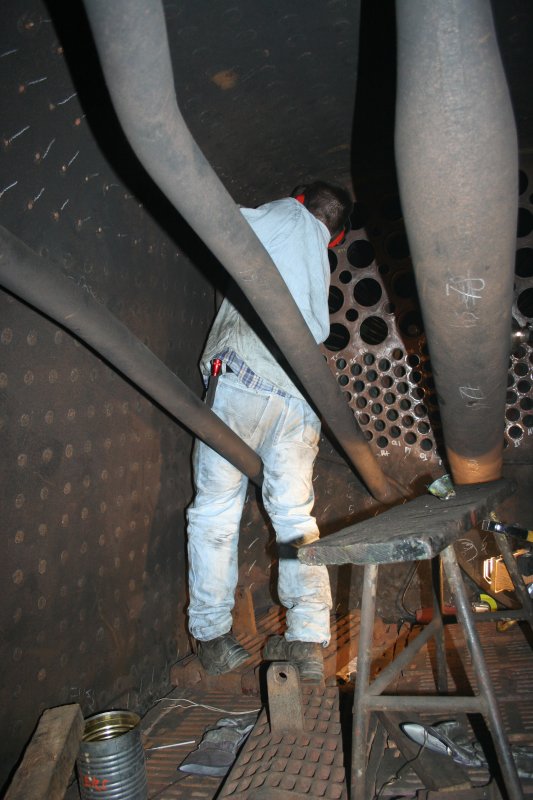
· A number of us took turns to expand the firebox tube ends with the air hammer. The technique developed last week worked well. Brian rolled any tubes that showed signs of moving during expansion a little more to ensure they were tight. He has become our expert with the tube roller, having expanded almost all the ends into the front tube sheet. The expansion is a tough job. It takes a lot of effort to control the large air hammer and ensure that a smooth flare is produced. All this must be done while squeezed in above the arch tubes where the heat builds up nicely. However, we found that you could do 6 to 8 before running out of steam. As you weaken, you are able to apply less force to the hammer and the flaring becomes less effective. So the time to stop is pretty clear!!. Anyway, by constantly switching operator, we achieved the objective and flared more than 130 tubes in the day. Here you see Phil and Brian at the end of the job. In this case Phil operates the hammer while Brian watches the tube end closely for any sign of movement. This is critical as the guy on the hammer cannot easily see if the tube starts to move;
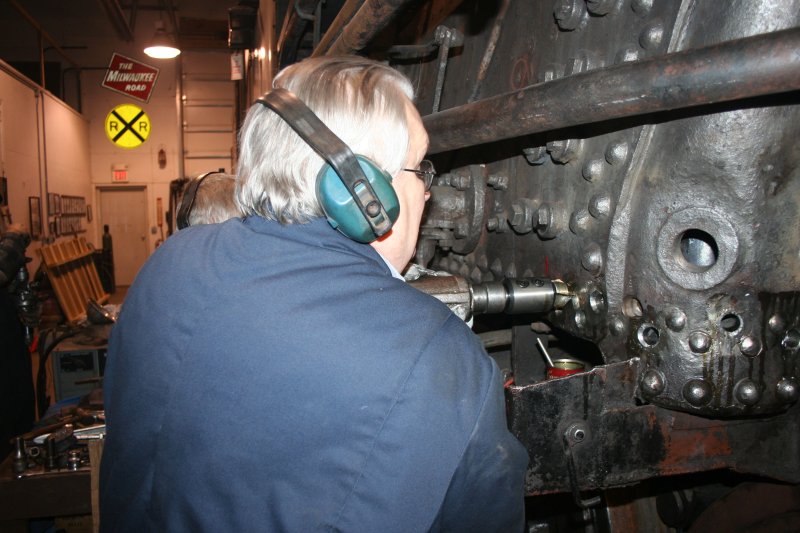
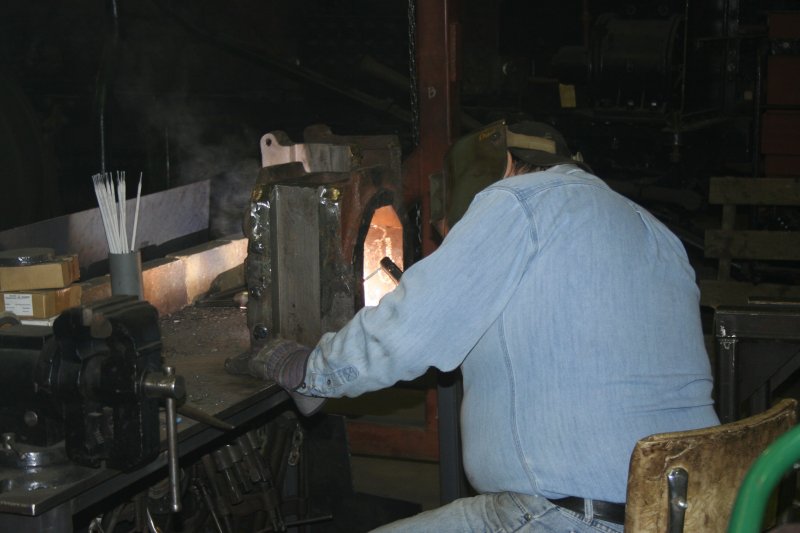
Meanwhile Mike and Ralph worked on the holes thru which the patch will be riveted to the mud ring. The preparation is everything. The hot rivet is hammered into its hole in maybe 25 seconds. However the shape it will take is determined by forming the hole and the design specifies that the rivets are not all the same. Some have conical heads with a small countersink into the sheet, while others are countersunk almost flush. Here Mike is cutting the countersink into which the rivet will be formed. So, as is the way with this work, we now move on from techniques with which we have become familiar to new ones. The next step on the tubing is to fit the 16 large super heater flues (and the remaining 9 small tubes that lie between them). While the general principles are the same, the tools are distinctly different. You certainly cannot use an expander on a tube this size. Both ends and the ferrules at the firebox end will need to be rolled into place and these rollers are on a whole different scale from those we have been using. On 428: · Dennis continued with building up the truck axles boxes. The focus this week was on building up the ledges on which the grease cellar rests to provide lubrication to the journal from below;
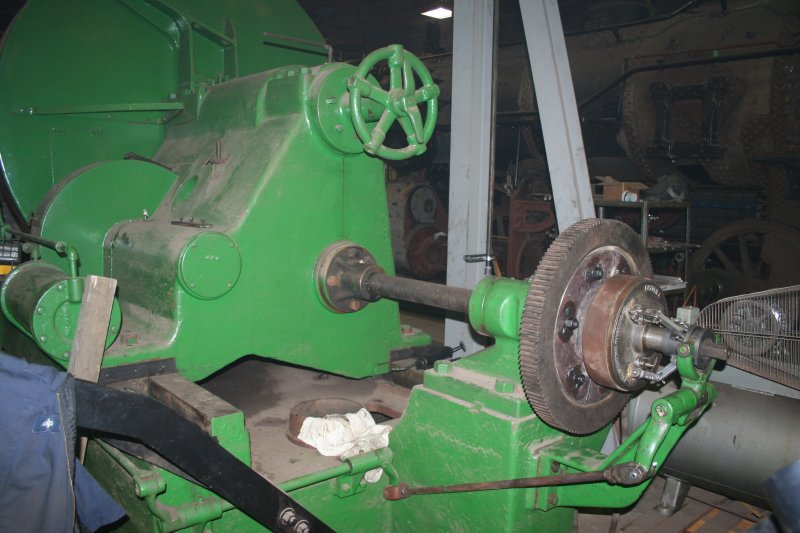
· While Dave and Phil continued building the machining guide to mount the axle box wedges in the shaper. Elsehwere in the shop: · A big visible step was made on the wheel lathe. The large gear, that was cracked and has been repaired, was finally fitted into place along with the clutch mechanism. The mechanism was broken, either when the lathe was acquired or in transit, and has been rebuilt with some missing and broken parts reconstructed from drawings. The gear is driven by an electric motor (behind the gear itself) and free wheels on the shaft unless the clutch is engaged (from a lever at the operator's station. The control linkage was also reinstalled and can be seen running across the end of the lathe to the clutch mechanism. Much to the relief of all involved, this now operates correctly when the control lever is moved!.
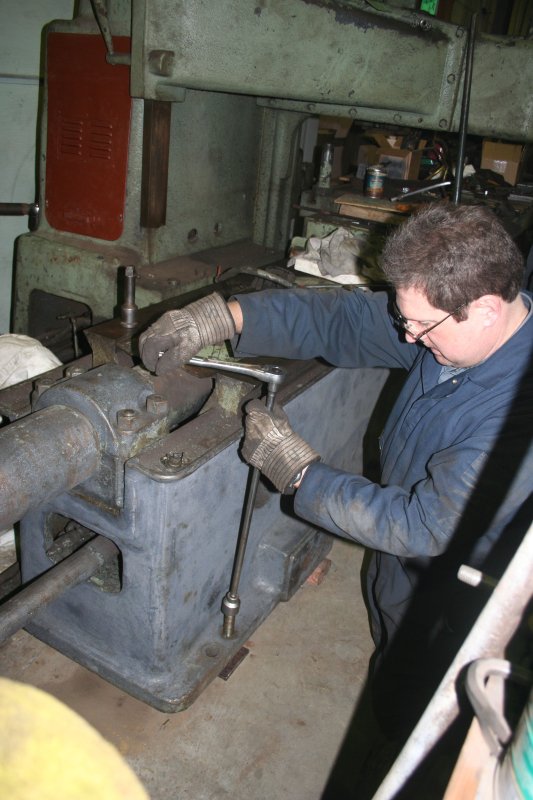
· Stu, Bob and Eric positioned the planer. This may not look much but is a big step in activating this machine. This a very substantial weight that has, to this point, been resting on rollers. It has now to be finally positioned and leveled after which the rebuilt hydraulics can be reconnected. During the afternoon and evening the machine was positioned. Then the leveling screws were all cleaned up and located on steel plates. The machine was the raised off the rollers and slowly lowered so that it sits only on the leveling screws. Next it will need to be accurately leveled (it currently demonstrates that the floor is not accurately level!) and locked into place. Here you can see the early stages as Stu screws down one of the leveling screws to lift the main body of the planer and release the rollers that are still seen projecting from under the machine
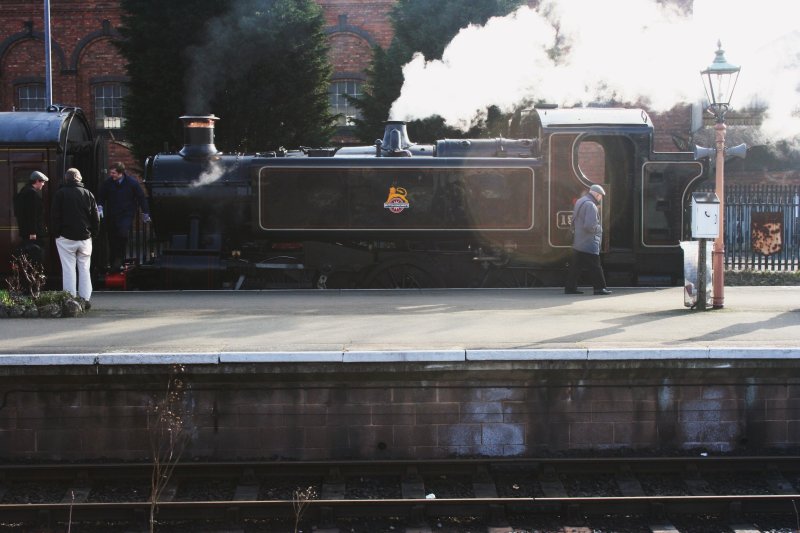
So next week we can start the next phase of the tubing. Nigel Sunday, March 10. 2013Travels to UK steam railwaysA little off the normal topic. During my trip to the UK I managed to spring a few hours away from the office to visit a couple of preserved steam railways. So attached are a few notes and photographs from these visits. On the Saturday I visited the Severn Valley Railway near Birmingham. This line is about 15 miles long running thru beautiful scenery along the river Severn. The train and its locomotive certainly provided pause for thought. I have often looked with amusement at the Thomas locomotive dwarfed by the train of heavyweights that it is "pulling" out of the yard. However 1501, an 0-6-0 pannier tank of Great Western heritage was here preparing to take its 7 car train over the hilly 15 mile line, which it was well able to do. In retrospect, these locomotives used to take the stock for express trains from Paddington terminus to and from the yards so were regularly moving 450 ton trains so this was no great load.
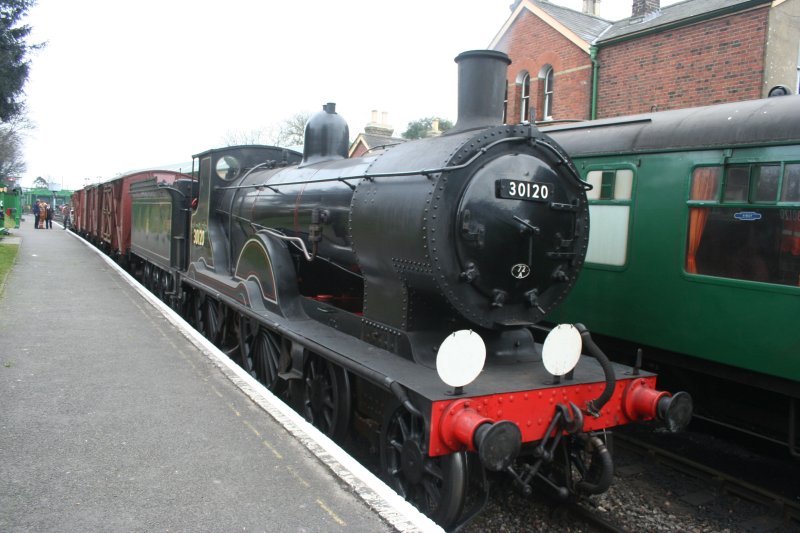
Last week I visited the Mid Hants Railway at Ropley in Hampshire. I follow the blog of the Wednesday volunteer gang there and was pleased to meet them. They made me very welcome and showed me around the workshop and yard. Most impressive what can be achieved when you have the operation to support some full time staff with volunteer support. Mid week the only locomotive in steam was the visiting T9 4-4-0, which was working a photographic charter.
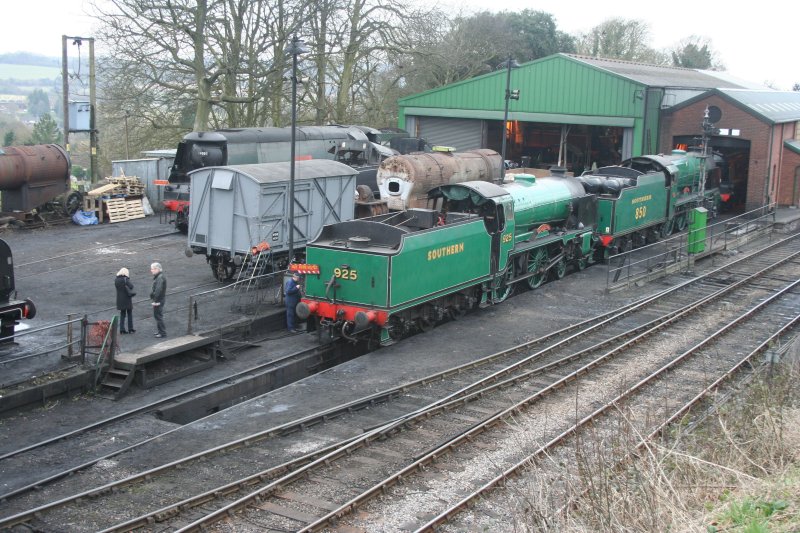
A range of locomotives were in the yard serviceable. In the foreground are 4-6-0 #850 Lord Nelson and schools class 4-4-0 #925 Cheltenham while in the background is 34007 Wadebridge, a Bulleid light Pacific.
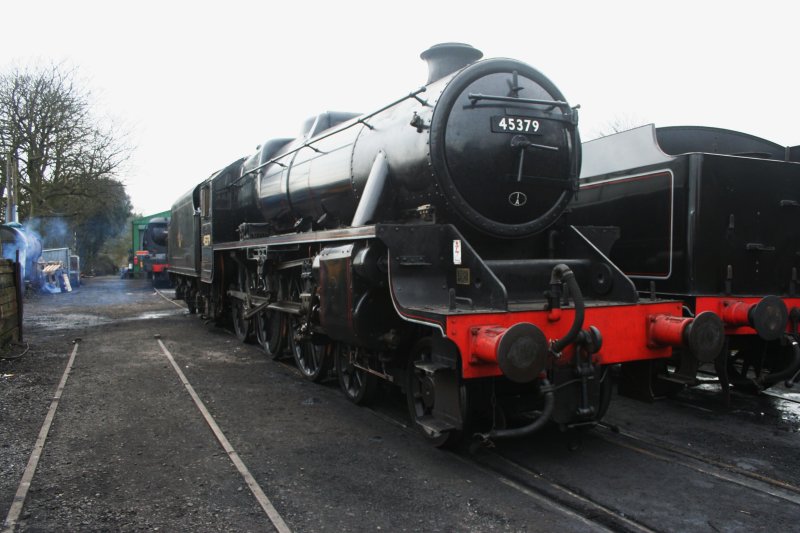
Another good looking locomotive was this Stanier "Black 5" 4-6-0 #45379. Now two years in service, Dave tells me she was rebuilt on site from scrap yard condition.
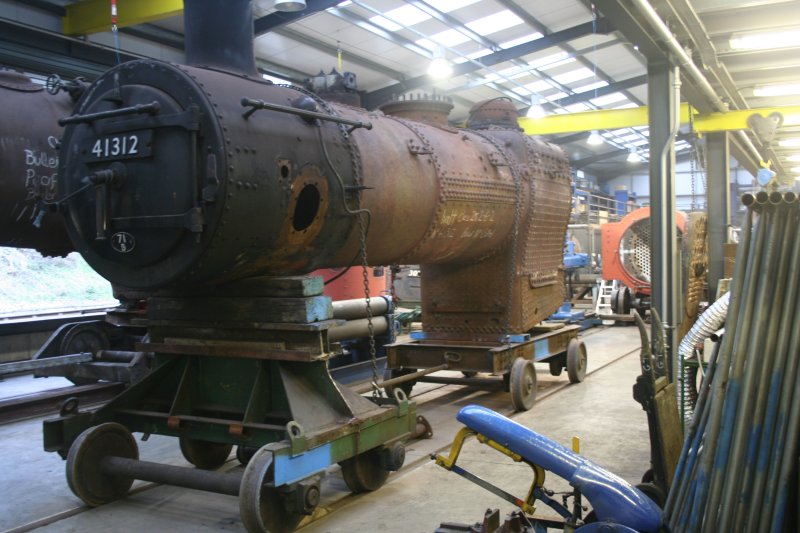
Another locomotive is in course of rebuild from scrap yard condition while others are undergoing periodic general overhaul. If we think the 15 year boiler requirement is bad, in the UK it is only 10 years between required boiler strip downs !. The difference between US and UK locomotive construction and therefore overhaul technique is very obvious. UK locomotive fireboxes usually fit between the fabricated frames so no major boiler overhaul can be carried out without removing the boiler from the frames. So it is common to have a separate boiler shop as they do at Ropley.
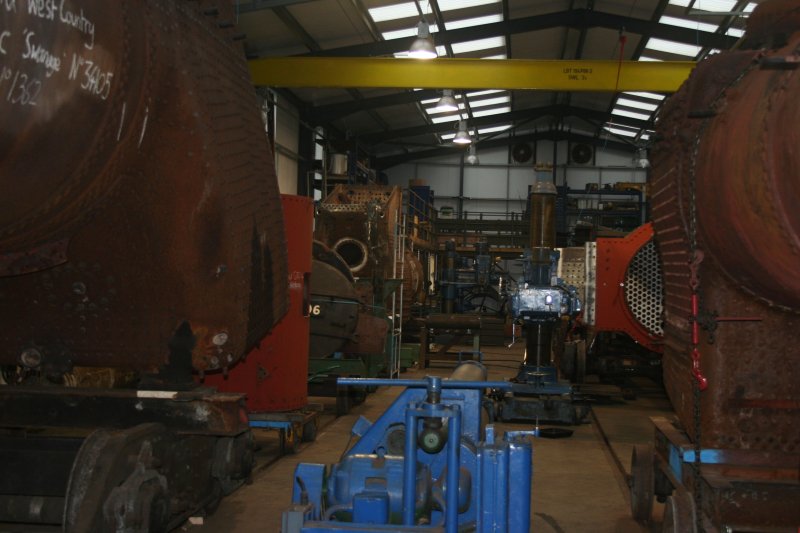
Here a number of boilers are in various stages of overhaul. In the background you can see a boiler rotated thru 180 degrees allowing ready access to the base of the firebox and mud ring. If you can do that, riveting the mud ring is less of a challenge than we face with #1630 !
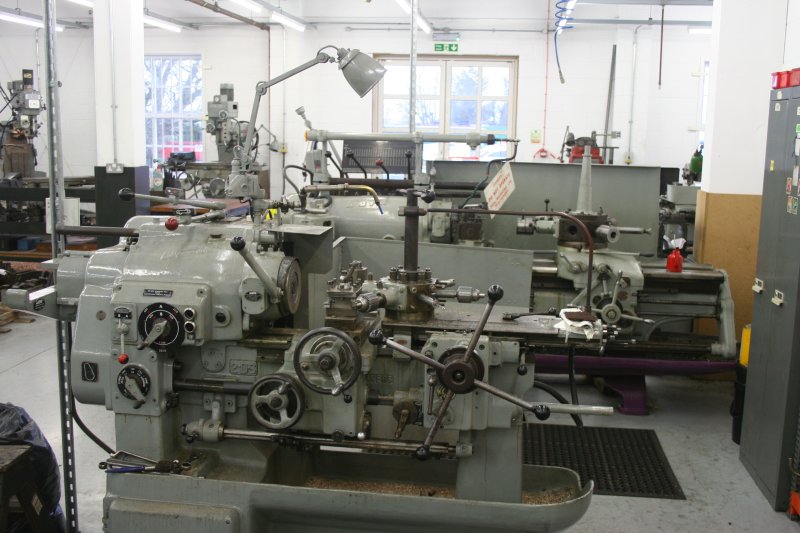
Attached to the main shop they have a nicely laid out machine room
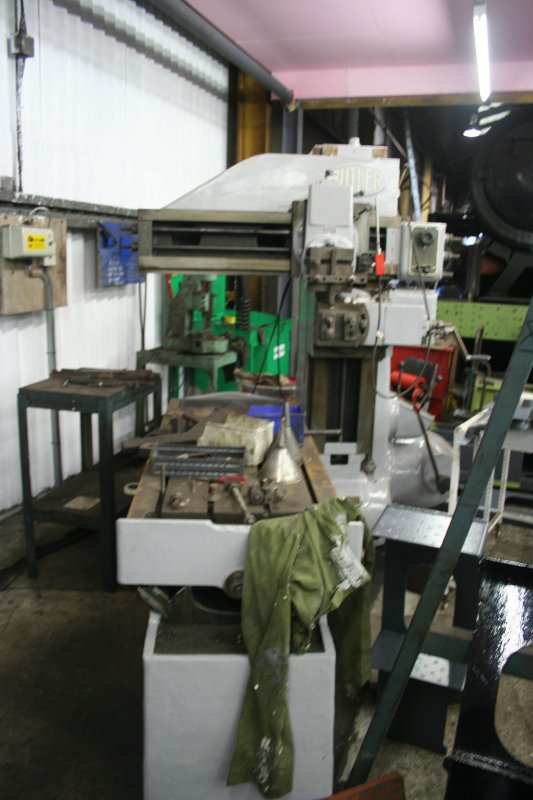
and they even have a planer. One big difference is that theirs works !!. Hopefully ours will soon.
Many thanks to Dave, Colin and the Wednesday gang for your hospitality, Nigel Sunday, March 10. 2013Steam Department Update 03-09-2013Thanks to Roger for the update in my absence last week. Having arrived back from the UK Friday, the jet lag made Saturday at the steam shop harder than usual for me !. However the team made good progress in a number of areas despite my preoccupation with what time of the day or night it was. On 1630:
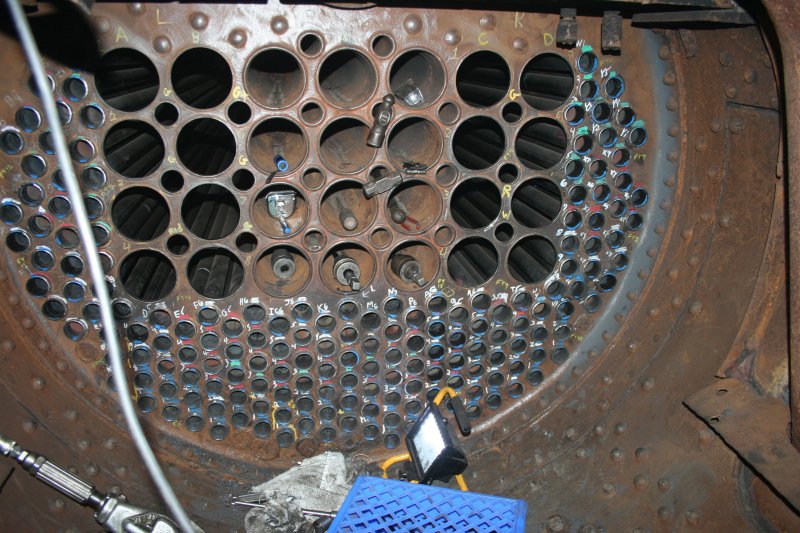
· Another milestone in fitting the small tubes. Brian finished rolling the front ends into the smokebox tubes sheet. In the view below you can see all the tubes now fitted and the 16 vacant holes into which we will start fitting the super heater flues;
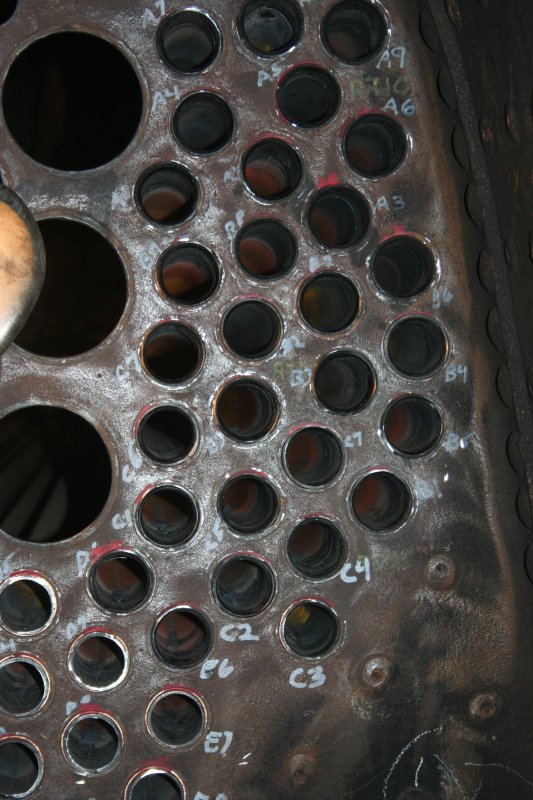
· After grinding most of the firebox ends to the final length for beading, we made a good start on flaring the ends in the firebox. We have to watch carefully to ensure that there is no movement as the tube end is flared and expand the front end a little more if there is any tendency to move but, having worked that out, progress is quite rapid;
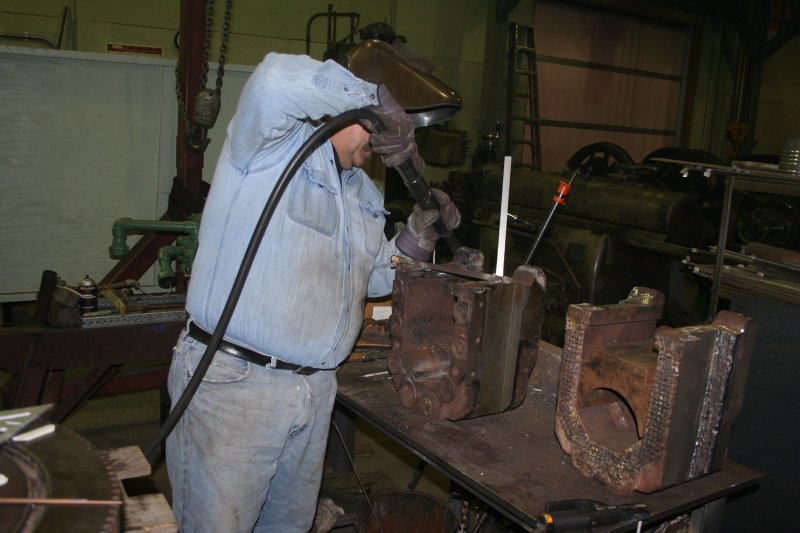
Here you can see the difference between those higher up, that are now flared, and the ones at the bottom still to be done. The comparison between adjacent tubes E6 and D2 provides a good example. Once this is complete, we can move on to fit the 16 super heater flues and the 9 small tubes that fit between them. · Last week Dennis finished welding the patch into place. A clear demonstration of my limited knowledge of the finer details of welding. It looked pretty complete to me two weeks ago but a further finishing pass and tidying up around some of the rivet holes was still required last week. · The holes have now been reamed for riveting and focus is now on cleaning and servicing the air tools that will be used for forming the rivets. The riveting will be a considerable job as these are substantially the largest rivets we have driven in the shop in many years. · Dave and Phil worked on cleaning and servicing the various control valves from the cab; · Ed continued with the pipe work, which is now getting close to completion There was quite a lot of activity on 428 focused on the leading truck and axle boxes; · Having finished the welding on 1630, Dennis moved on to building up the truck axle boxes. Once built up these will need to be machined and the bearings fitted;
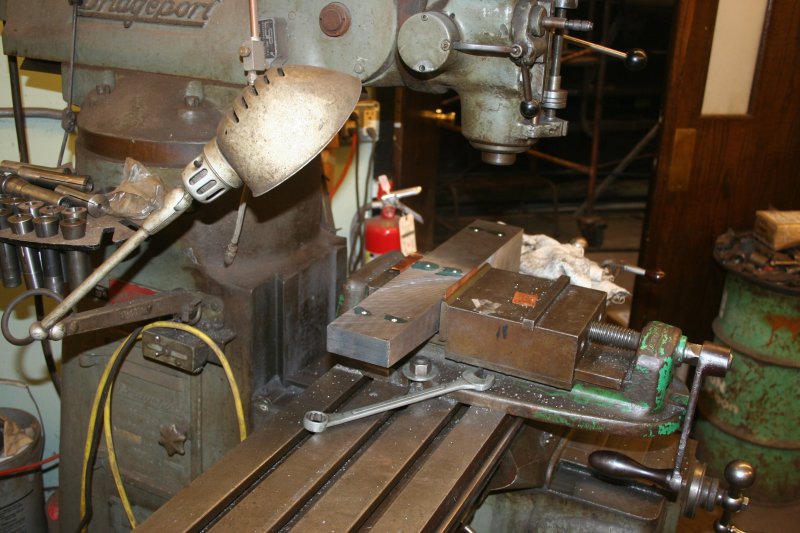
· Dave and Phil worked on producing a guide to mount the axle box wedges in the shaper. The wedges must be machined to provide an accurate and consistent angle between the faces.
One part of the guide is this tapered block. Here it is being drilled in preparation for mounting on the plate below.
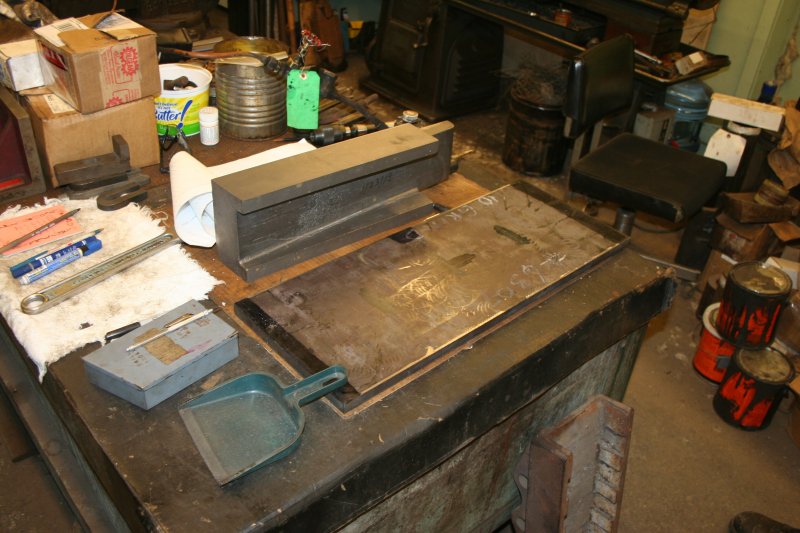
The tapered block will be attached to this plate so that the wedge can be locked in position with the angled face on the block. The outer face, against which the axle box will bear, will then be positioned so that is can be planed flat to provide the required angle versus the face within the channel (which bears against the frame). · Mike was working on another mount to hold the shoes in position for mounting on the shaper.
In the shop in general, there was a big step forward in the project, funded by the Benefit, to provide piped air supply to the new shop (South end). Jerry had put in several days work during the week and yesterday he and Jeff completed the major parts of the system. After blowing out the debris, valves were fitted on several of the outlets and the system tested for leaks. The system proved air tight and, when I left, Dennis was, for the first time ever !!, working in the fabrication area without 100 feet of hose stretching back into the main shop. This is a substantial improvement as long runs of hose and substantial distance from the operator to the shut off valve have been a safety concern. The next step will be to finish the connection thru the South wall of the shop. This will serve the dual function of providing air for work in the wheel drop area as well as allowing the Sullair to be connected to provide additional capacity without long hose runs. The final step will be to connect in the large compressor. A good day's progress. Hopefully next week I can be there in mind as well as body !! Nigel |
Blog AdministrationCalendar
QuicksearchSyndicate This Blog |
|||||||||||||||||||||||||||||||||||||||||||||||||


Comments
Mon, 09-08-2025 08:22
Good job on the Burlington Nortern 9976. OK.
Tue, 08-12-2025 12:56
No new news that I have heard of thus far.
Tue, 08-12-2025 12:53
I'll also be doing another update on it soon. Keep en eye out for that.
Tue, 08-12-2025 12:47
A little work was done to it for Diesel Days this year. You'll see photos floating around for the temporary short term job that was done to make it [...]
Wed, 08-06-2025 13:01
Is steam car CN 15444 going to be coming to museum several times it was to be moved to muesum
Sat, 07-19-2025 18:56
Yeah, sadly it's still there as of 7/19/2025
Thu, 06-12-2025 19:14
Its been 14 years guys, where is the unit? Like really? Did you guys misplace it? Or are repairs taking that long? At this point be might we will have [...]
Wed, 04-09-2025 17:40
Jamie Thanks for the update. She's gonna shine like every thing else you guys do! Smeds
Thu, 03-06-2025 16:28
Yes, there is a wye. Those two have been MU'ed on diesel days a year or two ago.
Wed, 03-05-2025 14:04
7009 number boards look good. Is there a way to turn a locomotive around at IRM? In case you ever had a mind to connect 7009 and 6847?
Fri, 03-29-2024 21:26
We're slackers and spend more time working on the equipment in the shop than keeping all you readers updated. We'll work on it, but I'm sure updates [...]
Thu, 03-14-2024 08:02
What happened to the Department Blog? It's been over 2 years and I still regularly check for updates, but nothing comes...