
|
|
Thursday, January 7. 2016Shay #5 from Brian Davies January 2016Shay update, January 2016: Happy New Year! My last report here regarding the Shay was back in September. I had fully intended to do a report following my three week trip up to IRM in October, but life has a way of intervening. It also doesn't help matters that I tend to like machining, painting, and mechanical work better than putting my thoughts on paper. But, here we go. As Nigel has been reporting, great progress has been made since my last report towards returning the Shay to service. I will try to put some names down here to thank and acknowledge those who have helped on the Shay for all of their hard work. I will undoubtedly miss names, and to those people, I can't thank you enough for all of your continued help on this project. When you great blog readers visit IRM, please remember that everything you see running and restored is thanks to the hard work of our volunteers and the generosity of our donors. Thank you all! On to the Shay. During my three week vacation work was progressing on the Shay on a daily basis. Many volunteers came in on weekdays when normally no one is in the shop, and this help really pushed our project forward. As Nigel has already given descriptions of much of what has been accomplished on the Shay during my three week "vacation" and leading up to today, I will attempt to add what I can to what he has already covered. As of now all of the work to properly seal and form the ends of every boiler tube is complete. At IRM, we use the time honored, traditional methods of installing boiler flues used almost universally in the steam era. I can go into this process in further detail in a future blog if people would like, but suffice it to say for now that the methods we use take a lot of time, but result in a tube job that should give us a very well-sealed boiler for all 15 years of service until the next federally mandated boiler inspection. One stay bolt was found to be broken the first time we filled the boiler with water, and a couple of days later it was replaced. Trevor, with help from Ben, has finished preparing the inside of the water tender for painting with a protective coating. In the upcoming weeks Cody will be leading the project of painting the inside of the tender tank. As Nigel has reported in previous shop reports, the boiler on the Shay has passed its federally mandated hydrostatic pressure test. This major milestone will now allow us to proceed with the jobs of adding parts back on the boiler. The boiler on steam locomotives gets an insulation material applied to it. This is called lagging. Surrounding the lagging is a sheet metal skin called the jacket. We use a type of block insulation that, while quite messy and itchy to apply, works quite well and can withstand the pressure of engine crews standing on the jacket repeatedly while doing maintenance on the locomotive. Jerry has started the process of securing wires circumferentially and evenly spaced along the boiler which will be used to secure the lagging to the boiler.
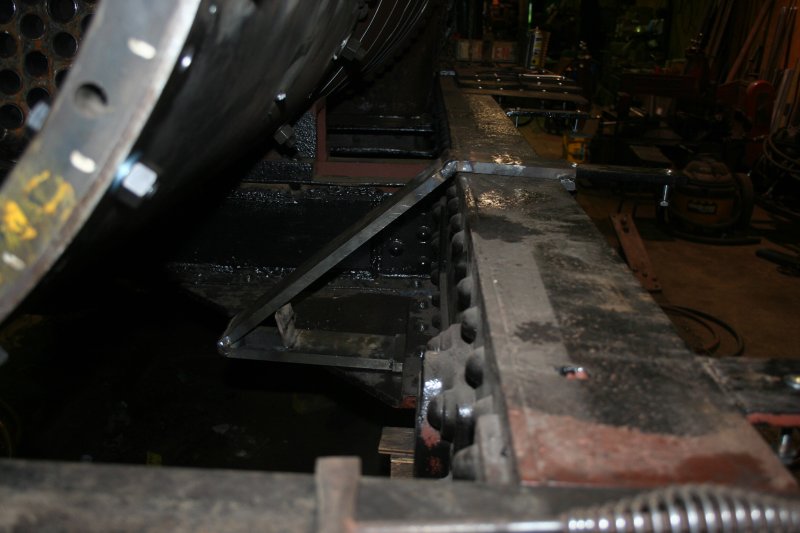
The process of applying the blocks of insulation will begin shortly. This job consists of wiring individual blocks of lagging onto the boiler, one at a time, securing them to the previously mentioned circumferential wires to hold them in place. Once the insulation is applied, the task of refitting the jacket can begin. To prepare for this, several volunteers, including Jane, Ben and others, have been working to remove old primer and rust from the back sides of every piece of jacketing, and then priming and painting the back side to help prevent rust and keep the jacket in good condition. We have thus far held off on doing any cleaning up of the outside surface of the jacket, other than removing old grease and oil, until we decide whether to paint the locomotive over this winter or not. Painting takes a good amount of volunteer time that may otherwise be needed for other mechanical projects to get the locomotive into operating condition. If the mechanical side of the project continues at a good pace, some paint work may start in the next few months. Once the lagging and jacketing is installed, work can then turn to reinstalling all of the piping necessary to make the locomotive operable. This includes water delivery pipes, steam pipes to the various appliances, and air piping for the bell, sanders, and brake system, as well as related brake control stands in the cab. During the Shay's whole operating life, from the time it was built to the time it was retired from regular service, it burned oil as its fuel source. When the Shay was converted to burn coal by the Chicago and North Western Railway in preparation for its arrival at IRM in the late 1960's, an industrial grate system was installed. These grates performed generally well over the years. However, as they were not designed for locomotive use, they were at times cantankerous and hard to rock in order to clean clinker and ashes from them each morning. Also eventually, due to age and use over time, the grates would warp or break, necessitating periodic replacement. Around the time the locomotive was removed from service at IRM the decision was made to make the proper grates for this locomotive. To this end, Steam Curator Tom Schneider, following original Lima Locomotive Works drawings, made new wood patterns to have all new, proper, grates and side bearers cast. Phil and I spent time in the Shay's firebox in October measuring and laying out where the new studs will be welded in the firebox to support the new grate system. In the next few weeks the hope is that our welder Dennis, aided by Phil, will weld in these studs. Once this is done installation of the grate system and its associated linkage can be carried out. Another large area of the locomotive, the smokebox, has seen a great amount of work done on it in the past couple of months. All of the holes needed to rivet on the new bottom portion of the smokebox have been drilled, and the bottom piece was bolted on, awaiting riveting and welding to the old portion. Several of the rivets that need to be installed are in an area inconveniently close to the frame of the locomotive. Because of these close confines, normal riveting practices are quite difficult. To make it possible to rivet in these areas, Tom and Dennis designed a special fixture that will allow us to use the frame of the locomotive to our advantage to aid us in driving the rivets!
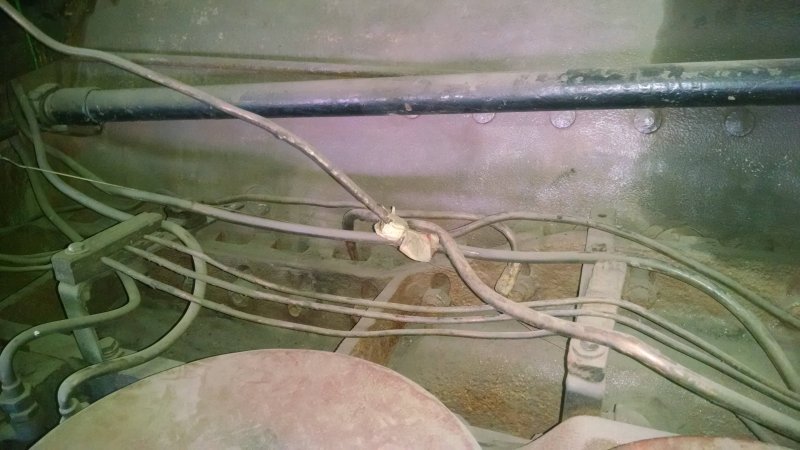
Hopefully Nigel can describe this in better detail in a future blog update. Once the riveting is done, Dennis will weld the new bottom to the old part of the smokebox. Soon after this is done, installation of the superheater units and other front end pieces can begin. To prepare for this, our machinist, Eric, has been busy machining a few newly cast pieces that were made to replace old steam fittings for use in the smokebox that were very heavily deteriorated from years of corrosion and use. There are always many, many small projects among the larger ones involved with locomotive restoration. One of these currently is replacement of several wood brackets used to secure lubrication piping above the motor unit. Over the years these pieces have rotted out to the point where they do little to hold the lubrication piping in place.
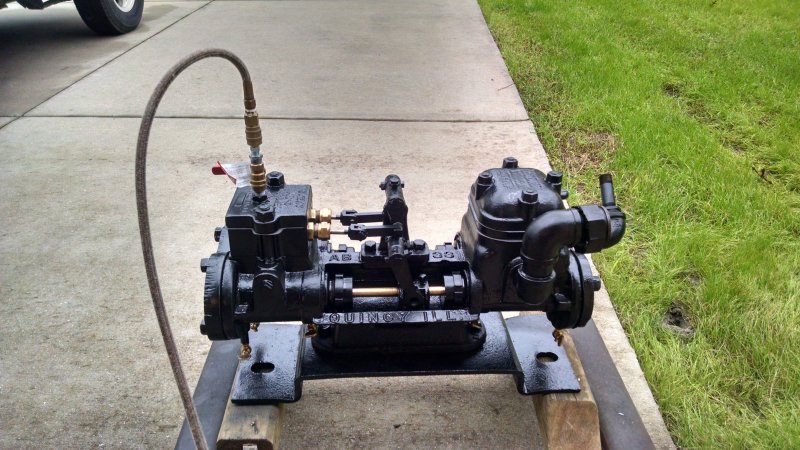
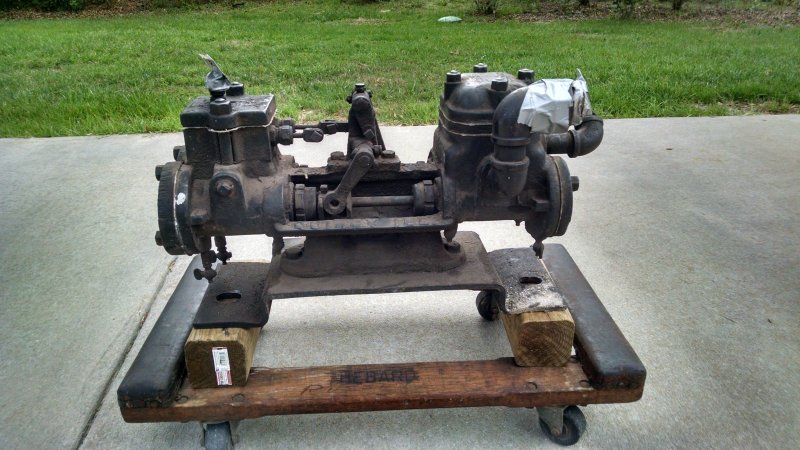
Phil and John have been working on replicating these pieces, and they should be reinstalled in the next few weeks. Being away from the museum as much as I am can not only make it a challenge to manage a project in a way that moves a project along at a good pace and keeps everyone happy, but it is also frustrating when I wish I could physically do more to help while I am not there. Because of this I took on a project for the Shay that could be done from home. It was quite common for logging locomotives to have steam driven water pumps on them to use for firefighting for washing the locomotive, and I am sure for various other uses. Our Shay has had one of these duplex steam pumps on it most of its life. Unfortunately, when the locomotive was retired and before it came to IRM the pump appears to have been removed from the locomotive. In the early to mid 1970s, volunteers replaced it with a different pump. While not the same brand of pump the locomotive carried in service, the pump is an appropriate stand in. In fact, while doing research on this pump, I found that the pump is older than the locomotive! This pump has not been operable in the time I have been a volunteer at IRM (starting in 1995) and even Tom Schneider, who has been with IRM since the mid 1970s, doesn't remember the last time this pump was operable. For many years I have wanted to rebuild this pump and return it to operation. I started working on it in April of this year, and I am happy to report that its rebuild was completed on December 23rd; my Christmas present to IRM, the Shay, and the steam shop.
If there is interest I can write a blog about the restoration of this pump at a future time. But for now, I am excited that the pump is again operable, works well, and will be serviceable on the Shay hopefully for years to come. Overall, work on the Shay is moving along at a fine pace. Much has been accomplished since my last report in September, and the list of things to do is growing ever shorter. We are still working towards the goal of seeing the locomotive operate in 2016. As Nigel and I have both mentioned, we are actively seeking donations towards the rebuilding of the Shay. Nigel has informed me that since his last plea for funds several donations have come in for the Shay. THANK YOU!! We really, truly appreciate every donation we receive. I think perhaps us members don't always express well how much we really appreciate all of you who donate money to preserve and rebuild our equipment, but we couldn't do the work we do without your help. So again, thank you very, very much. I would also like to say a huge THANK YOU to every member of the Steam Department who has helped on the Shay's restoration to date. Each of you will be to thank for the locomotive's return to service. This said, we always welcome new volunteers. If any of you reading this have thought over time, "Someday I would really like to go out there and try volunteering in the Steam Shop," well, why wait? The work is dirty and results can happen slowly, but there is a lifetime of learning available to those who are interested, and generally a good amount of fun as well. You don't need to know a thing about steam locomotives, but just have a willingness to listen, learn, and work. Come out and talk to us in the shop. There is always someone there every Saturday. Whether you are a donor, a volunteer, or a visitor to IRM, thank you for your support, and here's hoping that 2016 sees us have two of our own steam locomotives in operation for the first time since 1999! Brian DaviesMonday, January 4. 2016Diesel Shop update 1/2/2016Saturday in the shop was quite busy. We had Gregg W, Mike B, Don P, Rob S, Dan C, Jeron G, Laddie V, Jim W, Cody Z, and myself. Gregg was working in the M-35, as he put it, "putting things back together that he started taking apart 30 years ago." Mike and I started out bolting the platforms that were painted the day before back into the 504 and painted the top of them along with the bolts. Don changed out some broken toggle switches for the nose and cab dome lights in 1848. 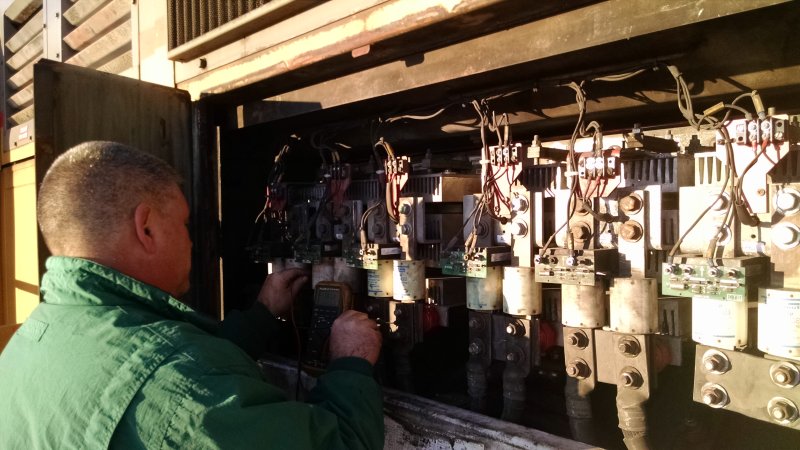 Photo: Dan taking measurements on UP 1848. Jeron, Mike, Don and myself went outside and chipped and dug out a handful of switches and the doors on track 22 so we could move 1848 and 504 outside to test. After they were moved outside using 8537, our trusty 45 tonner, we started 1848 and 504 to let them warm up. Later on Dan tested the rectifier modules that were replaced on 1848 under self load, all worked well there, although there was an issue with specific throttle positions missing some engine speed changes, likely something with the A valve on the governor. We'll look into that soon. On 504 we just wanted to test out the cab heaters, which worked great. Back in the shop, Laddie, Rob and Dan moved the controller from CNW 1518 from the bench up into the cab. Rob continued working on sandblasting cab parts of the 411. Jim and Don watered the batteries of 33 and put it on the charger since it has been a while since that was done. Later on, all of us started cleaning up various materials around the shop, moving a lot of material for the 33 further down the aisle to allow room to work next to 33. A lot of parts that have recently arrived were moved to where they go. A lot of electrical parts that we won't likely use for a while were moved from the parts room to a crate. A lot of general shop cleanup happened until late in the evening. 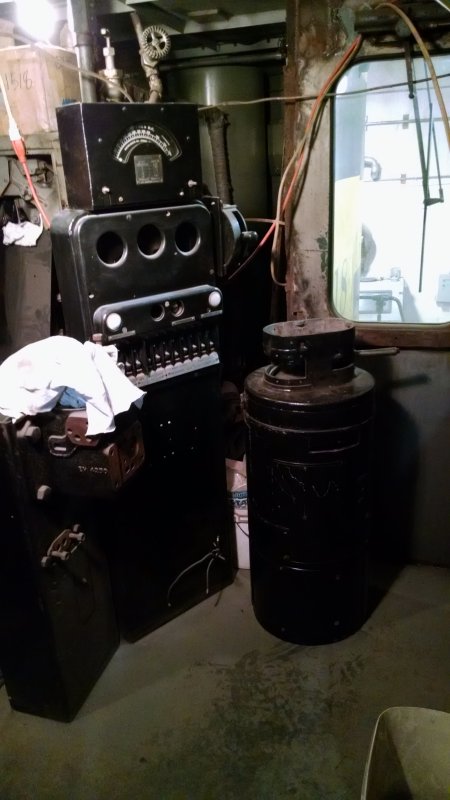 Photo: The controller of CNW 1518 placed on the cab. We even plugged in a backlit number board for Milwaukee Road 197 that someone dropped off a while back. Anyone know if it is still around? 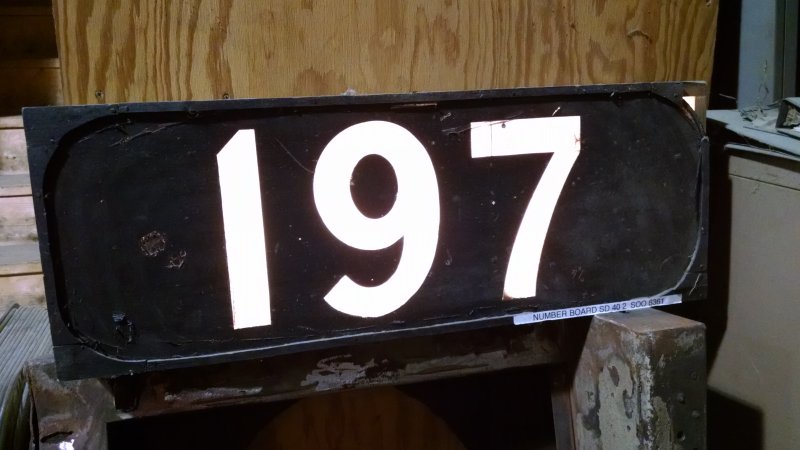 Photo: MILW 197 number board. Saturday, January 2. 2016Diesel Shop update 1/1/2016The first day of the new year it was just myself and Evelina spending a few hours in the shop this afternoon. Evelina stopped by to paint a bunch of targets for the some switch stands in the heated shop, but also helped out on 504 in between letting coats of paint dry. The main goal was to put the cab heater on the fireman side back together with new gaskets and hose couplings to replace the dry rotted ones pulled off a few days ago. After cutting everything to size and putting new hose clamps on the bottom hoses, the cab heat system was charged with water. Just a couple of little areas weeped a bit, and tightening the flanges thoroughly appears to have solved that. The next step is to start it up whenever the next time happens to be and try it all out. 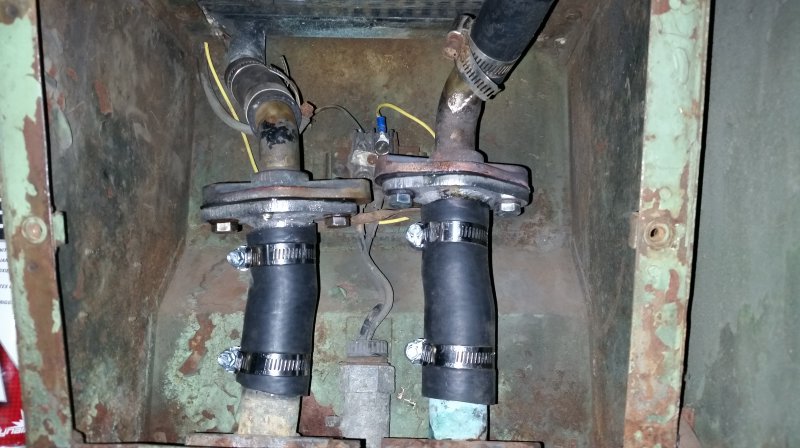 Photo: The FM side heater repairs. Since the heater work went rather quickly, we started working on the platform that goes between the front of the main generator and the back wall of the front electrical cabinet. This is something that has been on the list to complete since 504's restoration a several years ago. Evelina wire wheeled the two halves, primed them all and painted the bottom side. Meanwhile, I spend some time drilling and tapping 15 of the 22 broken bolts that hold the platform halves to the framework in the engine compartment. We needlechipped and wire wheeled, then primed those areas in the engine compartment. Tomorrow I'll finish installing and painting the platforms, which will finally complete this small project. 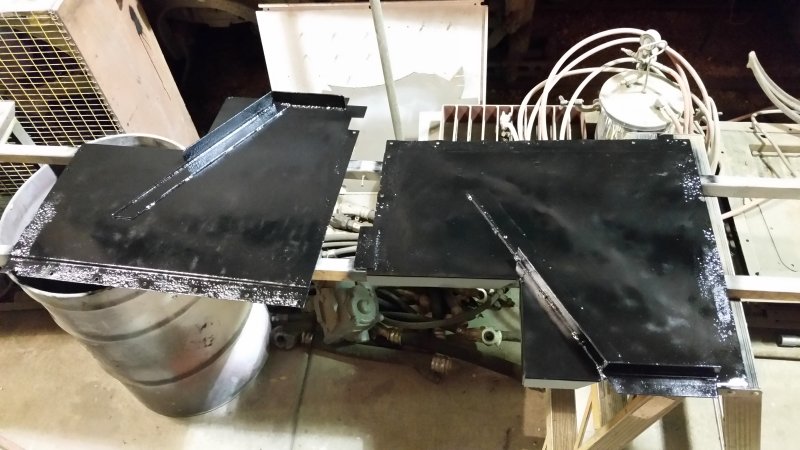 Photo: The platform that goes behind the electrical cabinet. 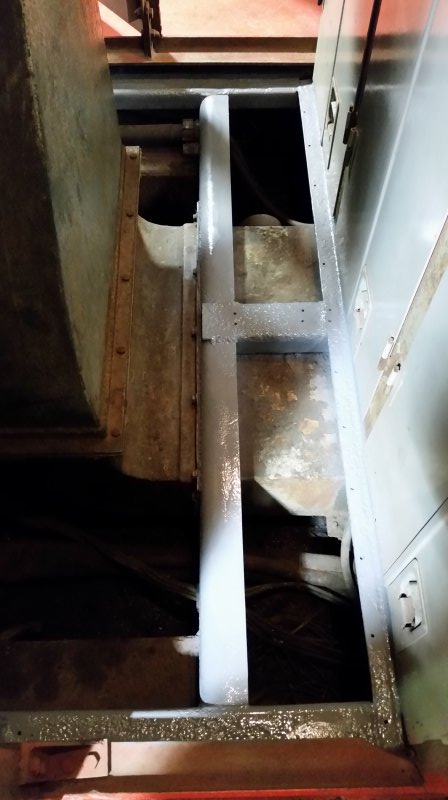 Photo: The frame that supports the platform.
|
Blog AdministrationCalendar
QuicksearchArchivesSyndicate This Blog |
||||||||||||||||||||||||||||||||||||||||||||||||||||||||


Comments
Wed, 04-01-2026 09:01
Good job on the barn 15
Wed, 03-25-2026 18:21
Exciting to see a new barn going up! What's next, after the RAIL project is complete?
Mon, 09-08-2025 08:22
Good job on the Burlington Nortern 9976. OK.
Tue, 08-12-2025 12:56
No new news that I have heard of thus far.
Tue, 08-12-2025 12:53
I'll also be doing another update on it soon. Keep en eye out for that.
Tue, 08-12-2025 12:47
A little work was done to it for Diesel Days this year. You'll see photos floating around for the temporary short term job that was done to make it [...]
Wed, 08-06-2025 13:01
Is steam car CN 15444 going to be coming to museum several times it was to be moved to muesum
Sat, 07-19-2025 18:56
Yeah, sadly it's still there as of 7/19/2025
Thu, 06-12-2025 19:14
Its been 14 years guys, where is the unit? Like really? Did you guys misplace it? Or are repairs taking that long? At this point be might we will have [...]
Wed, 04-09-2025 17:40
Jamie Thanks for the update. She's gonna shine like every thing else you guys do! Smeds
Thu, 03-06-2025 16:28
Yes, there is a wye. Those two have been MU'ed on diesel days a year or two ago.
Wed, 03-05-2025 14:04
7009 number boards look good. Is there a way to turn a locomotive around at IRM? In case you ever had a mind to connect 7009 and 6847?