

|
|
Monday, September 2. 2013Steam Department Update 08-31-2013
It was a crazy week in the steam department. Passing the hydro test last weekend opened up a mass of new work on 1630, while the 60th anniversary event provided a great opportunity to operate as well as many demands for moving equipment in preparation. Luckily Brian Davies has been visiting from Florida so we have had steam department capability on site every day.
On 1630 many tasks are now under way and the critical ones have been progressing quite rapidly:
· After the hydro test, the dome cover was removed,. the water was drained and the boiler ventilated. This enabled the second important FRA inspection. When a boiler has been subject to excess pressure (such as the 125% operating required for the hydro) it must be internally inspected to assure that it has suffered no ill effects, such as loosened braces. By Friday it was dry and the inspection was undertaken when the inspector was on site to check Leviathan. Everything was as it should be. So we are now cleared to move forward to steam test. One key thing to note is that you will see reference to pressure or hydro testing in the next couple of weeks as we finish beading the tube ends. From here on it will always be at no more than the 180 psi operating pressure and just to ensure that we have not created any seepage at the tube ends. We have proved the basic integrity of the boiler and it must not be over pressured, else we would need to do a further internal inspection.
· During the week, Jerry had re-installed the support bars and grates on the engineer's side so she now has a complete and operating grate system again. Yours truly comes in on Friday and wonders why we now have air pipes snaking up the cab steps and thru the cab instead of neatly thru the ash pan as they were before. (Because the grates normally separate the ash pan from the firebox dummy !)
· The dome lid was replaced on Saturday to enable testing of tubes as they are beaded. Unfortunately some work is required on the throttle body so that could not be refitted and the lid will need to come off at a later point to refit this.
· Jane was hard at work painting parts ready for installation. All the bands that will hold the cladding sheets in place are now done. Now if only we can get her the paint for the air tanks we can get those fitted again !.
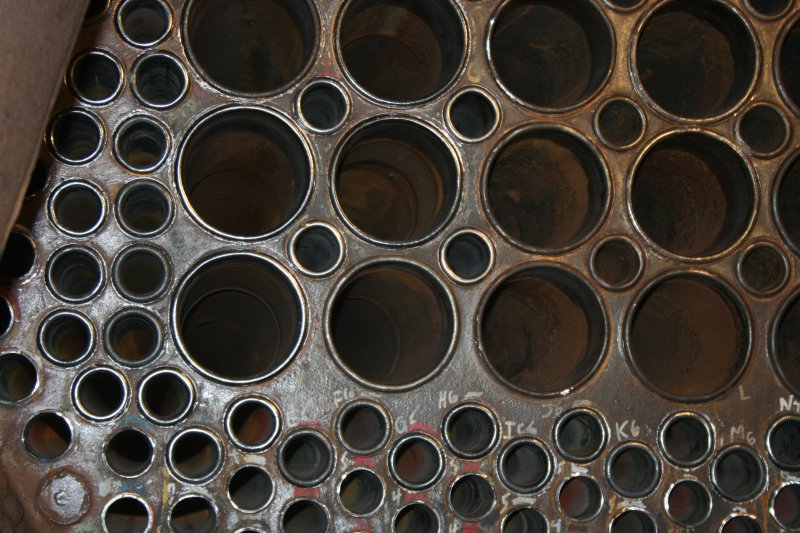
· Beading the tube ends has proceeded well. As shown later, beading requires the 1/4 inch projection of the tube to be rolled over tightly against the sheet. In the front not all the tubes are beaded. The super heater flues and the small tubes beside and immediately below them are beaded to provide additional longitudinal bracing to the tube sheets. In the rear, everything is beaded to protect the seam between tube and tube sheet from the direct flame burn.
Progress was maybe not quite as fast as we had hoped but the weather conspired against us !. Brian Davies has done most of the work but has now trained Brian Krause in the technique, which makes describing who did what complicated !!.
During the week Brian D beaded all the required tubes in the front tube sheet. On a couple of evening he apologized for not moving as fast as he had hoped. When I worked in the shop Friday I fully understood. At 90+ degrees and high humidity, doing anything physical was tough. How he did as much as he did I can barely imagine.
In the picture above you can see the distinction between the tubes higher up, that have a smooth rounded profile overlapping the seam between tube and tube sheet, and those lower down, where the tube is simply expanded into place. This is the effect of beading.
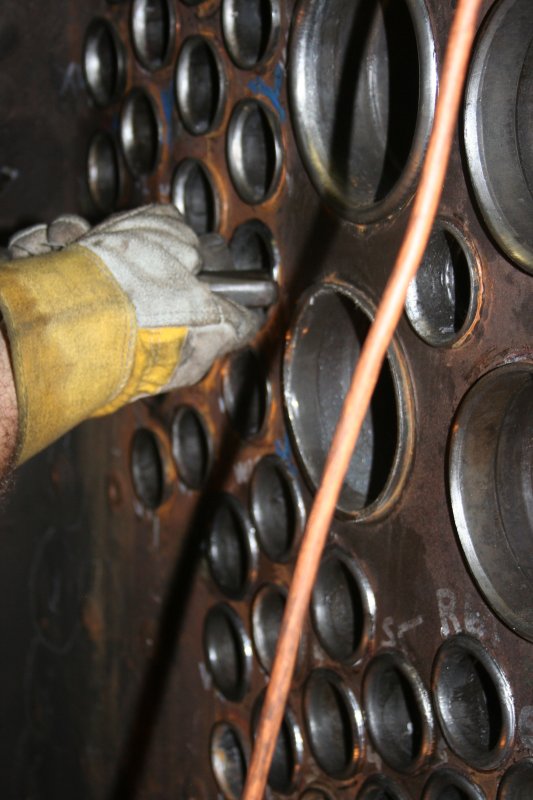
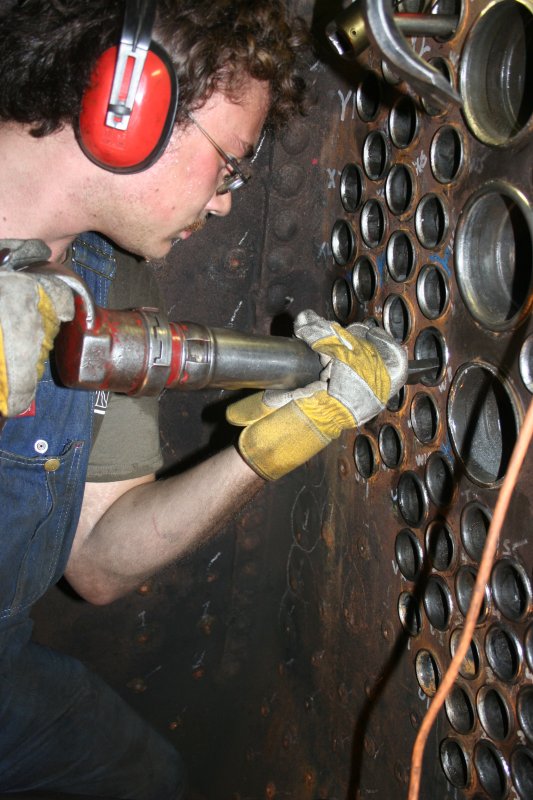
On Saturday and Sunday Brian K worked on the firebox tubes during breaks from the 60th anniversary operation. On Sunday I observed the process and took the photographs below.
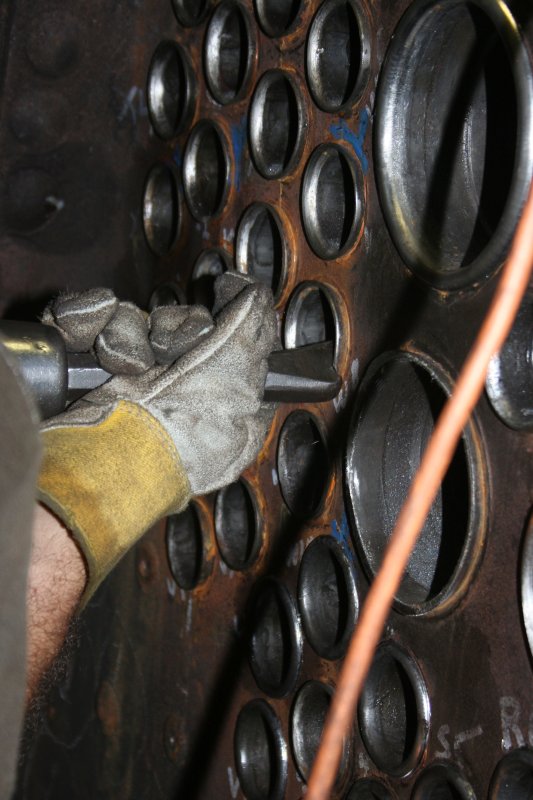
At the start, the end of the tube is expanded into the sheet and, if necessary, reduced to a projection of 1/4 inch. The specially shaped tool in the air hammer has a small extension outside the tube and a longer one inside.
Having started to
hammer the edge of the tube is rolled outward.
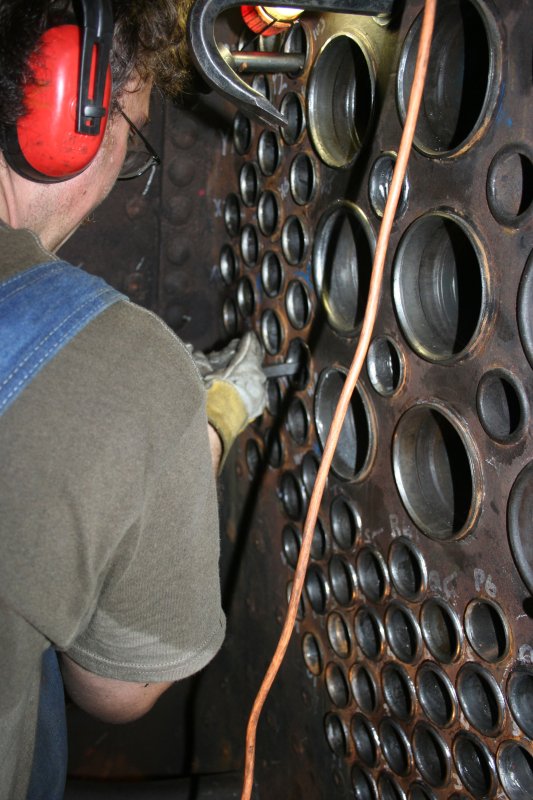
Working steadily
around the whole circumference of the tube, Brian forms the rounded profile all
around the tube end.
A little tidying up
to ensure it is smooth all around, the rolled edge is tight against the tube
sheet and another one is done.
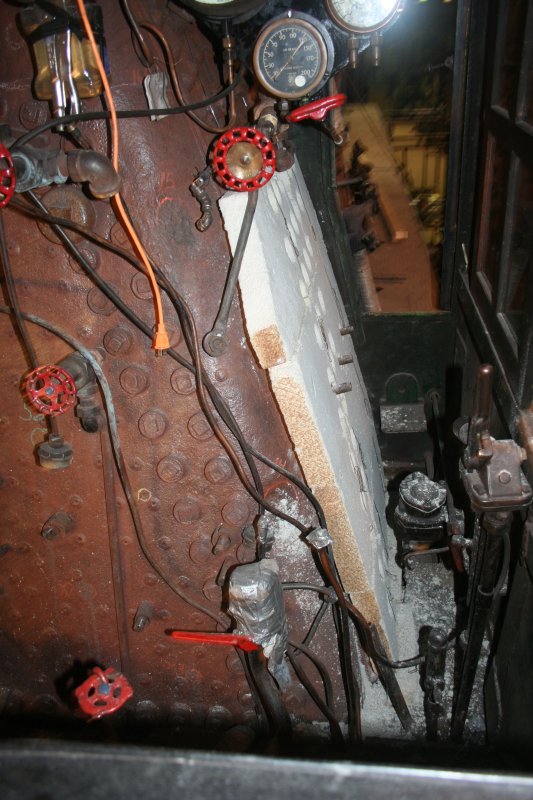
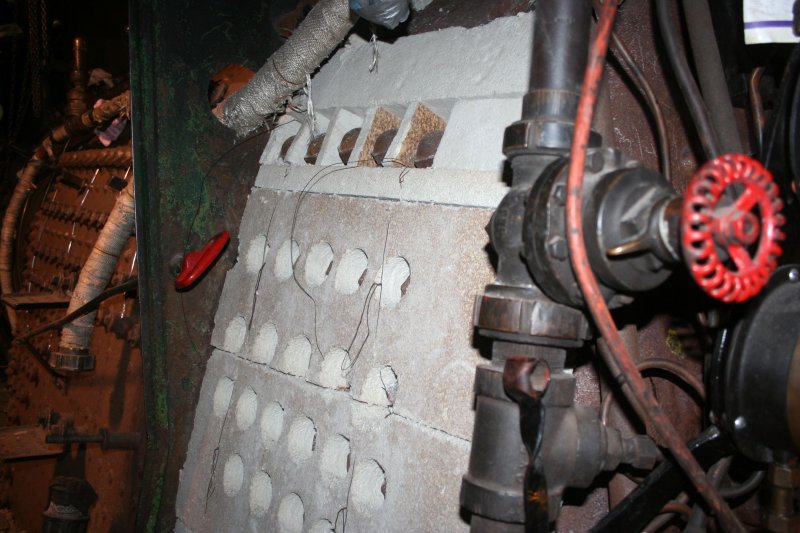
· The other major piece of work now under way is lagging the firebox in the cab. This apparently simple task is going to be a censored nightmare !. First blocks of insulation have to be secured all over the surface of the firebox. This varies from fairly large intact blocks on the lower sides, thru pieces that have to be laboriously cut to fit around stay caps higher on the sides to irregularly cut pieces, that will need to be squeezed into narrow spaces between fittings and pipes, high up on the top. The material is an unpleasant mix of fiber and silicates that is very brittle when cut. So getting it located and intact is a most unpleasant challenge. Once areas are in place we then have the fun of squeezing pieces of sheet metal between the pipes and into a position where they can be secured. This will have to be done as soon as possible since the exposed blocks of carefully located insulation are very fragile and will tend to break up on contact until they are covered.
Bob Milhaupt, who was a regular volunteer until he moved to Michigan, visited for the weekend and worked steadily at this job. By Sunday the insulation was in place well up both sides of the firebox. Dennis repaired one of the cladding sheets that had to be cut to remove it so we have the metal ready to install as soon as we can cover the top of the firebox.
·
Another activity related to the lagging was
identifying the route of some pipes that have been disconnected or replaced so
that we are sure they are in the correct place before lagging is put over them.
·
On Saturday the firebox door casting was lifted
out of the tender so that work could begin on preparing this for fitting. Rick managed to safely remove a couple of
badly burned bolts that secure the distribution plate and all the loose fire
clay. David made good progress in
removing accumulated rust in preparation for repainting. Once the beading is complete in the firebox
this casting can be re-installed. (You
can still get into the firebox with the door casting in place but it will be a
LOT more difficult).
·
Another major stream of work started with Jeff
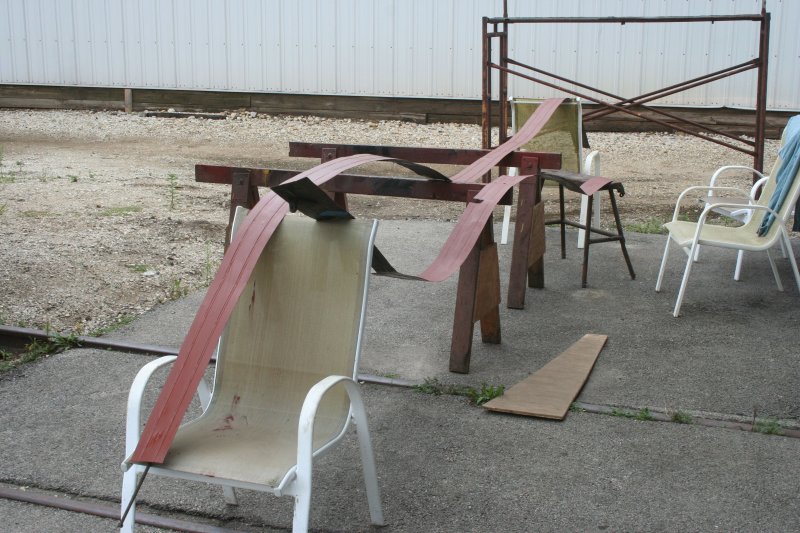
bringing in from the boxcar the various pieces of sheet metal and mesh that
form the table plate and spark arrestor around the blast pipe in the
smokebox. As you may imagine this is a
harsh environment so the whole construction needs to be assessed to determine
which pieces can be reused and which replaced.
So Dennis needs to start on this to ensure that we have it ready once
the blast pipe is installed.
In other areas
within the shop:
·
Phil and Cameron
worked with Tom on machining the bolster for the Shay;
·
Tom continued
machining shoes for the axle boxes on 428.
There was a lot of
work outside in support of the 60th anniversary:
·
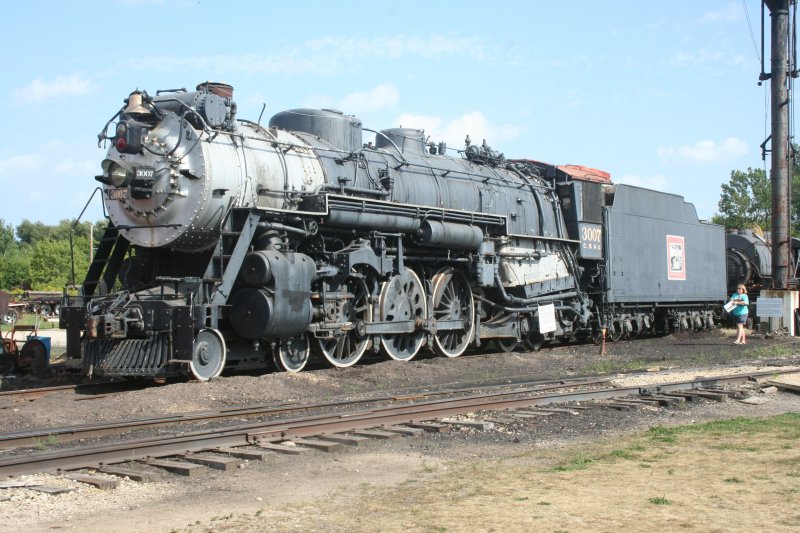
3007 and the
Centennial were moved out of barn 9 for display. This is a very time consuming exercise as a
lot of equipment that does not move often had to be moved to enable this. A number of people were involved in
lubricating the equipment so that it could be safely moved and then assisting
in the switching. When you move pieces
that are normally static great care is required as stiffness may make them much
more prone to derailment.
·
It was great to see
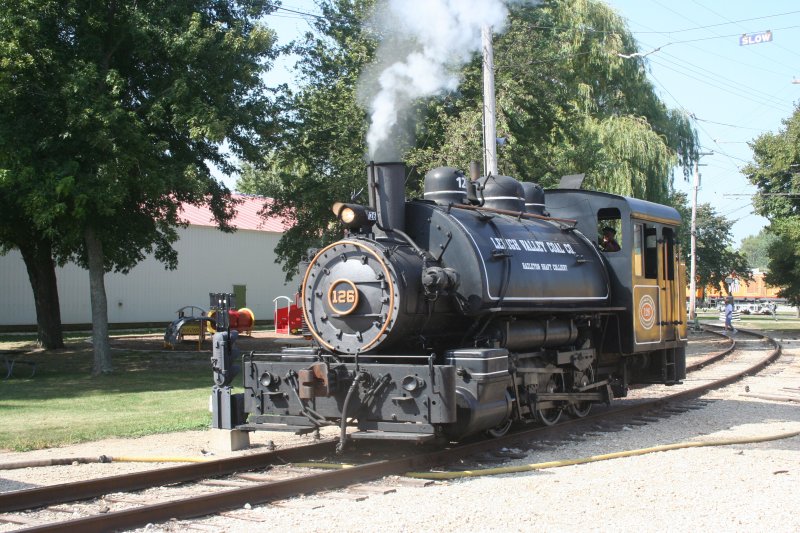
steam in operation with both 126 and Leviathan on site. While Leviathan was fully crewed, the
department provided crews for 126 thru the weekend. This was a great opportunity to get some
operating experience ahead of 1630 coming into service. I thoroughly enjoyed a short spell firing
126. However, when spreading a few part
shovels of coal around her firebox, you became rather aware that the box on
1630, that you had just crawled out of, will present some rather different
challenges !.
·
We observed the FRA
inspection of Leviathan on Friday which was useful as it confirmed what the
inspectors will want to see in the steam testing of 1630.
·
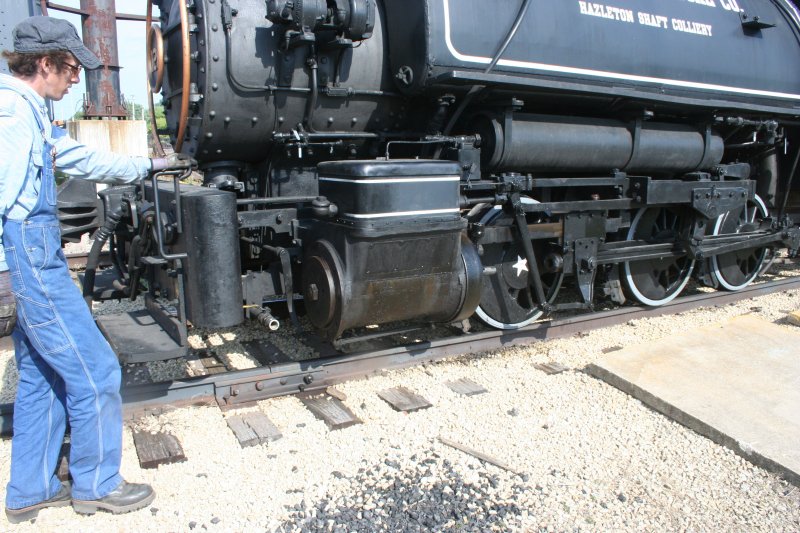
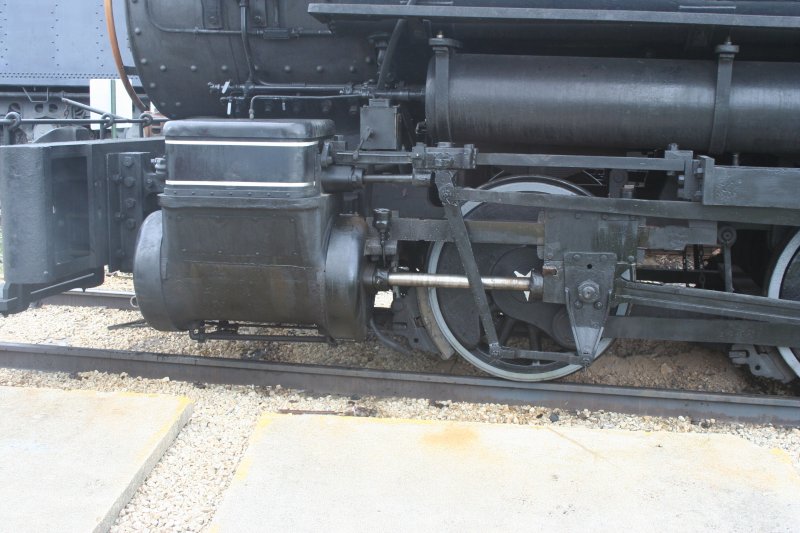
On Friday, 126
provided a chastening example of the exposures in operating a steam
engine. The piston rod worked loose and
detached from the crosshead when switching.
This allowed the piston to be fired forward, smashing the front cylinder
head casting. Luckily Barney had a spare
on another locomotive in process of restoration so, with lot of driving over
night to fetch it from Indiana, she was repaired and back in service on
Saturday. But it certainly highlights
how easily major damage can occur to a steam engine. Repairing something similar on 1630 would be
huge.
So a lot of progress. Much more must happen to enable the steam
test but the objective is now in sight.
Nigel
Sunday, September 1. 2013Wood Shop Update - August 31, 2013I am going to keep with the usual subject header although in this case none of the photos were taken in the shop area. The weather was just too nice and with the 60th anniversary in full swing, it was more a day for watching rather than working. Special events, special equipment, special displays, special operations. But some of us soldiered on with our projects. 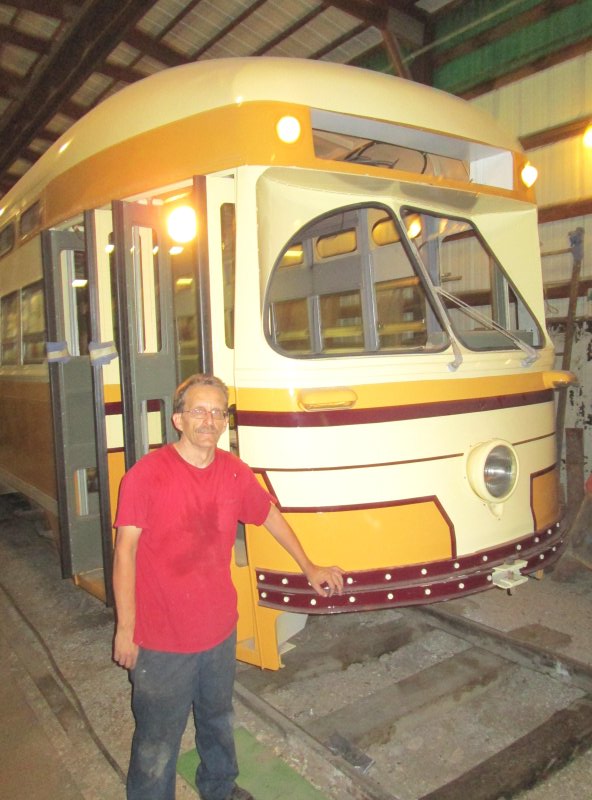 Lights This is a very dramatic photo of Eric Lorenz and the front end of Cleveland Transit System 4223, one of our PCC cars. Eric has been working the last several weeks to make new wiring harnesses and string all that cable in the carbody, in preparation for installing ceiling panels and trim. Here, the thing to note is the front end marker lights illuminated for the first time. On to show you some of our work on our snowplow, Chicago Great Western X 38. 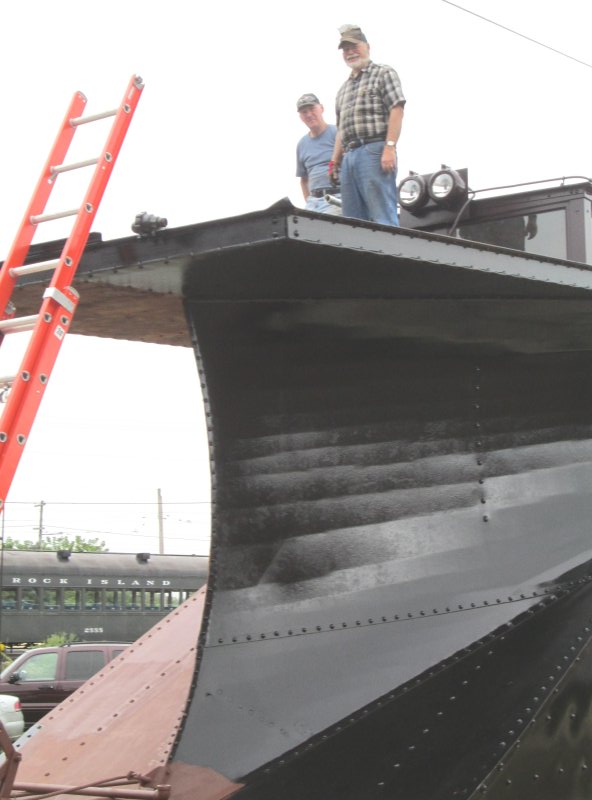 On the Roof Jim Leonard and Bill Peterson are up in the roof of the plow. They assured me they were hard at work but it looks to me they merely have a good bleacher seat for watching the trains going by. 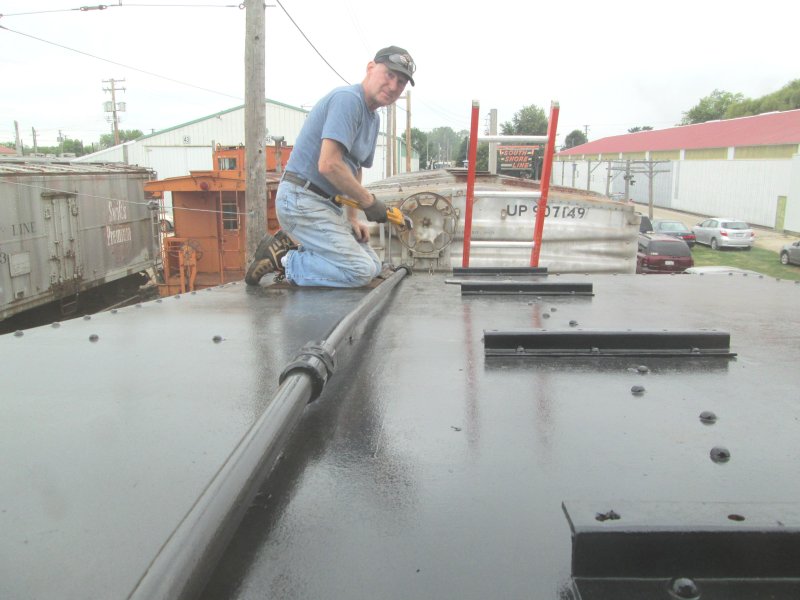 A Wrenching Episode I guess they really were working. Jim has a large pipe wrench, well in hand. For several weeks we have been attempting to remove the damaged train line air pipe, that which runs down from the roof to the front end coupler. It has resisted many of our efforts. But they succeeded, straightened the air pipe, cleaned the old paint from it, and primed it. 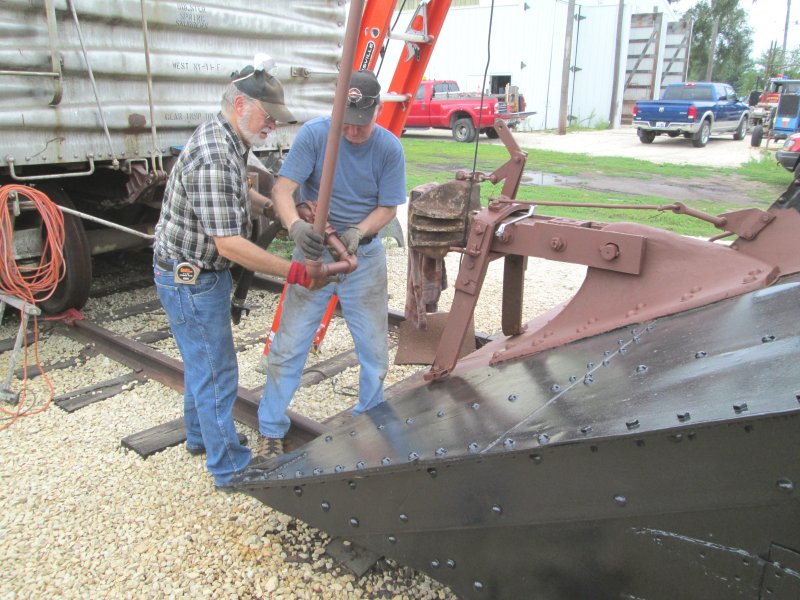 Going Back Together And the drop line from the roof is in, and now Bill and Jim are adding the angle cock and air hose assembly. 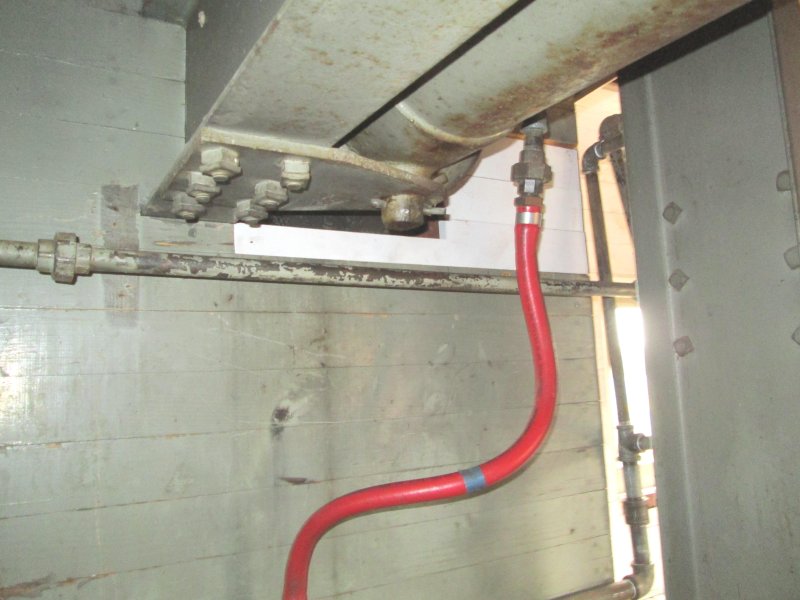 New Siding Here is some new interior siding which was tricky to shape and patch in around one of the plow wing air cylinders. It was gone by the time we received the plow and Dave Rogan did a very good job of fabricating and installing the boards primed in white in this pic. 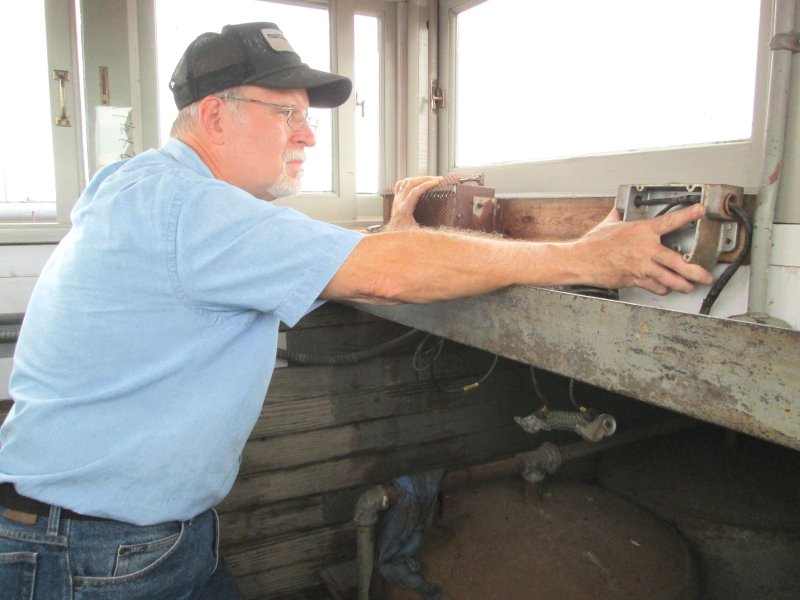 Moving Up Dave joined me in the cupola. I was scraping paint, while Dave worked to re mount some of the electrical gear that was installed when the current sealed beam headlights were installed. 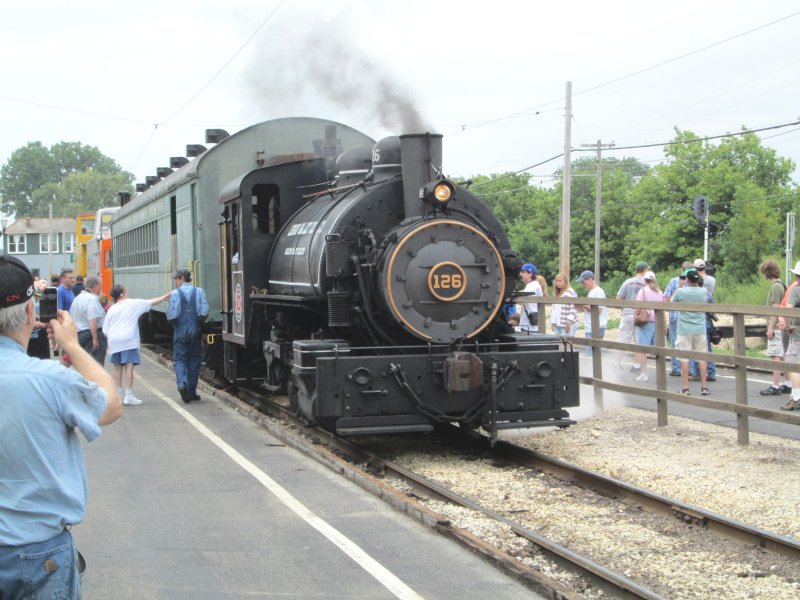 Train Watching I said earlier it was a day for train watching. Here is the 126 in the depot, and pulling a mixed caboose train to the delight of visitors, young and old. 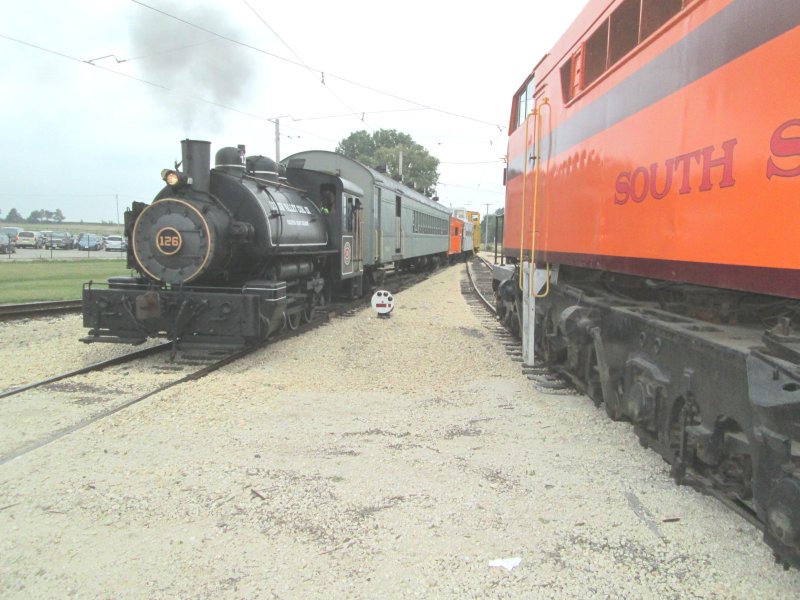 Nice Meeting You Here The caboose train provided three mile round trips - also operating were the LEVIATHAN steam train, the Nebraska Zephyr, and South Shore 803. Here the 126 is returning from one of its popular trips as South Shore 803 idles on the west end of Station Track 2. Brother Chris Buck was the dispatcher, and I bet it was real interesting. At least five different mainline trains, some operating short turns and all needing to be governed efficiently and safely. Tuesday, August 27. 2013What Is Coming Next?In the Freight Car Department we try to limit the number of active restorations underway at any one time, to keep resources focused and get results in something less than five years. But we are always planning the next project. In this case, WELCOME to a tank car used by the Great Northern Railway.  GN X 1390 The car was built in 1956 by American Car and Foundry in Milton, Pennsylvania and is a 20,000 gallon car of fairly modern construction. All welded tank and sills, roller bearing trucks. The tank, underbody, and trucks are all black, with an orange dome and safety panel near it on the top of the tank. Large GREAT NORTHERN lettering is on the the tank to the left of the dome and ladder, while the reporting marks GN X 1390 are to the right. We feel this is a good candidate for our work since it has not deteriorated to the point of needing rebuilding. Also it has NO windows or doors to complicate the work, no rivets (thousands of them) requiring detailing and extra attention during painting. The plan is to hire a contractor to completely clean the car and then to apply two coats of primer and two coats of finish paint. This will result in a good job and be completed in a timely fashion, compared to the option of having our volunteer crew use a needle gun and hand paint the car. The trade off is that we need money to do the job. We are actively engaged in the bidding process and it seems this work will cost us about $12,000. A small price to pay considering our limited staff. Many of you reading these reports often say you wish you could help - I am guessing you would want to take a turn on the needle gun in 95 F weather. No? Then you may still help with a donation to fund RX1390 to top off what monies we have on hand. The mailing address is: Illinois Railway Museum Box 427 Union, IL 60180 The car is mechanically in good condition and has been used in our demonstration freight trains and special events this year. Amazingly, some (most) of the original GREAT NORTHERN lettering is still visible (with some work). We are now documenting and tracing all of that so it may be reapplied to the painted car. The scheme was all black, white lettering, and a bright orange dome area. The car was needed by the GN to ferry diesel fuel oil to the various on line service facilities as the rush was on to dieselize and a great deal of that fuel was needed in many locations. The X before the number indicates it was a company service car and not part of the interchange pool of freight cars. After the merger into Burlington Northern, the car remained on the BN roster until it was acquired by IRM. Here are some detail shots of the remaining lettering. The captions will note the areas of interest and what you are seeing. This is the type of documentation and detective work, sometimes working through layers of paint, to assure the finished restoration will be an accurate and authentic job. 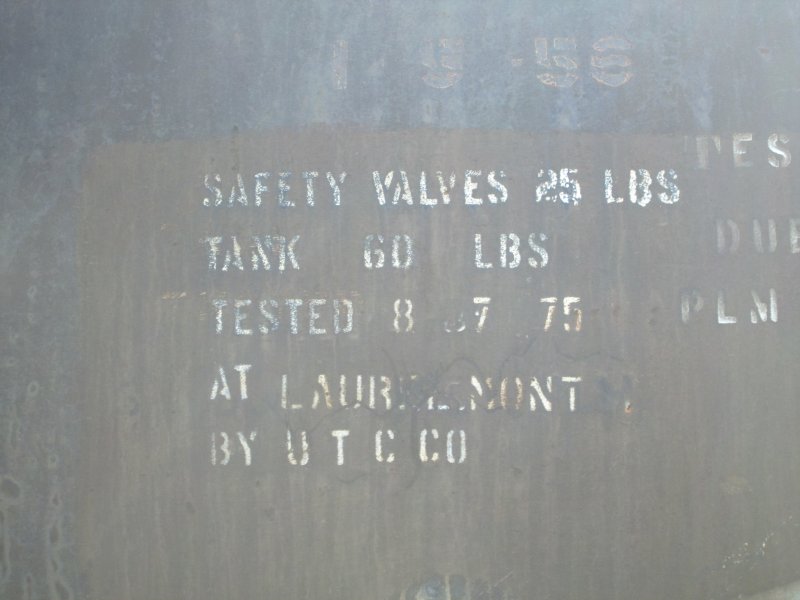 Test Data On the right hand end of each side it was required to display test data for the tank integrity and safety valves. This was retested and renewed during the life of the car, typically every ten years or so. In this case the required testing was done by the Union Tank Car Co (under maintenance contract) at their facility in Laurel, Montana. 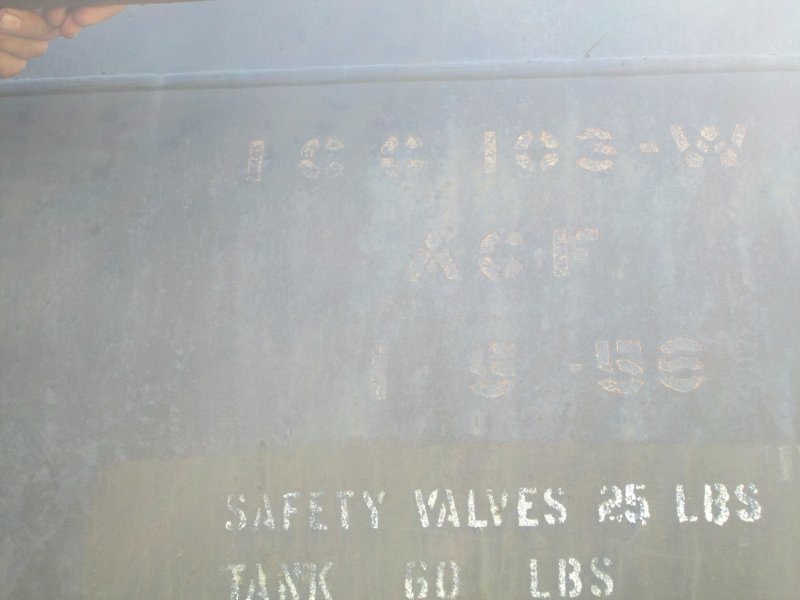 ICC Class Above the test data was the designation of the ICC class for the type of car - in this case 103-W. Below that is ACF indicating the builder, American Car and Foundry; and its birthday, 1-5-56. 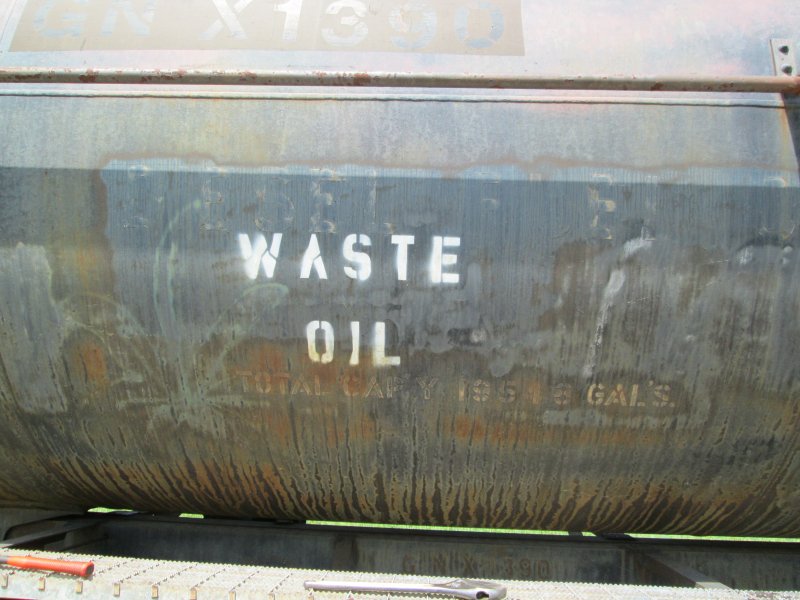 DIESEL FUEL ONLY Here is some of the needed detective work. Faintly, in this photo you will see lettering for DIESEL FUEL ONLY which was as the car was built. It has been painted over and WASTE OIL stenciled in the vicinity by BN. But if you know where to look - - - Below the WASTE OIL add on stencil is the original "TOTAL CAP'Y 19458 GALS." 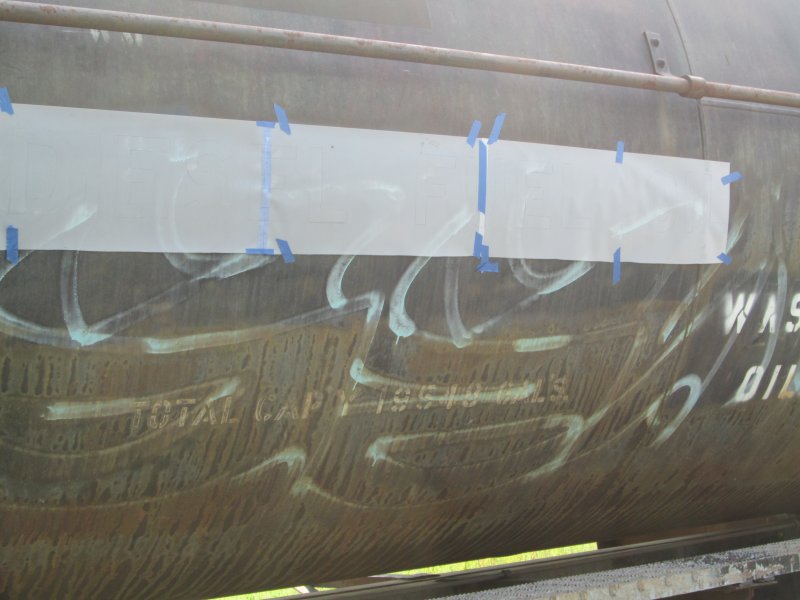 Documentation The remnants of the above lettering are traced out in detail and then mylar taped over it to trace again. This includes the necessary steps of locating the lettering compared to various notation points on the carbody, ends, or underbody. 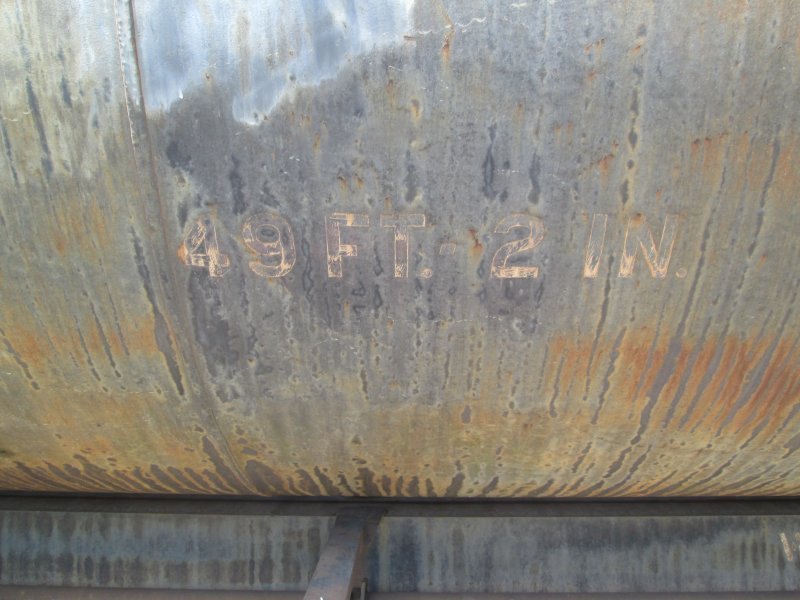 Length Since this car was not in regular interchange service it did not carry a lot of the familiar lettering seen on other cars - such as capacity, light weight, or load limit. But it did have "49 FT. 2 IN." 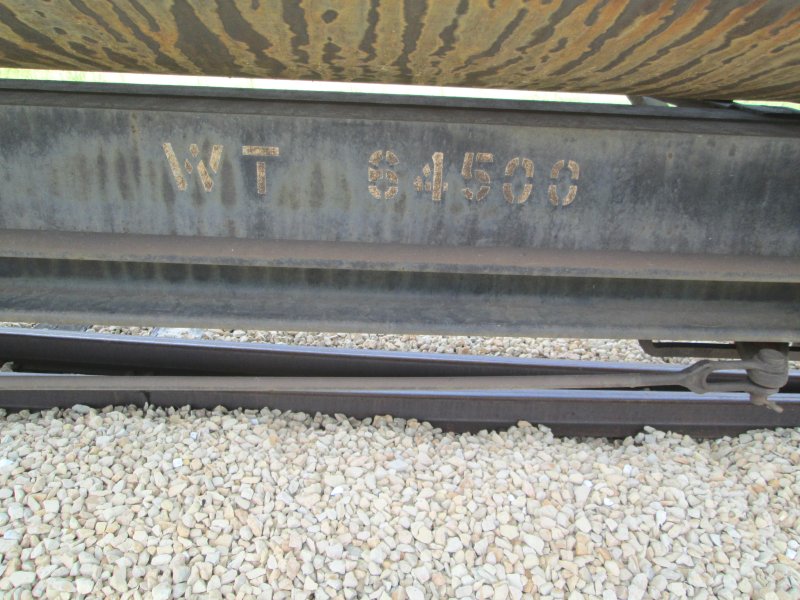 Weight Some of the familiar data is not where expected. On the center sill is "WT. 64500". It is astounding that this original GN lettering in size and style survives 67 years after being painted. 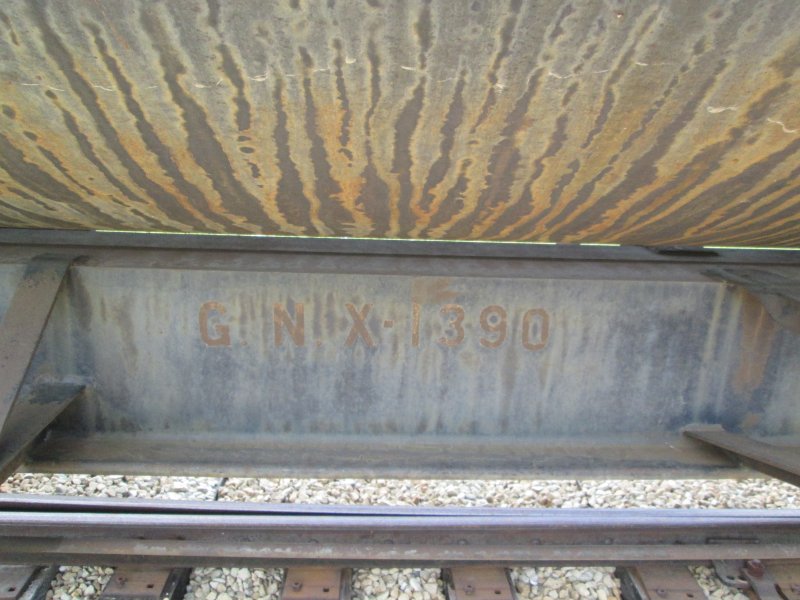 Center Sill The reporting marks in 4 inch letters are also on the center sill "G.N. X-1390" 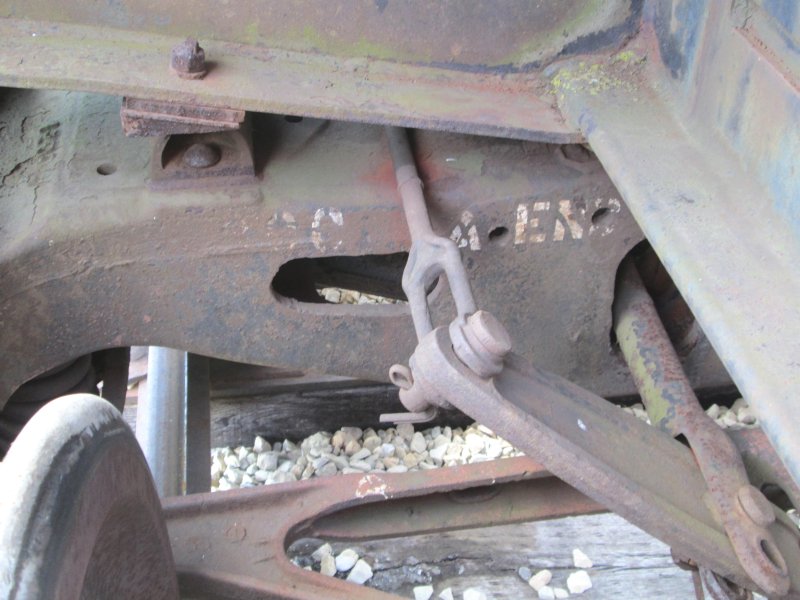 Truck Bolster Some railroads identified the trucks on the car and which car they belonged to. It is not a consistent practice on all railroads and even not consistent for a single railroad on all their cars. Above see "X 1390 A END" 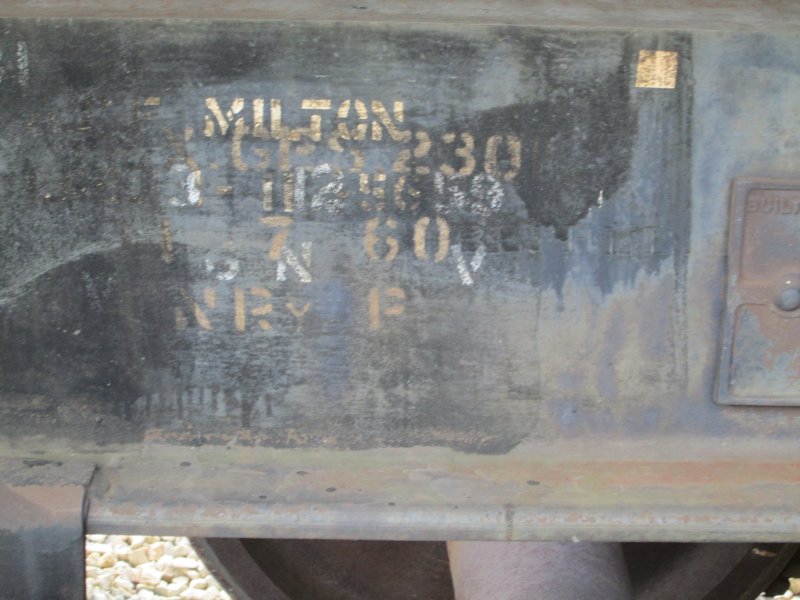 Lube Data Lube data is recorded on the right end of the center sill. Here we can make out at least three layers of that data. Hieroglyphic detectives are welcome to help us peel back the layers. 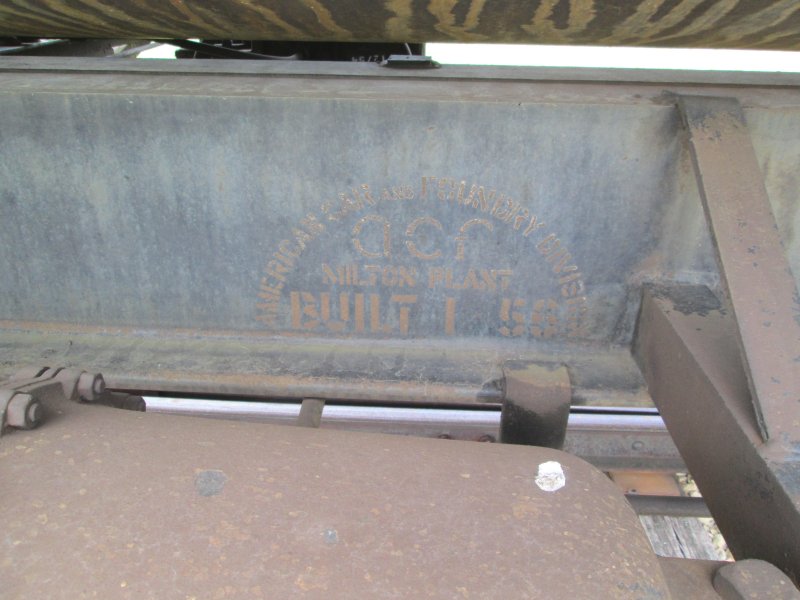 Logo Car builders often applied their logo somewhere on each new car as it left their plant. That only survived until the car was first repainted. Look at this. WOW! The original ACF logo remains visible on the center sill. 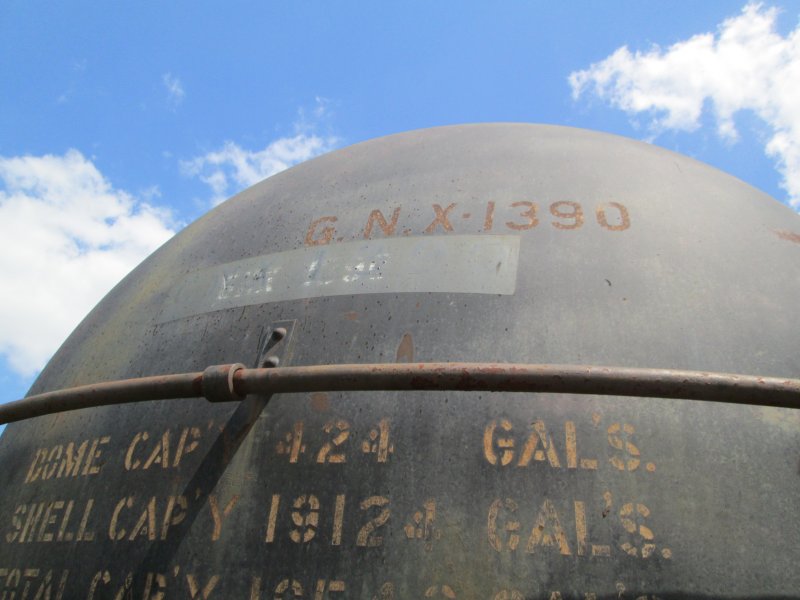 End Marks The original GN reporting marks, also in 4 inch letters, comes through high on the dished tank ends. 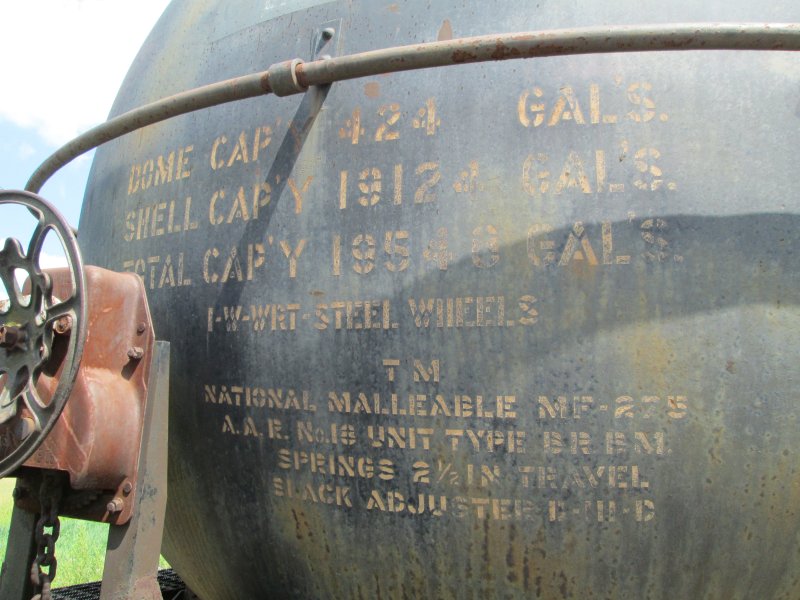 End Data Each end has three lines of 3 inch lettering, one of 2 inch wheel data, and five lines of smaller equipment details. Who wants to trace all that and cut the transfer pattern? More importantly, WHO WANTS TO PAINT IT? Yes this is a very long entry and I have worked along on it for more than one day. Please help with a donation to the project. |
Blog AdministrationCalendarQuicksearchArchivesSyndicate This Blog |


Comments
Tue, 06-02-2026 19:38
Always a treat when a new diesel comes to IRM! Only wish we'd get more diesel department news from week to week, I always wonder what's going on in [...]
Wed, 04-01-2026 09:01
Good job on the barn 15
Wed, 03-25-2026 18:21
Exciting to see a new barn going up! What's next, after the RAIL project is complete?
Mon, 09-08-2025 08:22
Good job on the Burlington Nortern 9976. OK.
Tue, 08-12-2025 12:56
No new news that I have heard of thus far.
Tue, 08-12-2025 12:53
I'll also be doing another update on it soon. Keep en eye out for that.
Tue, 08-12-2025 12:47
A little work was done to it for Diesel Days this year. You'll see photos floating around for the temporary short term job that was done to make it [...]
Wed, 08-06-2025 13:01
Is steam car CN 15444 going to be coming to museum several times it was to be moved to muesum
Sat, 07-19-2025 18:56
Yeah, sadly it's still there as of 7/19/2025
Thu, 06-12-2025 19:14
Its been 14 years guys, where is the unit? Like really? Did you guys misplace it? Or are repairs taking that long? At this point be might we will have [...]
Wed, 04-09-2025 17:40
Jamie Thanks for the update. She's gonna shine like every thing else you guys do! Smeds
Thu, 03-06-2025 16:28
Yes, there is a wye. Those two have been MU'ed on diesel days a year or two ago.