

|
|
Sunday, September 8. 2013Steam Department Update 09-07-2013
It is good to be on the home straight with 1630 but it is increasingly clear that there is still a lot of work to do!. Also some of it is pretty slow and tedious.
It has been a huge benefit to have Brian Davies on site for the last three weeks and a great deal has been achieved in that time. Things will move a lot more slowly when he returns to Florida on Monday.
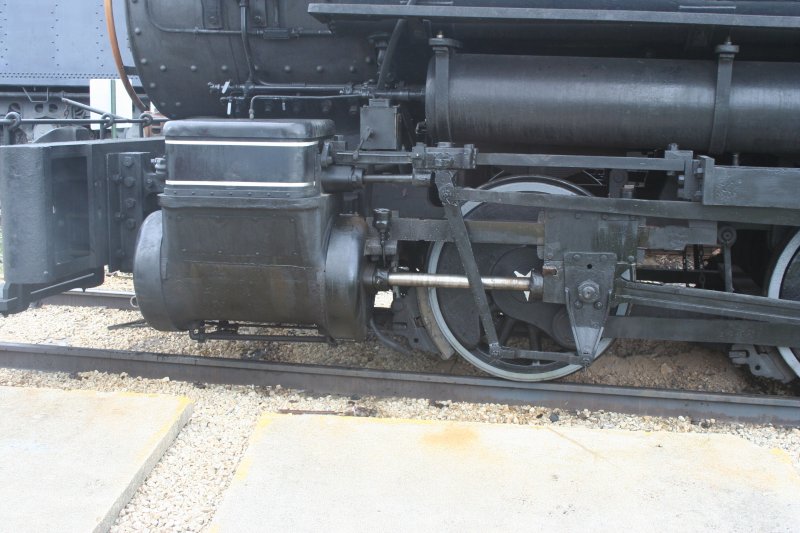
When I arrived on Saturday it was spectacular to see most of the steam collection in the open air, having been switched out of barn 9 for the filming of the Transformers 4.
On 1630 the has been a lot of progress. The two major areas of activity have been finalizing the fitting of tubes (as a prerequisite to installing the super heater elements) and fitting lagging to allow installation of controls and air tanks that must be in place to allow testing.
· During the week Brian Davies had put in a lot of hours and had completed the beading of all tubes in the rear tube sheet;
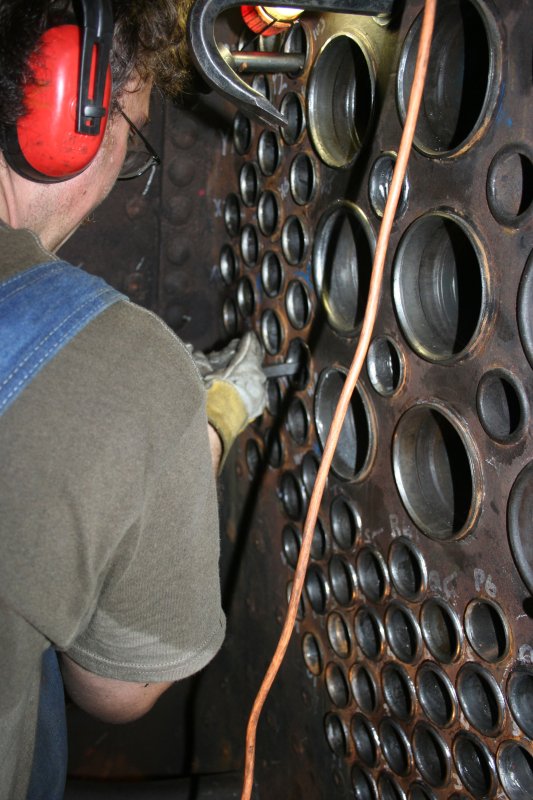
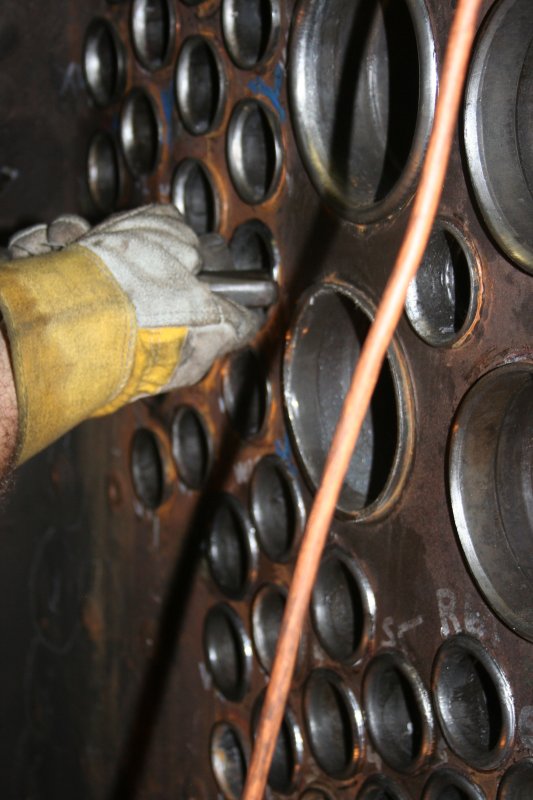
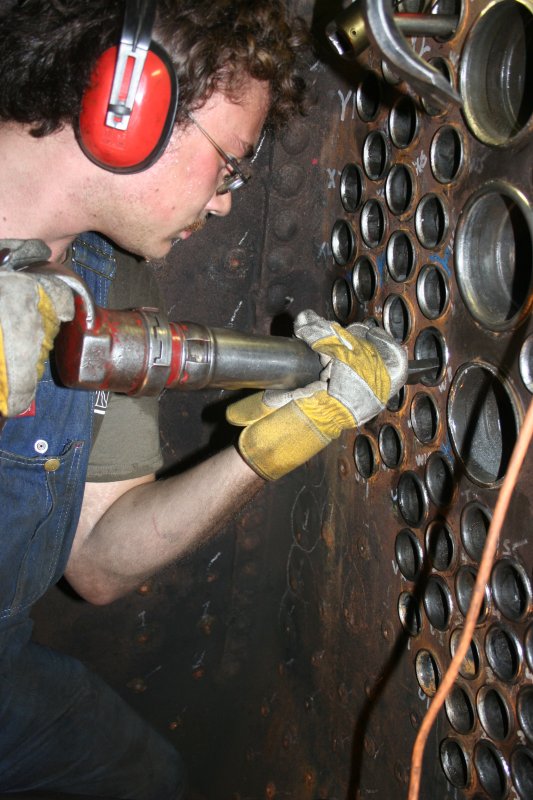
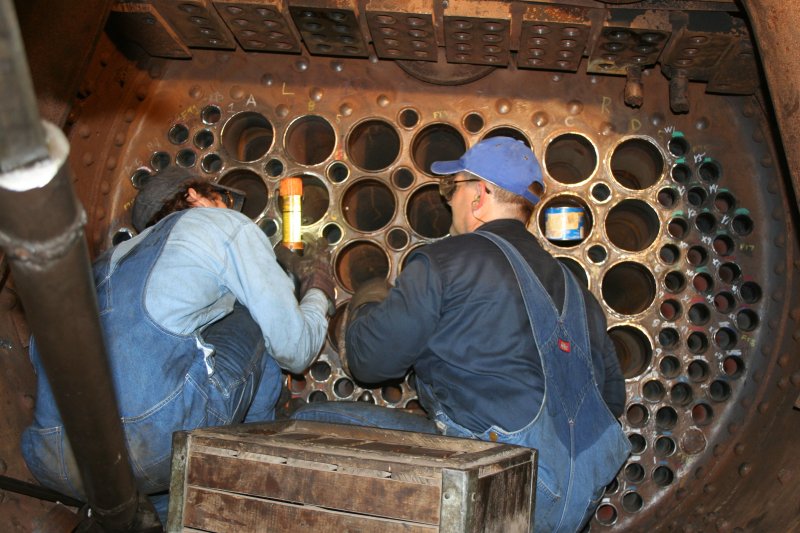
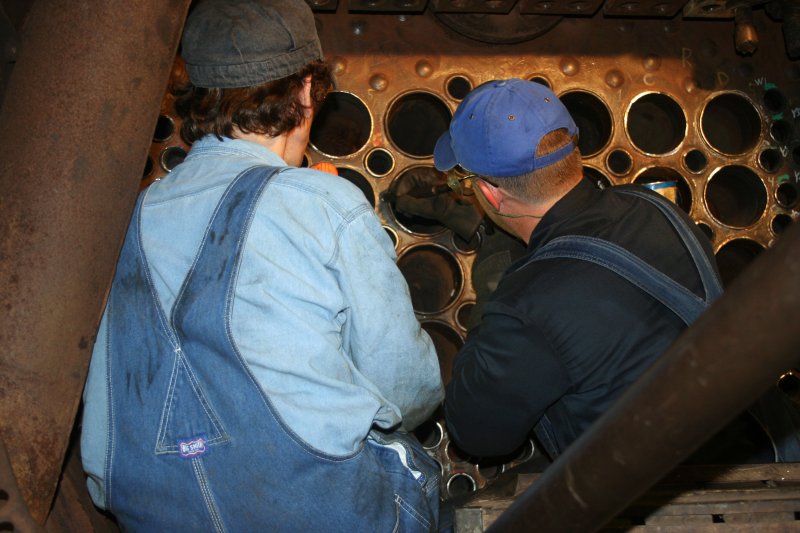
· On Saturday teams of us took it in turns to prosser the tube ends in the rear tube sheet. This process involves expanding the tube slightly on the water side of the tube sheet, using a multi-segment expander driven by an air hammer. The effect of slightly expanding the tube on the water side is to firmly lock the tube into the sheet between the bead and the slight expansion caused by prossering. Anyway, it is a two man job and, by several teams taking it in turns, all 200 tubes were completed by late afternoon. The boiler was then refilled and we started to heat the water. The objective on Sunday will be to test the tube ends under operating pressure and tighten any that show leaks as a result of the beading and prossering. As soon as we are satisfied that the tube ends are dry, the tubing exercise is complete. The motor can then be removed from the smoke box and installation of the super heater elements can begin. So I wait with some trepidation to see if this can be achieved on Sunday !.
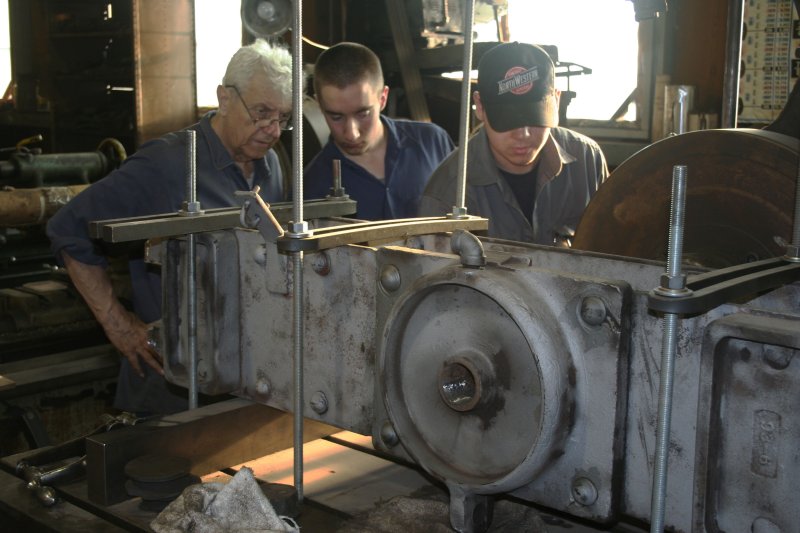
· Stu and Bob worked with Tom to set up a mounting that will allow the throttle to be rigidly located for machining and lapping. The surfaces of the throttle valve need to be leveled and ground to a tight fit that will provide a good seal before the throttle is refitted. By end of day the throttle was mounted and ready for work to be done.
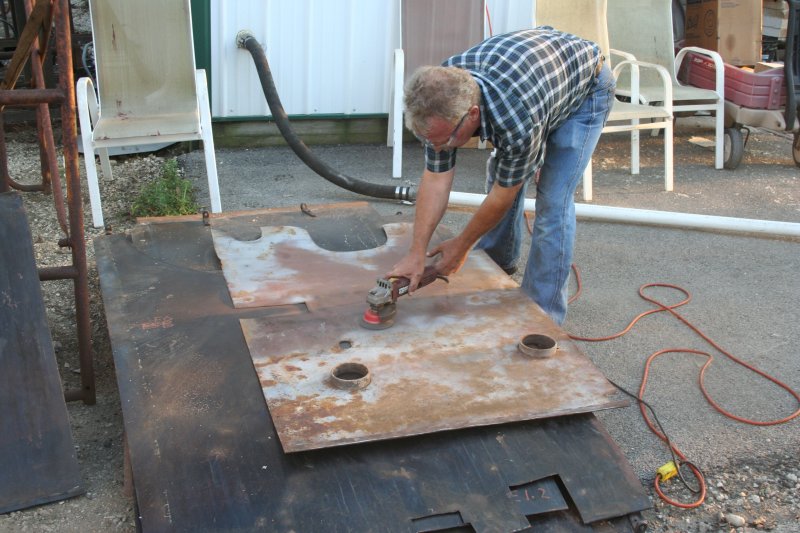
· Dennis started on the plate work and mesh that fits around the blast pipe. He has now assessed all the pieces and identified what new material will need to be fitted to complete this structure once the blast pipe is in place and the super heater elements tested.
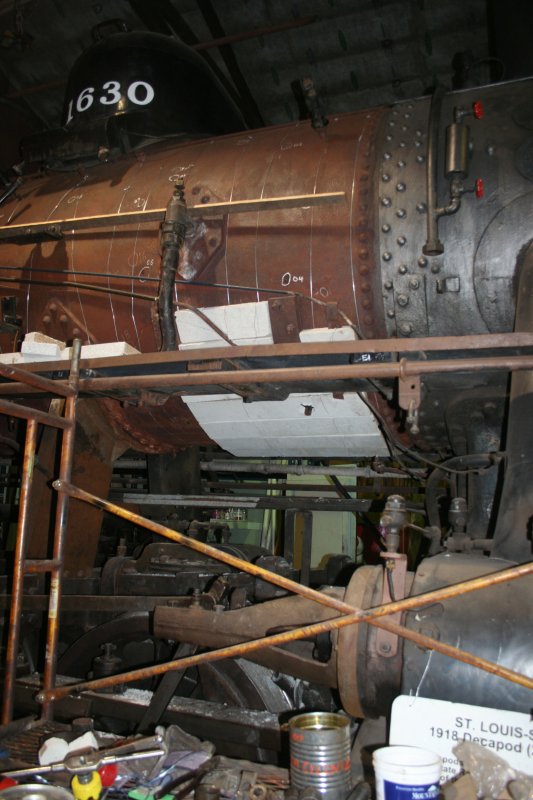
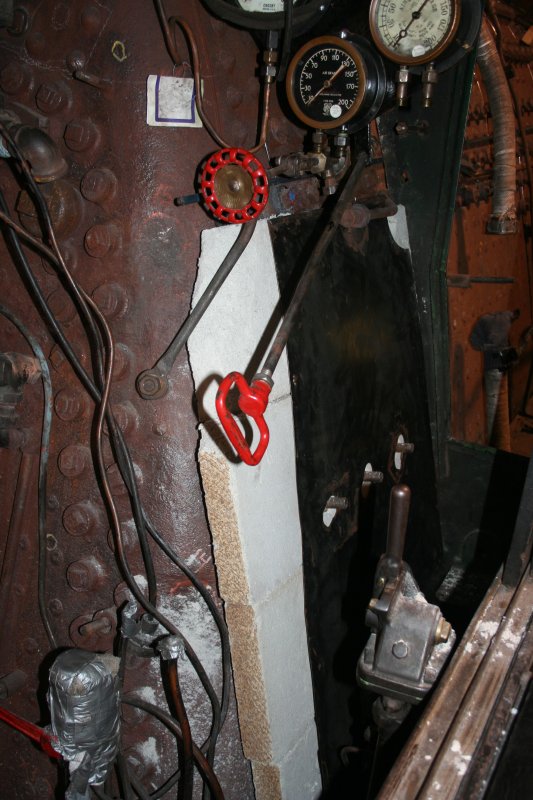
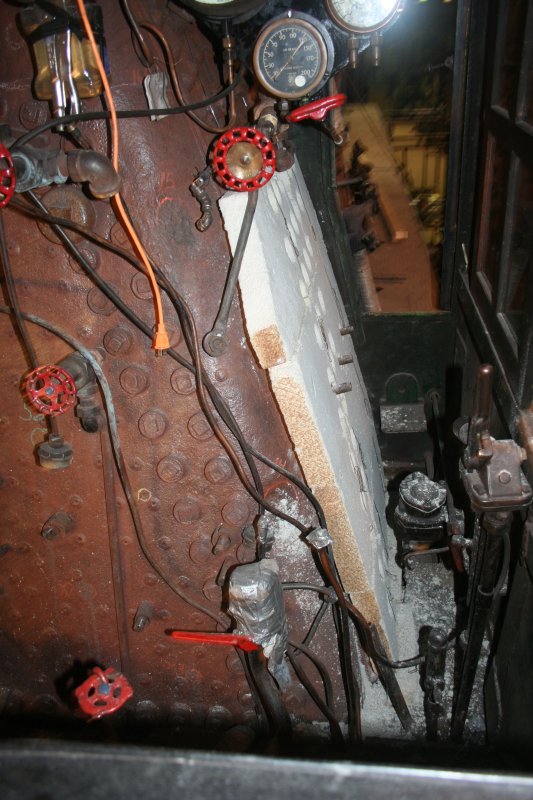
· The lagging is proving rather more troublesome. Two areas are critical for the steam test, the firebox in the cab (to allow fitting of numerous pipes, valves and gauges that are required both for steam testing and pressure testing of the super heater elements) and the first couple of sections of the barrel at the front (to allow refitting of the large air tanks required to complete the air system).
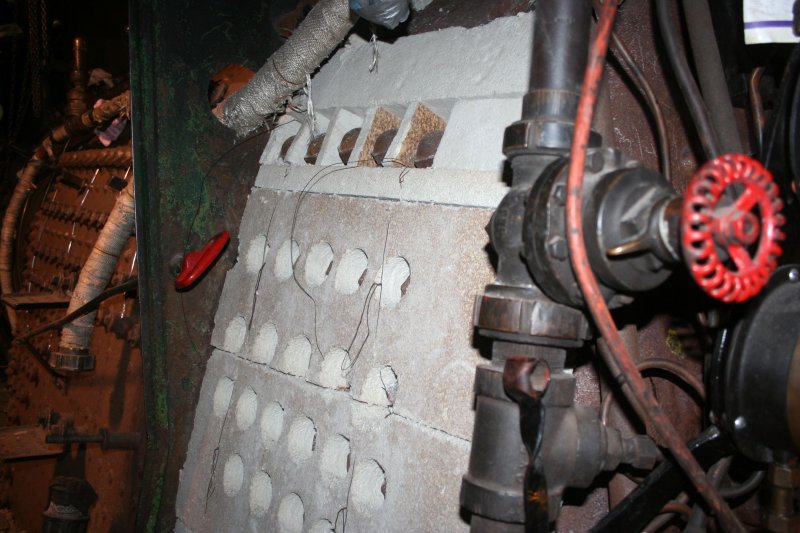
· Work started on fitting the barrel lagging at the front. This is not as simple as it looks (and it does not even look that simple !). The insulation is rigid blocks that cannot be conformed to the curvature of the barrel. So it must be cut into strips about 12 inches wide and the edges cut at an angle so that adjacent blocks fit tightly together along their length. However the blocks must also be tapered along their length. The boiler is formed of 3/4 inch plate in overlapping sections. So, in order to get a smooth taper over which the sheet metal can be fitted, the 2 1/2 inch insulation must be tapered along its length. (Basically the last section at the rear of one boiler ring is the full 2 1/2 inches thick while the front section on the next ring to the rear is 1 3/4 inches thick so that the insulation runs smoothly over the 3/4 inch transition in the boiler plates). Then, having cut sections of insulation to the correct taper along its length and sides, each must be cut around any pipes, hand rails or other projections to fit a specific location. The block is then wired to the wire rings that were placed around the barrel some weeks ago until a complete circle is achieved around the boiler. This will then be strapped into place and the sheet metal fitted over it.
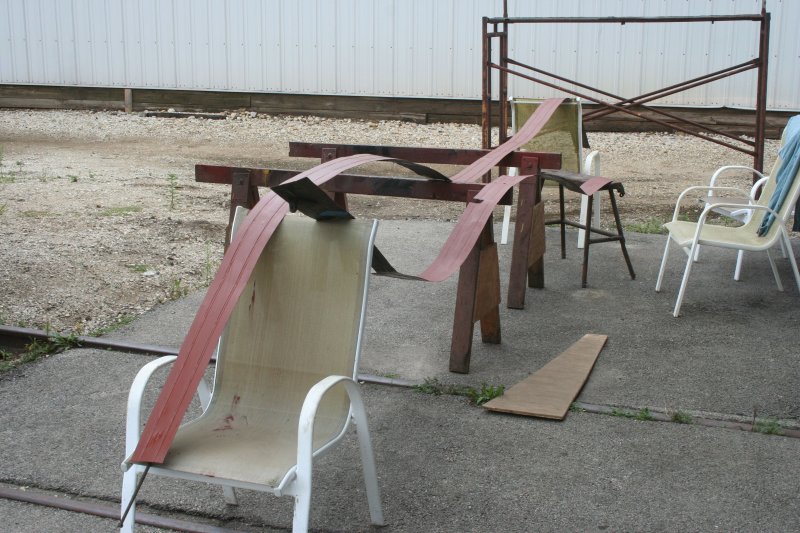
· The sheet metal provided a bit of a setback. Jane had done a lot of work to ensure that all the metal had been cleaned and primed ready for use and had actually been short of painting work in the last couple of weeks once this was done. When we tried to locate the first major sheets required for the front ring they could not be found .............. until we found a whole lot of 1630 sheet metal that had been stored behind a few sheets belonging to #26 !!. It had been overlooked for cleaning and painting so Jerry spent much of the evening wire brushing a lot of sheets and I started painting the ones we need most urgently ..... oh bleep !.
· However the real nightmare is the cab. The sheets covering the top and sides of the firebox in the cab overlap and hold down the curved sections that cover the transition between wrapper and backhead. These, in turn, secure the sheets covering the backhead. The arch of sheet metal running up the sides and across the top of the firebox in the cab must first be located so that the curved sections can be located under its edge. The critical element of the arch is that two pieces of sheet metal must be worked up into the maze of pipes and valves around the turret and linked with 3/8th threaded rods either side of the turret. In addition, insulation must be set under this area in the form of small cut blocks or mud. Once the link is made the sheets form a complete arch that is tensioned by other threaded rods secured into the footplate. All jolly good fun as the area into which the metal and insulation must be placed can only be reached at arms' length from the narrow space at the sides of the firebox or by lying on the cab roof and reaching down several feet into a nest of pipes.
o Most of the work in this area on Saturday was planning to determine in which order pieces can best be fitted. This is critical to the project as the controls essential to testing for leakage in the super heaters cannot be fitted until this is done.
o The sheet metal either side of the firebox is in place to provide protection to the insulation already installed.
o David finished cleaning the fire hole door and I chased the threads on the mounting studs so this can be fitted as soon as the tube ends in the fire box have been proved tight. This is important as much of the backhead lagging is based upon the fire hole door casting.
In other areas
within the shop:
·
Phil and Cameron
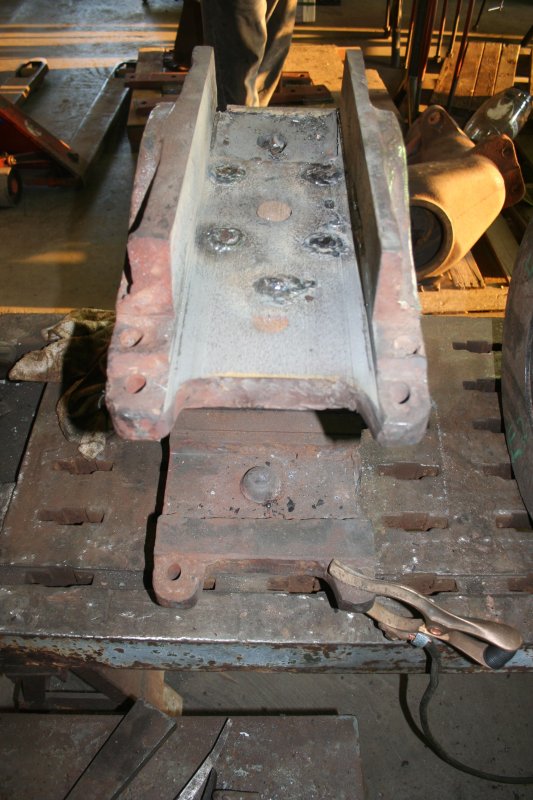
worked with Tom on machining the bolster for the Shay;
·
Dennis started the
long process of building up the axle boxes for 428;
·
Stu and Bob achieved
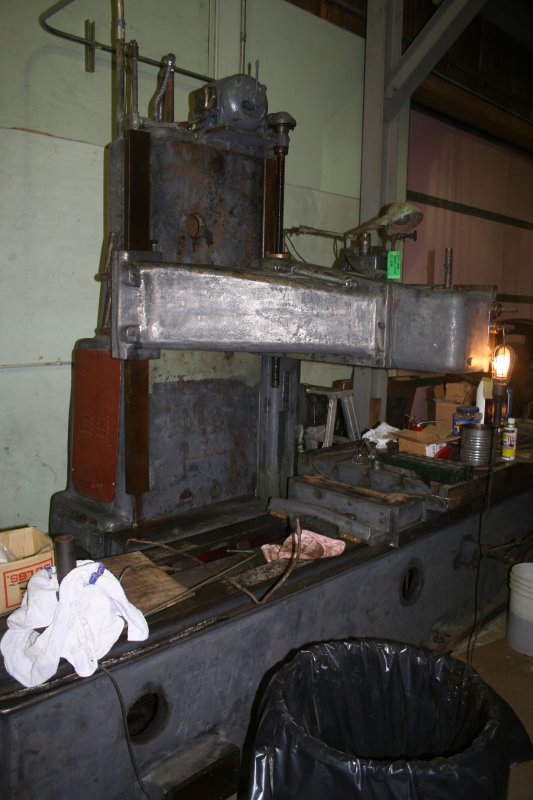
a major milestone on the planer. The
power is now connected and both motors were tested. The head can now be raised and lowered
correctly and the motor driving the hydraulic pump now operates. The next big challenge is how to remove
decades of muck from the drain area under the bed. Since the lubricant supply to the table is
collected and returned to the pump thru this area, there is a considerable
incentive to get it as clean as possible before we try circulating oil thru the
system.
So, a lot of work
done but still a good deal more needed to get to the steam test.
Nigel
Monday, September 2. 2013Steam Department Update 08-31-2013
It was a crazy week in the steam department. Passing the hydro test last weekend opened up a mass of new work on 1630, while the 60th anniversary event provided a great opportunity to operate as well as many demands for moving equipment in preparation. Luckily Brian Davies has been visiting from Florida so we have had steam department capability on site every day.
On 1630 many tasks are now under way and the critical ones have been progressing quite rapidly:
· After the hydro test, the dome cover was removed,. the water was drained and the boiler ventilated. This enabled the second important FRA inspection. When a boiler has been subject to excess pressure (such as the 125% operating required for the hydro) it must be internally inspected to assure that it has suffered no ill effects, such as loosened braces. By Friday it was dry and the inspection was undertaken when the inspector was on site to check Leviathan. Everything was as it should be. So we are now cleared to move forward to steam test. One key thing to note is that you will see reference to pressure or hydro testing in the next couple of weeks as we finish beading the tube ends. From here on it will always be at no more than the 180 psi operating pressure and just to ensure that we have not created any seepage at the tube ends. We have proved the basic integrity of the boiler and it must not be over pressured, else we would need to do a further internal inspection.
· During the week, Jerry had re-installed the support bars and grates on the engineer's side so she now has a complete and operating grate system again. Yours truly comes in on Friday and wonders why we now have air pipes snaking up the cab steps and thru the cab instead of neatly thru the ash pan as they were before. (Because the grates normally separate the ash pan from the firebox dummy !)
· The dome lid was replaced on Saturday to enable testing of tubes as they are beaded. Unfortunately some work is required on the throttle body so that could not be refitted and the lid will need to come off at a later point to refit this.
· Jane was hard at work painting parts ready for installation. All the bands that will hold the cladding sheets in place are now done. Now if only we can get her the paint for the air tanks we can get those fitted again !.
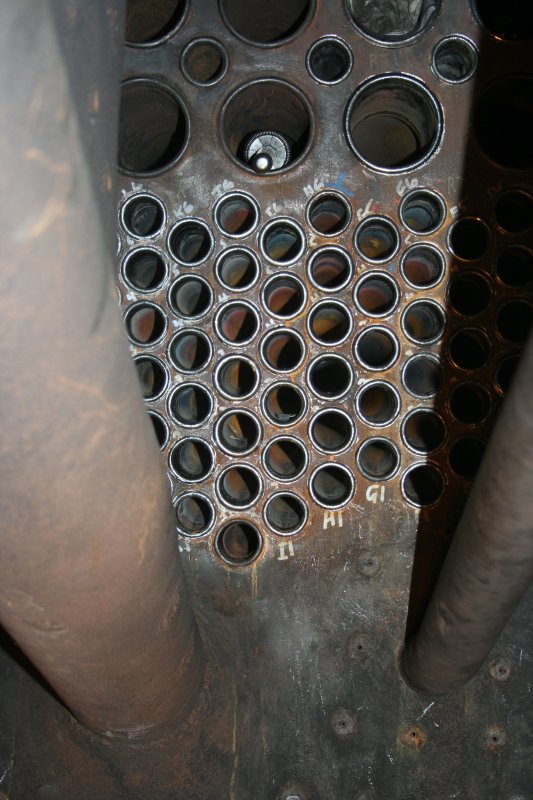
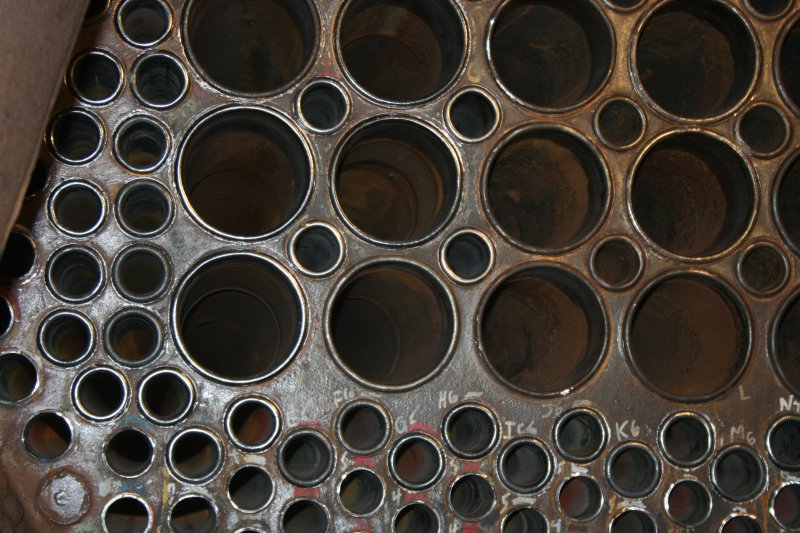
· Beading the tube ends has proceeded well. As shown later, beading requires the 1/4 inch projection of the tube to be rolled over tightly against the sheet. In the front not all the tubes are beaded. The super heater flues and the small tubes beside and immediately below them are beaded to provide additional longitudinal bracing to the tube sheets. In the rear, everything is beaded to protect the seam between tube and tube sheet from the direct flame burn.
Progress was maybe not quite as fast as we had hoped but the weather conspired against us !. Brian Davies has done most of the work but has now trained Brian Krause in the technique, which makes describing who did what complicated !!.
During the week Brian D beaded all the required tubes in the front tube sheet. On a couple of evening he apologized for not moving as fast as he had hoped. When I worked in the shop Friday I fully understood. At 90+ degrees and high humidity, doing anything physical was tough. How he did as much as he did I can barely imagine.
In the picture above you can see the distinction between the tubes higher up, that have a smooth rounded profile overlapping the seam between tube and tube sheet, and those lower down, where the tube is simply expanded into place. This is the effect of beading.
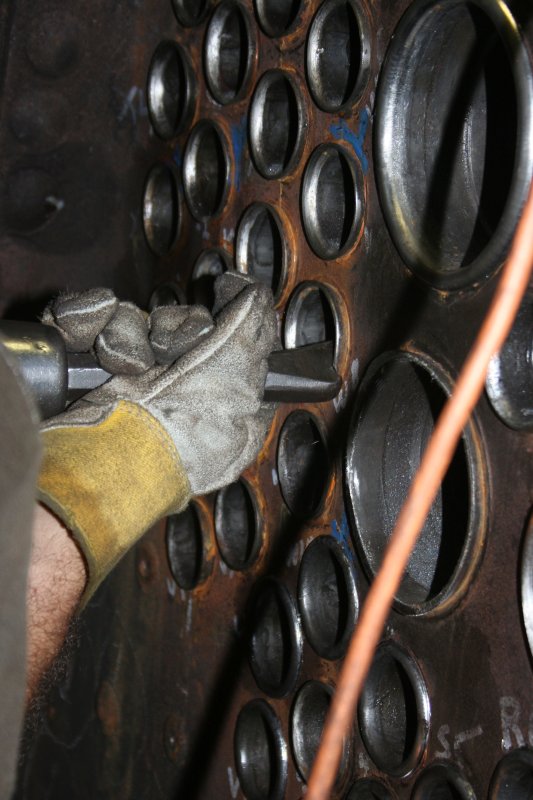
On Saturday and Sunday Brian K worked on the firebox tubes during breaks from the 60th anniversary operation. On Sunday I observed the process and took the photographs below.
At the start, the end of the tube is expanded into the sheet and, if necessary, reduced to a projection of 1/4 inch. The specially shaped tool in the air hammer has a small extension outside the tube and a longer one inside.
Having started to
hammer the edge of the tube is rolled outward.
Working steadily
around the whole circumference of the tube, Brian forms the rounded profile all
around the tube end.
A little tidying up
to ensure it is smooth all around, the rolled edge is tight against the tube
sheet and another one is done.
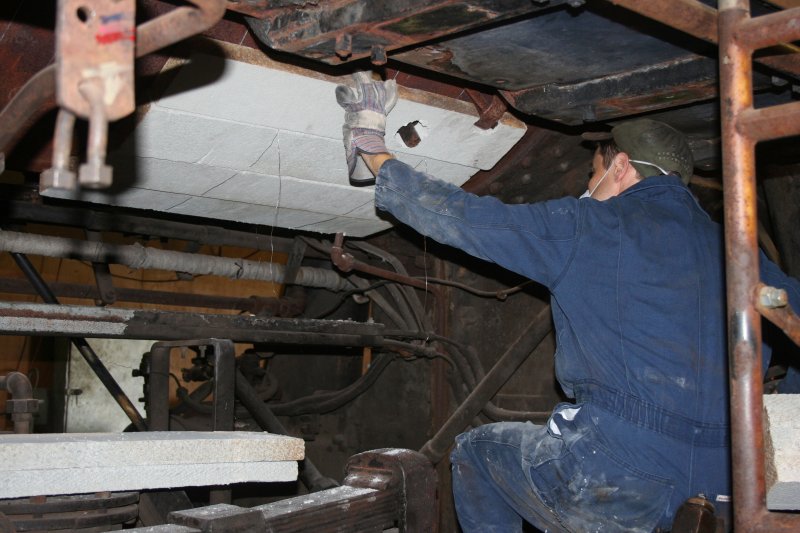
· The other major piece of work now under way is lagging the firebox in the cab. This apparently simple task is going to be a censored nightmare !. First blocks of insulation have to be secured all over the surface of the firebox. This varies from fairly large intact blocks on the lower sides, thru pieces that have to be laboriously cut to fit around stay caps higher on the sides to irregularly cut pieces, that will need to be squeezed into narrow spaces between fittings and pipes, high up on the top. The material is an unpleasant mix of fiber and silicates that is very brittle when cut. So getting it located and intact is a most unpleasant challenge. Once areas are in place we then have the fun of squeezing pieces of sheet metal between the pipes and into a position where they can be secured. This will have to be done as soon as possible since the exposed blocks of carefully located insulation are very fragile and will tend to break up on contact until they are covered.
Bob Milhaupt, who was a regular volunteer until he moved to Michigan, visited for the weekend and worked steadily at this job. By Sunday the insulation was in place well up both sides of the firebox. Dennis repaired one of the cladding sheets that had to be cut to remove it so we have the metal ready to install as soon as we can cover the top of the firebox.
·
Another activity related to the lagging was
identifying the route of some pipes that have been disconnected or replaced so
that we are sure they are in the correct place before lagging is put over them.
·
On Saturday the firebox door casting was lifted
out of the tender so that work could begin on preparing this for fitting. Rick managed to safely remove a couple of
badly burned bolts that secure the distribution plate and all the loose fire
clay. David made good progress in
removing accumulated rust in preparation for repainting. Once the beading is complete in the firebox
this casting can be re-installed. (You
can still get into the firebox with the door casting in place but it will be a
LOT more difficult).
·
Another major stream of work started with Jeff
bringing in from the boxcar the various pieces of sheet metal and mesh that
form the table plate and spark arrestor around the blast pipe in the
smokebox. As you may imagine this is a
harsh environment so the whole construction needs to be assessed to determine
which pieces can be reused and which replaced.
So Dennis needs to start on this to ensure that we have it ready once
the blast pipe is installed.
In other areas
within the shop:
·
Phil and Cameron
worked with Tom on machining the bolster for the Shay;
·
Tom continued
machining shoes for the axle boxes on 428.
There was a lot of
work outside in support of the 60th anniversary:
·
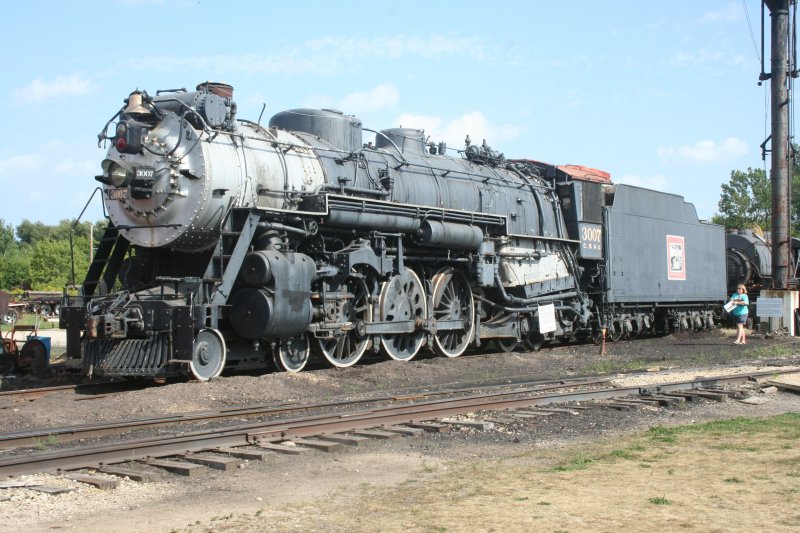
3007 and the
Centennial were moved out of barn 9 for display. This is a very time consuming exercise as a
lot of equipment that does not move often had to be moved to enable this. A number of people were involved in
lubricating the equipment so that it could be safely moved and then assisting
in the switching. When you move pieces
that are normally static great care is required as stiffness may make them much
more prone to derailment.
·
It was great to see
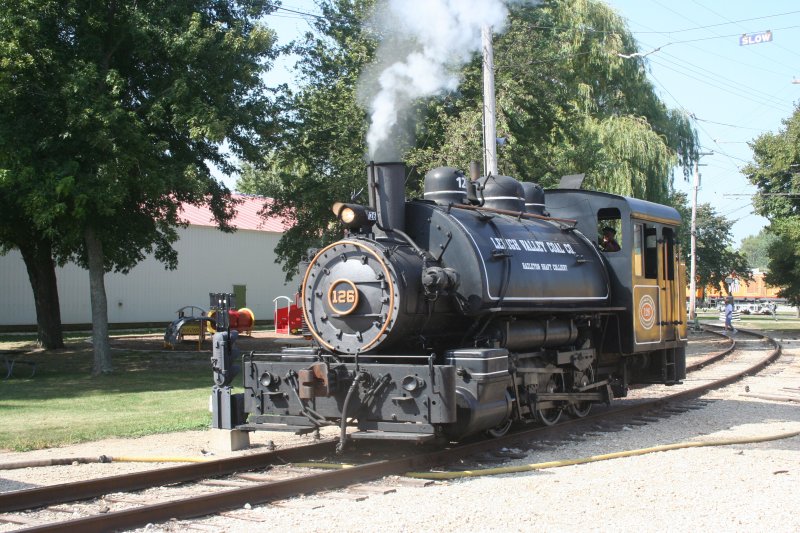
steam in operation with both 126 and Leviathan on site. While Leviathan was fully crewed, the
department provided crews for 126 thru the weekend. This was a great opportunity to get some
operating experience ahead of 1630 coming into service. I thoroughly enjoyed a short spell firing
126. However, when spreading a few part
shovels of coal around her firebox, you became rather aware that the box on
1630, that you had just crawled out of, will present some rather different
challenges !.
·
We observed the FRA
inspection of Leviathan on Friday which was useful as it confirmed what the
inspectors will want to see in the steam testing of 1630.
·
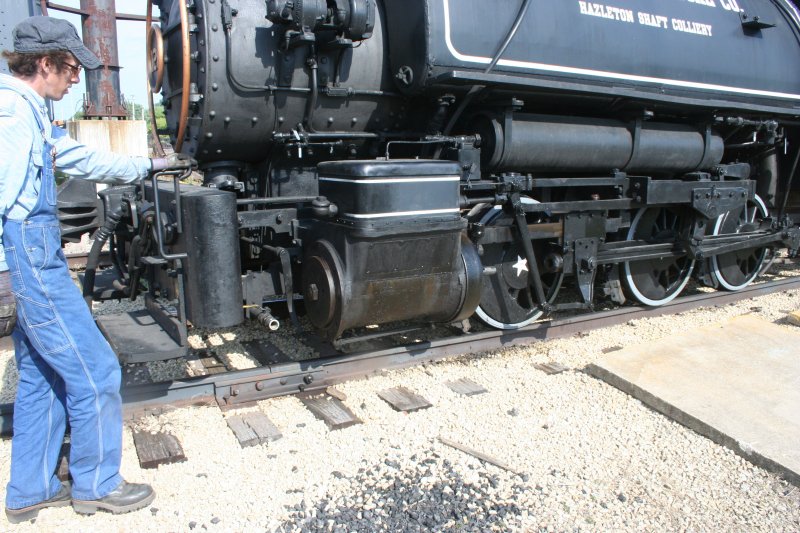
On Friday, 126
provided a chastening example of the exposures in operating a steam
engine. The piston rod worked loose and
detached from the crosshead when switching.
This allowed the piston to be fired forward, smashing the front cylinder
head casting. Luckily Barney had a spare
on another locomotive in process of restoration so, with lot of driving over
night to fetch it from Indiana, she was repaired and back in service on
Saturday. But it certainly highlights
how easily major damage can occur to a steam engine. Repairing something similar on 1630 would be
huge.
So a lot of progress. Much more must happen to enable the steam
test but the objective is now in sight.
Nigel
Sunday, August 25. 2013Steam Department Update 08-24-2013It was a week of very hard work leading to a huge milestone. As described last week, we had reached the frustrating point of chasing leaks around the tube ends and a small check list of other minor issues requiring correction in order to get the boiler fit for the formal hydro test. Brian Davies is staying at Union for three weeks to help with the work and he put in long hours with some of us who were able to spend a day at Union during the week. Several important tasks were achieved. With Jason, he was able to largely complete the cleaning and checking of the air brake valves. However the key focus was the boiler. As the number of leaking tubes decreased, they became more frustrating and more inclined to cause an adjacent tube to leak when you rolled them. The final session on Saturday had many of us involved during the day and lasted until 11 at night but by the end, we were down to one super heater flue that has a small leak around it that we expect will seal itself when the boiler is fully heated, although it drips very slowly under hydro pressure.
So, Brian, Jim and I were back in the shop at 8:30 on Sunday, unfortunately not to assist with the last day of Thomas but to meet with the FRA inspector for the formal hydro test. I am glad to say that the old lady passed !. Aside from the tube end and a few drips from tri-cocks and blow down valves she held pressure very well with no sign of leakage. So Saturday was rather a frustrating day. Very little on 1630, aside from the tubes, could be worked on until the hydro was completed. Cameron and Phil worked with Tom on the bolster for the Shay.
Richard and Ed continued to work on preparing the cladding for lagging in the cab. Bob finally received a suitable breaker to link the planer into the supply panel. So he was able to continue work on running power to the planer. However on Sunday, after the test, a great deal of work opened up. The tubes can now be beaded so, in preparation for that, I spent quite a while in the smokebox grinding tube ends to the exact 1/4 inch required to form good bead. Later Brian took over and, by the time that I left, we were close to the point where he can bead all flues and tubes in the smokebox that are to be beaded. Ideally we want to get this done in the next couple of days so that the beaded tubes can be tested for leaks by Wednesday. On Wednesday we hope to take off the dome cover, drain the boiler and start drying it out so that the inspector can carry out the internal inspection on Friday. This is a Federal requirement. When a boiler has been over pressured, as it is for the formal hydro test, it must be inspected to ensure that nothing internal, such as the brace attachments, has been damaged or loosened. After this, any pressure testing is strictly limited to boiler pressure (180 psi). If any pressure beyond this is applied a further internal inspection is required. Beading of the smokebox end is essential before a lot of work starting with refitting the super heater elements and then moving on to the rest of the smokebox equipment can be undertaken. In the cab, work will now start on lagging the firebox and fitting the cladding so that all the controls can be finally refitted. With the hydro complete, we can now start covering the boiler again. Up until today, none of this could be started as a clear view of all the surfaces of the boiler was required for the inspection. In the firebox, Jerry applied the protective paint to the patch and rivets below where the grates will fit. Once this is dry, the grates that have been removed while we worked on the patch, will be refitted. One key thing about the milestone today is that, while she may currently look less complete than she did in 2011, we have actually passed the key inspection step for which we were preparing in Spring 2011 when we hit the problem with the firebox. So overall a very successful week. While not too much visible has changed, but we have removed the barrier to a whole lot of tasks that will make 1630 look much more like an operating locomotive again in the next month. Nigel |
Blog AdministrationCalendar
QuicksearchSyndicate This Blog |
|||||||||||||||||||||||||||||||||||||||||||||||||


Comments
Mon, 09-08-2025 08:22
Good job on the Burlington Nortern 9976. OK.
Tue, 08-12-2025 12:56
No new news that I have heard of thus far.
Tue, 08-12-2025 12:53
I'll also be doing another update on it soon. Keep en eye out for that.
Tue, 08-12-2025 12:47
A little work was done to it for Diesel Days this year. You'll see photos floating around for the temporary short term job that was done to make it [...]
Wed, 08-06-2025 13:01
Is steam car CN 15444 going to be coming to museum several times it was to be moved to muesum
Sat, 07-19-2025 18:56
Yeah, sadly it's still there as of 7/19/2025
Thu, 06-12-2025 19:14
Its been 14 years guys, where is the unit? Like really? Did you guys misplace it? Or are repairs taking that long? At this point be might we will have [...]
Wed, 04-09-2025 17:40
Jamie Thanks for the update. She's gonna shine like every thing else you guys do! Smeds
Thu, 03-06-2025 16:28
Yes, there is a wye. Those two have been MU'ed on diesel days a year or two ago.
Wed, 03-05-2025 14:04
7009 number boards look good. Is there a way to turn a locomotive around at IRM? In case you ever had a mind to connect 7009 and 6847?
Fri, 03-29-2024 21:26
We're slackers and spend more time working on the equipment in the shop than keeping all you readers updated. We'll work on it, but I'm sure updates [...]
Thu, 03-14-2024 08:02
What happened to the Department Blog? It's been over 2 years and I still regularly check for updates, but nothing comes...